

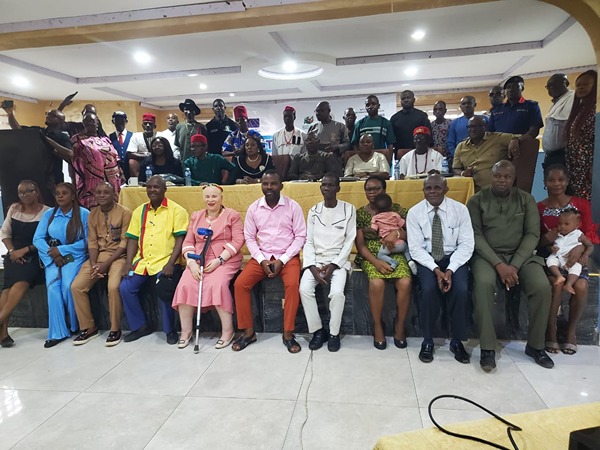
A town hall meeting of the Anambra State Police Stakeholders Partnership Forum, PSPF, alluded to the drastic reduction of insecurity in the state since the enactment of the Anambra State Homeland Security Law, the creation of its Agunechemba Outfit, and the launch of Operation ‘Udo ga achi.’
The town hall meeting held in Awka had as its theme ‘Strengthening Stakeholding and Partnership on promoting Human Rights, Police Accountability, and Effective Criminal Justice Administration in Anambra State’.
Facilitated by the Rule of Law and Accountability Advocacy Centre, RULAAC, the town hall was supported by the International Idea/ RoLAC, with funding from the European Union.
At the event, representatives of the state government, the security agencies, including the police and the Nigeria Security and Civil Defense Corps, NSCDC, the Civil Society Organizations, and the media were brought to a roundtable to discuss issues around police accountability, the administration of criminal justice law in the state, and the new security initiative in the state.
The Executive Director of RULAAC, Okechukwu Nwanguma, explained that the PSPF, established in the state in 2019, had provided a platform for a structured dialogue between police and CSOs, aiming to ensure that police personnel are held accountable for any violation of rights and that citizens are empowered through knowledge and advocacy.
He revealed that the meeting will further the partnership towards holding security agents accountable through effective public complaints mechanisms, which he said must adhere to accessibility, transparency, independence, and fairness.
By upholding these values, police complaint mechanisms can enhance public trust and confidence in law enforcement, identify and address systemic issues and service failures, promote accountability and transparency within police forces, and foster a culture of continuous improvement and learning, he said.
“The town is focused on the vital themes of strengthening stakeholding and partnership in promoting human rights, police accountability, and ACJL to foster a culture of respect for human rights,” Nwanguma noted.
The RULAAC boss commended Governor Chukwuma Soludo’s bold move through the State Homeland Security Law to confront crime and insecurity in the state and establish a complementary security provider called “Agunechemba” (sentinel at the gate) and the Udo ga Achi (peace shall reign), which targets atrocity insecurity.
He maintained that the initiative is worth supporting without partisan or other mundane considerations, as the welfare and security of the people and residents of this state must be put first and ahead of any other personal or narrow interests.
In her remarks, the State Project Director of Program, RoLAC Josephine Onah, said they are supporting the meeting as a viable means of reaching out to segments of society that they cannot ordinarily reach but who are critical to the realization of their goals.
She said under the support, they are focusing on promoting the implementation of the administration of the Criminal Justice Law, which we supported its enactment in 2022.
She highlighted some aspects of the Law still facing challenges, including the manner of obtaining confessional statements, the rising number of ATPs, Awaiting Trial Persons, and under-usage of the Plea Bargain.
In a presentation on the ‘Highlights of the Anambra Homeland Security Law,’ the State Attorney-General and Commissioner for Justice, Prof Sylvia Ifemeje, maintained that the Agunechemba was not created to take over the job of the police but to work internally and in collaboration with conventional security outfits to rid the state of insecurity.
She revealed that contrary to what is insinuated in various sections of the media, the law is not targeted at any religion or group but only came about due to an unusual turn in the state’s security situation, which, if not checked, would have wrecked the state.
For his part, the state Commissioner for Information, Law Mefor, said the law provides the framework for the security agencies to go after crime enablers, some of which include fake native doctors and ezenwanyis, ritualists, and others, who, if not dealt with, insecurity will not end in the state.
He said the new security architecture goes beyond the kinetic and non-kinetic aspects of crime fighting to re-enact the core values of the Igbo people and achieve social reformation.
He emphasized that the state government has set a standard of operation for the Agunechemba operatives, assuring that while the system will not be 100% foolproof, the government is committed to dealing with any report of corruption or misconduct on the part of the operatives.
In his presentation, the Deputy Commissioner of Police in charge of the State Criminal Investigation Department, CID, DCP Moses Gana, represented by CSP Gbaruko Pascal, acknowledged that police in Anambra State have to enforce the constitutional rights of all citizens in the State by upholding the fundamental rights of citizens in its operations, engendering a positive change in how the public perceives it and ensuring that its functions are performed in a manner sensitive to the needs and wellbeing of the general public.
He assured that the State Police Command, under the supervision of CP Ikioye Orutugu, has embraced innovations provided by the Law for police, ensuring cooperation and partnership between the Police and host communities in maintaining peace, protecting liberties, lives, and properties, and ensuring that the fundamental human rights of people in the State are upheld and protected.
Speaking on behalf of CSOs on the topic ‘Policing accountability: an evaluation of how it has faired in Anambra State,’ Professor of Political Science with Nnamdi Azikiwe University Jaja Nwanegbo observed that until the advent of the Udo ga achi operation, the pattern of interagency activities was weak.
“That is why you will see the police operating in an environment where the DSS has intelligence reports but is not providing them to the police.
“Our thinking is that if these bodies can work together as one force, they all have different areas of specialty and bringing them together will engender a unique pattern of output that the people will be happy for,” he said.
On the newly introduced security operation, Prof Nwanegbo said the results came out very quickly and very sharply but expressed concerns that the Agunechemba operatives are leaving the major field operations and relocating to inside town operations, extorting people and doing the same thing the people were complaining about the police.
“The truth is that we want them because they have constituted a beautiful check on insecurity, but how do we make sure that they do not turn out to become a monster we will have difficulty removing tomorrow.
“Our suggestion is to control advancing the models of internal control mechanisms and commands so that they will understand that they are being watched. When they know that they are being watched, they will do the right things and refrain from using absolute power.
“The foreign police are not saints. The camera system and trackers that are on their uniforms are a way of putting them on check.
“As we are doing so for the Agunechemba, we are also doing it for the police, so that they will be kept on their toes in ensuring accountability because human nature is naturally susceptible to that level of over-expression,” he posited.
In their separate goodwill messages, the Secretary of the State Traditional Rulers Council, Igwe Pius Omachonu, and the representative of the Southeast Zonal Office of the Institute for Peace and Conflict Resolution, IPCR, Ministry of Foreign Affairs commended the initiative of the townhall meeting, hammering on the need for an effective reward system in the security agencies.


