

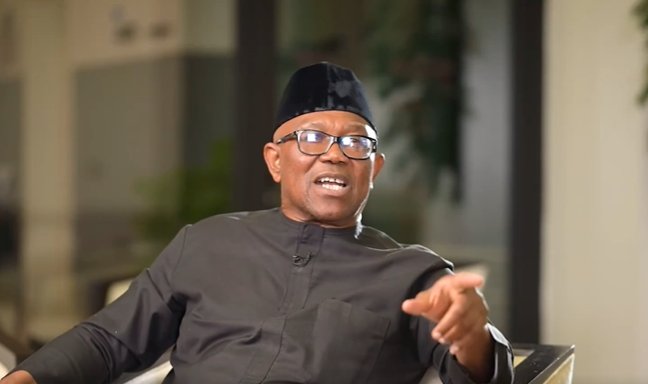
There is a curious pattern in Nigerian politics. The more difficult a political opponent becomes to ignore, the greater the temptation to attack the person rather than confront the issues that have made him politically relevant. Peter Obi appears to have become a good example of this tendency. Rather than consistently engaging the ideas, policies and political arguments associated with him, some of his critics have resorted to ridicule, personal attacks, disparaging comments about his supporters and attempts to reduce his political movement to an army of social-media enthusiasts. But if badmouthing is all they have against Obi, they may be missing the bigger picture. The bigger picture is not simply Peter Obi.
Without a doubt, it is the Nigeria that made his political message resonate in the first place. That distinction is important. Obi did not create the economic hardship confronting millions of Nigerians. He did not invent youth unemployment, rising living costs, insecurity, declining purchasing power, poor public infrastructure or the widespread frustration with the country’s political leadership. Neither did he create the growing demand among citizens for greater accountability and a different approach to governance. What his political rise demonstrated was that these grievances could be converted into a powerful electoral message.
Obi’s message may be disputed. His policies may be criticized. His record may be scrutinized. His political calculations may be questioned. Indeed, they should be. But dismissing the political constituency around him as mere “social-media warriors” does not answer the underlying question: “Why did so many Nigerians, particularly young people, become sufficiently interested in his candidacy to organize, campaign and identify with it? That is the question his opponents should be asking.
Because politics is not simply about the politician at the centre of a movement. It is also about the circumstances that give the movement life. A politician can disappear from the headlines for weeks and still remain politically relevant if the grievances associated with his message remain unresolved. This is where badmouthing becomes an inadequate political strategy. If a critic believes Obi’s economic ideas are unrealistic, the appropriate response is to demonstrate why. If his record in public office is being overstated, the appropriate response is to provide the facts. If his political structure has weaknesses, those weaknesses should be exposed through serious political analysis. If his supporters make claims that are inaccurate, those claims should be challenged with evidence. But simply calling supporters names does not win an argument. Nor does mocking them make their concerns disappear. The same principle applies to the wider electorate.
Nigerians do not experience politics as an abstract academic exercise. They experience it when the price of food rises, when transport fares increase, when electricity bills become difficult to pay, when businesses struggle with operating costs, when graduates cannot find jobs and when families have to make increasingly painful choices about what they can afford.
These experiences shape political attitudes. A voter who is struggling to feed a family is unlikely to be persuaded indefinitely by arguments about political personalities. A young Nigerian worried about employment is unlikely to abandon a political alternative simply because its supporters are mocked online.
A small business owner struggling with energy costs, taxation, rent and weak consumer demand is more likely to ask what a politician proposes to change those realities than to care about the insults exchanged between political camps.
This is why the political class must be careful about confusing social-media visibility with the totality of political sentiment.
Social media certainly plays an important role in contemporary Nigerian politics. It provides a platform for mobilization, debate, propaganda, misinformation and political activism.
But it is not the only place where political opinions are formed. Political conversations take place in markets, workplaces, universities, motor parks, churches, mosques, homes, beer parlours, professional associations and neighbourhoods.
They happen in commercial buses and roadside shops. They happen wherever Nigerians discuss the condition of their country.
To dismiss an entire political constituency because some of its loudest voices are active online is therefore to misunderstand how political movements evolve. It is equally important not to romanticize Obi or his supporters.
There have been moments when sections of the movement have been excessively partisan. Some supporters have treated criticism of Obi as hostility. Others have engaged opponents in ways that have contributed to the polarization of political debate. Those excesses deserve criticism.
But the existence of overzealous supporters does not invalidate the legitimate concerns of millions of other citizens.
Every major political movement has its extremists, cheerleaders and social-media warriors. That is not unique to Obi.
The more serious question is whether the movement reflects broader political concerns. And that is where his opponents cannot afford to be complacent.
The 2023 presidential election changed the way many Nigerians, particularly younger voters, looked at electoral politics. It demonstrated that a political movement could emerge outside the traditional structures and force itself into the centre of national political discussion.
Whatever one’s assessment of Obi’s politics, that development cannot simply be wished away. Nor can it be erased by repeatedly telling his supporters that they are inexperienced. Political experience is important. But so is the lived experience of citizens.
A young Nigerian who has spent years searching for employment has an experience of the country that deserves to be heard. A business owner who has watched operating costs rise has an experience that deserves to be considered.
A family struggling with food, housing, transport and healthcare costs has an experience that cannot be dismissed as social-media propaganda. This is the bigger picture.
The political establishment risks making a serious mistake when it assumes that dissatisfaction with the status quo can be neutralized by attacking the people who articulate it. It cannot. At best, attacks may win a news cycle. They may generate hashtags. They may energize supporters on either side. But they do not solve the underlying problem. The better response is competition.
If one candidate says Nigeria should produce more and consume less, another candidate should explain how his own economic programme would achieve better results. If one politician talks about cutting waste, another should explain how public resources would be deployed more efficiently.
If Obi’s proposals are considered impractical, his critics should present practical alternatives. If his political claims are inaccurate, they should be challenged with facts. That is what serious politics should look like. It is also what voters deserve.
Democracy is not a competition in which the objective is merely to make the other candidate look bad. It is supposed to be a contest of ideas, records, programmes, character and credibility. Of course, political campaigns are rarely that clean. But voters ultimately have to decide which arguments they find convincing. That means political parties and candidates must do more than attack one another. They must explain themselves. This is particularly relevant as Nigeria moves towards another major electoral contest.
In fact, the political environment of 2027 will not be identical to that of 2023. Alliances can change. Political platforms can evolve. New candidates can emerge. Voters can change their minds. The movement associated with Obi may also change. But one thing is unlikely to disappear simply because politicians attack it: the grievances that produced the demand for political alternatives. That is why the question should not be whether Peter Obi can be criticized. He can, and should be.
The question is whether criticism will be substantive or whether political opponents will rely primarily on ridicule, insults and personal attacks. If the latter becomes the dominant strategy, they may be concentrating on the man while ignoring the mood of the country.
And that would be a serious political miscalculation. Because the real challenge is not to silence people who support Obi. It is to persuade them. It is not to ridicule their concerns. It is to address them. It is not to dismiss them as social-media warriors.
It is to give them compelling reasons to believe that another political alternative deserves their attention. That is the essence of democratic competition.
Peter Obi is not beyond scrutiny, nor should any politician be. His record, policies, alliances, statements and political strategy should all be subjected to rigorous examination. But rigorous examination is not the same thing as badmouthing. Personal attacks may entertain political loyalists, but they do not necessarily answer the questions being asked by citizens. And therein lies the bigger picture.
The enduring significance of Obi’s political presence may ultimately have less to do with the politician himself than with the electorate that continues to find something in his message worth listening to. His critics can attack him. They can question him. They can challenge his record. They can disagree with his policies. They can even attempt to persuade his supporters to abandon him. All of that is legitimate politics. But if badmouthing is all they have, they may discover that they have been talking about Obi while Nigerians are talking about Nigeria. And in any democracy, that distinction matters.


