

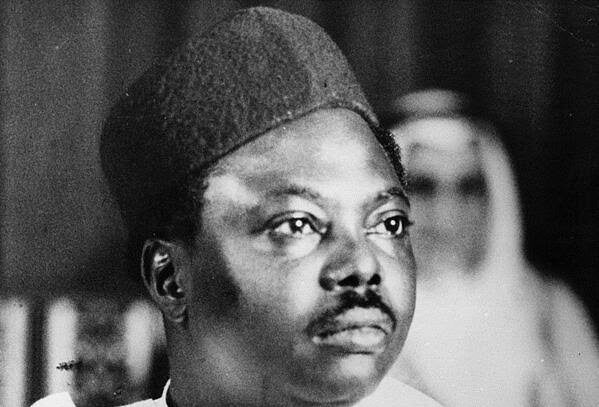
On a dark Friday, 13 February 1976, a political catastrophe erupted and devastated Nigeria. General Murtala Ramat Mohammed, Nigeria’s brilliant Head of State for just 200 days, was brutally assassinated on his way to the office in Lagos. His grievous ‘sin’ was the ‘notorious’ political will of moving the country forward!
That horrible day inaugurated the onset of a bleak future for Nigeria. It ended his rigorous and redeeming campaign against the ugly monster corruption and other development killers. In just six months, Murtala rapidly demonstrated what it meant to be a dedicated and servant leader for others to benefit and emulate. His numerous achievements within that short period included creation of additional states and universities, choice of Abuja as the new federal capital, civil service reforms, reducing inflation and instilling a new sense of discipline among others. The overall lesson here is how well leadership has impacted, not how long one has stayed in power.
In the end, he gifted us more than what we had expected in terms of loyalty to the nation. Vividly, his disciplined mind looked awesome and overwhelming for an unbreakable cause. His spoken actions protected and promoted our aspirations. Perhaps those who conspired and eliminated him were full of high jealousy. Eventually, he had painfully gone after fulfilling the pledge of the clarion call, but his living memory is vibrant in our minds. Even 50 years after his death, the good samaritans in this period of leadership crisis can learn a good instruction from his transparent leadership to rebuild Nigeria.
It is always called a foiled or abortive coup. But to me, it was a successful coup, having deprived us of the central character, the phenomenal driver behind the steering of massive reconstructions, whose jingoistic efforts defined our future to attain global dignity. The infamous coup abruptly sabotaged the engine room of national consciousness. 50 years after, we are still casualties, troubled by the deepening pains, but still searching for healing that is nowhere to be found. The coup did not collapse because it separated us forever from the euphoric era of “Ramatism Movement”. It was one journalist, Olu Obafemi, who coined Ramatism from Ramat, Murtala’s middle name. He lamented how that gigantic project had been buried with the demise of Murtala.
It was an accomplished putsch if one reflects how Lt. Col. Bukar Suka Dimka, the chief antagonist of the cataclysm, was continuously smiling when he was apprehended. It was a clear sign that his main target was the elimination of Murtala. My conviction is that there was no proper alternative to Dimka’s unrelenting callousness. In other words, none would have recklessly acted the way Dimka did. But then, what was his motive of the killing? Again, it was a successful coup that oppressed and silenced the resonating voice of Murtala as the revered apostle of ‘ Africa has come of age’. That ‘stubborn’ articulation was like a volcanic eruption to the unrepentant imperialists and their local partners. Since then, that expression of continental anger has disappeared mysteriously.
Incredibly, Murtala’s regime won the military version of the government of the people by the people and for the people. It was never false in attraction and functions. Joyfully, Nigerians lived with the unrivalled reality of an assertive and purposeful leadership. Indeed, Murtala’s brief but reformative government was a complete and comforting template for empowering our collective dreams and hopes. When the fear of failure furiously attacked him, his swift response was nothing less than being a revolutionary, the costly and political asset he shared with us and sustained till his last breath to let Nigeria attain superiority.
A fundamental and thought-provoking question is largely missing. If General Murtala Mohammed had lived longer and handed over power to the civilian regime in 1979, what would have been the extent of our development? Of course, he would have taken us to the promised land. Definitely, Nigerians would have cajoled him to transform into a civilian president. Sadly, the bullets of the rebels did not allow Murtala to carry us to the final destination of comfort zone.
Before his passing away, the heroic Murtala was passionately teaching us how to be good students of ‘institutional’ leadership and not ‘personal’ leadership. The former drives full accountability while the latter does not. For Murtala and the rest of us, it was all about leadership for accountability not for acceptability. The reactionary gunmen conspired against the nation when he was tirelessly inspiring. They vehemently denied him acceptability because he jingoistically worked for accountability. Such was the highest oddity of that traumatic episode.
For the first time in its historical evolution, Nigeria got a golden opportunity of having a leader who was charismatic, courageous, visionary, competent, nationalistic and a radical. It is very rare to have a single leader with a unique combination of these outstanding qualities. But during that revolutionary period, Nigeria got one in the person of Murtala. He knew that the time was his to make a huge deal with history. He managed his time diligently and measured his performance to make national reforms that would have everlasting effects on the country. Of course, his last 200 days on earth served two joint eventualities. One, they were the last days of his life. Two, they were the days he gave Nigeria a new life.
Indeed, Murtala introduced a paradigm shift in the careful articulation of the art of governance in favour of the general public. Murtala’s actions were decisive, mainly against state enemies and their collective interests. He strengthened the foundation of institutional and national goals. He was extremely pompous of displaying leadership by example when most contemporary leaders demonstrate great arrogance of leadership laden with utter deceit. While discharging his heroic duties, the strength of his hopes and dreams for a better Nigeria increased. We saw him as too ambitious and in a great haste to let us see the beautiful light at the end of the tunnel.
His living, his thoughts, his actions, his visions for a greater nation blended and manifested in his last 200 days as if he had received divine revelation. Fortunately, he was very crafty in handling them for the desired outcome. Murtala’s unprecedented epoch was akin to Libya’s Muammar Gaddafi and Cuba’s Fidel Castro. By and large, the revolt against Murtala was a revolt against progressive elements all over the world. Murtala was not just a Head of State, but also an epitome of global human emancipation. They murdered him, but his iconic legacies can never be killed! They will continue to live with us till eternity.
By the time Generals TY Danjuma and Joe Garba decided to remove General Yakubu Gowon from office as Head of State, they approached Murtala for support. His condition for participation was that blood should not flow. Ironically, he was not spared the bullets of the reactionary elements. Finally, Murtala died poor, lacking material possessions, but rich in bequeathing enduring legacies.
Conclusively, Murtala died with no regrets of showing unflinching loyalty to the country, while his assassins died with the enormous burden of national betrayal. He remains unforgettable. Rest in peace, Murtala Mohammed!


