

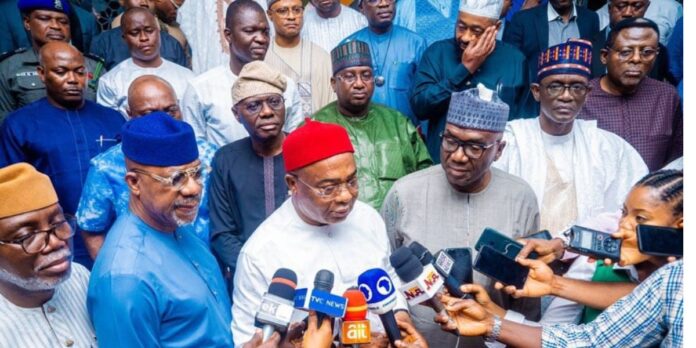
The reports emerging from the Progressive Governors Forum read like the kind of political gossip Nigerians have become dangerously accustomed to. Whispers of betrayal. Allegations of financial impropriety. Angry factions gathering behind closed doors. A chairman suddenly discovering that power in Nigeria is never truly owned, only borrowed until the room turns against you.
Yet beneath the drama surrounding the reported move by governors within the APC to unseat Hope Uzodinma lies something far more revealing than an ordinary leadership dispute. This is not merely a quarrel over the chairmanship of a governors’ forum. It is a glimpse into the moral architecture of Nigeria’s ruling elite, a class so deeply consumed by accumulation that even among themselves, trust has become impossible.
That is the truly stunning part.
Nigeria is currently living through one of the most financially consequential moments in its democratic history. The removal of fuel subsidies and the floating of the naira dramatically expanded revenues flowing into state governments through FAAC allocations. Governors today control levels of liquidity many of their predecessors could scarcely imagine. In theory, this should have triggered an era of aggressive development. Roads rebuilt. Schools modernized. Hospitals revived. Infrastructure expanded. Agriculture mechanized. Investment aggressively pursued.
Instead, the public is once again confronted with allegations centered not around development, policy, or innovation, but around money. Who controls it. Who manages it. Who allegedly cannot be trusted with it.
It is impossible not to notice the irony.
At a time when citizens are being lectured daily about sacrifice, endurance, and economic pain, the political class appears trapped in a permanent internal struggle over access to wealth. Ordinary Nigerians have spent the last year adjusting to rising transport fares, collapsing purchasing power, impossible food prices, and the humiliation of surviving in an economy that punishes work but rewards access. Yet somewhere within the upper floors of power, men already entrusted with enormous public resources are reportedly locked in disputes over financial accountability inside their own forum.
One is forced to ask: when does enough finally become enough?
Perhaps that is the wrong question. Perhaps the real lesson of Nigerian politics is that enough does not exist. Power here rarely cures appetite. It expands it. The closer many within the elite move toward abundance, the more desperate the struggle for control appears to become. Scarcity may explain corruption at the lower levels of society. It cannot explain this.
And that is why this moment matters.
The APC has long attempted to project itself as a disciplined political machine held together by ideology, strategy, and national reach. But what this crisis exposes is something far more fragile beneath the surface. Political parties in Nigeria increasingly resemble temporary holding companies for elite interests rather than institutions built around coherent philosophical visions. Loyalty shifts easily. Alliances mutate overnight. Yesterday’s enemies become today’s strategic partners. The language of ideology survives mainly as campaign decoration.
What remains constant is access.
That is why the reported emergence of figures outside the traditional internal hierarchy as possible stabilizing forces feels less shocking than it should. In contemporary Nigerian politics, partisan boundaries have become remarkably fluid among the elite because the deeper operating culture is often shared across party lines. Beneath the noise of APC versus PDP lies a quieter fraternity united less by ideology than by proximity to power and the preservation of influence.
For citizens, this realization is deeply corrosive.
The Progressive Governors Forum was supposed to represent something substantial, a platform for coordination, policy innovation, and sub national leadership at a time when Nigeria desperately needs competent governance. Governors occupy one of the most powerful positions within the federation. They control security influence, huge allocations, political structures, and the everyday realities of millions of people. A serious governors’ forum should function as an engine room for national transformation.
Yet once again, the conversation is swallowed by allegations of impropriety and internal distrust.
This is the tragedy of Nigeria’s political culture. Institutions rarely remain institutions for long. Eventually, they become theatres of personal ambition, financial suspicion, and elite competition. The public watches the spectacle unfold with a mixture of exhaustion and amusement because Nigerians have seen this film too many times before. Another scandal. Another denial. Another realignment. Another carefully worded statement promising unity after private warfare.
Meanwhile, outside the banquet halls of politics, the country itself continues to stagger under the weight of insecurity, inflation, unemployment, collapsing infrastructure, and public despair.
That contrast is what gives this story its emotional force.
While citizens debate how to survive, those entrusted with governing them appear increasingly consumed by disputes over internal control and financial stewardship. The symbolism is devastating. It reinforces the growing belief that for too many within the political elite, governance has become secondary to acquisition. Public office is no longer seen primarily as stewardship, but as strategic access to networks of influence, resources, and protection.
And perhaps the most disturbing part is that none of this shocks the public anymore.
That may be the clearest sign of democratic decay.
In healthier societies, allegations of financial impropriety involving powerful public officials trigger institutional urgency and moral outrage. In Nigeria, they have become ambient noise, folded into the daily rhythm of national life alongside fuel queues, blackouts, and inflation headlines. Citizens no longer react with surprise. They react with familiarity.
The danger in that normalization cannot be overstated.
Because once a society becomes emotionally adjusted to corruption among its ruling class, accountability itself begins to die quietly.
Ultimately, the reported revolt within the governors’ forum is bigger than Hope Uzodinma, bigger than internal APC tensions, and bigger than whichever faction temporarily gains control of the structure. What Nigerians are witnessing is the exposure of a deeper national condition, a political culture where even those entrusted with immense privilege still behave as though the feast is insufficient.
The tragedy is not merely that the powerful are fighting among themselves.
It is that the country they are fighting over is still waiting to be governed.
Stephanie Shaakaa
08034861434


