

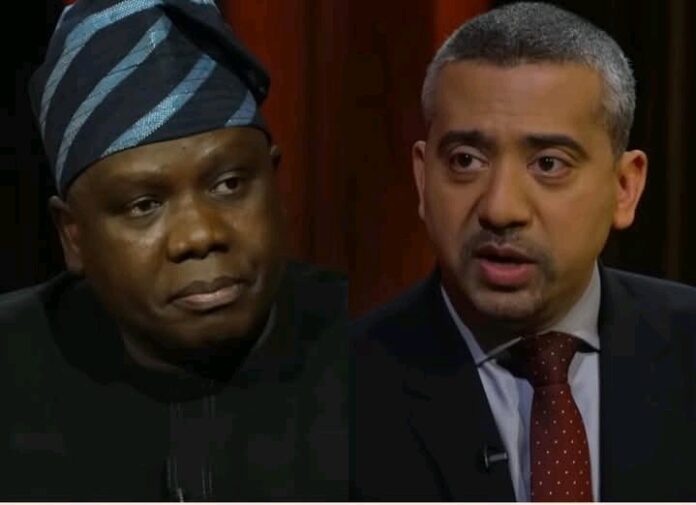
In the aftermath of Daniel Bwala’s widely discussed interview with Mehdi Hasan on Al Jazeera on Friday, March 6, I found myself reflecting on a deceptively simple but deeply consequential question: what truly constitutes the most valuable quality for effective public relations or public commentary? The exchange, which many observers claim forced Bwala to retreat from earlier assertions on live international television, quickly ignited debates across social media and political circles. Yet, beyond the spectacle of the moment lies a more enduring intellectual puzzle about persuasion, credibility, and the architecture of public influence.
Over time, I have encountered many people who describe Bwala as an exceptionally intelligent man, one whose mastery of language allows him to elevate or diminish reputations with remarkable ease. A netizen known by the username Ronald Trump, for instance, often expresses admiration for Bwala’s oratory power, particularly his ability to dominate debates with relentless verbal energy, refusing to retreat even under pressure. In many political cultures, this capacity to make the loudest and most persistent argument is often mistaken for the ultimate skill in image-making. It creates the aura of strength, the illusion of invincibility, and sometimes the temporary triumph of rhetoric over reflection.
Yet I am not entirely persuaded that brilliance with words or the sheer ability to argue without backing down represents the most reliable foundation for successful public relations or meaningful public commentary. Though I do not claim professional expertise in the discipline of PR, my experience observing political discourse suggests something more subtle is at work. Intelligence alone, no matter how dazzling, does not immunize a commentator against the unforgiving scrutiny of the public sphere. In fact, history repeatedly shows that towering intellectuals can become unexpectedly vulnerable when confronted with probing questions that pierce through layers of rhetoric.
Communication theorists have long explored this paradox. Scholars such as Jürgen Habermas argue within the theoretical framework of the “public sphere” that credibility in discourse depends less on rhetorical aggression and more on communicative rationality, where arguments survive not because they are loud, but because they withstand reasoned scrutiny. Similarly, research in persuasion theory, particularly the elaboration likelihood model developed by Richard E. Petty and John T. Cacioppo, demonstrates that audiences often respond more enduringly to arguments perceived as thoughtful, balanced, and credible rather than purely forceful. What may appear as dominance in the moment can collapse under the weight of sustained analysis.
From my own observations, the most powerful defense mechanism for any public commentator seeking to avoid ridicule or embarrassment is not merely intelligence, eloquence, or stubborn persistence. It is objectivity. Objectivity, in my view, is the quiet but formidable weapon that grants durability in the marketplace of ideas. It is what allows a commentator to withstand tough questions, skeptical audiences, and the relentless cross-examination of public opinion.
Admittedly, this principle encounters a practical dilemma in the world of public relations. A PR professional is often expected to defend a client or institution rather than operate as a neutral analyst. Here lies the most delicate tension in the profession. Can someone, no matter how intelligent, defend distortions, exaggerations, or outright fabrications indefinitely without eventually compromising both dignity and conscience? The challenge becomes not merely intellectual but moral.
My own suspicion is that the true work of public relations is widely misunderstood. Rather than manufacturing fiction or constructing elaborate defenses for indefensible positions, the most effective PR strategy may actually lie in uncovering overlooked truths. A skilled communicator identifies neglected perspectives, clarifies misunderstood contexts, and brings deeper analytical insights to light, the points that the public may not initially notice but can ultimately recognize as reasonable and persuasive. In other words, persuasion grounded in reality possesses a far longer shelf life than persuasion built on illusion.
This perspective resonates with a thought often attributed to Ahmadu Bello, who famously observed that the greatest weapon is the truth. The remark carries particular weight because Bello himself commanded remarkable respect both nationally and internationally despite not being adorned with an abundance of academic degrees. His authority flowed less from intellectual flamboyance than from the perception of sincerity and clarity of purpose.
Of course, the philosophical problem of truth is itself complex. Absolute truth is notoriously elusive; perspectives differ, contexts evolve, and interpretations multiply. Yet objectivity, even when only approximated, remains the closest safeguard against the collapse of credibility. Studies in political communication repeatedly show that audiences tend to forgive disagreement but rarely forgive perceived dishonesty. The difference between surviving scrutiny and succumbing to it often lies in the ability to maintain a defensible connection to reality.
This is why I often struggle to understand how anyone could assume they can indefinitely outmaneuver the public with sheer intellectual theatrics or pseudo-intellectual bravado. Propaganda may dominate the airwaves temporarily, but the collective intelligence of an audience has a remarkable capacity to detect inconsistency over time. The court of public opinion is slow, but it is rarely blind.
Perhaps that is why I approach public commentary with a certain caution, even apprehension. The fear that haunts many speakers is not the complexity of arguments but the simplicity of a question, a direct, honest query that exposes the fragility of a position built on exaggeration or speculation. It is that possibility which reminds me, whenever I speak publicly, of the importance of fairness over recklessness, balance over bravado, and objectivity over the seductive but fragile power of rhetoric.
So, words may win applause, but only truth sustains respect.
Bagudu can be reached via bagudumohammed15197@gmail.com or 07034943575.


