

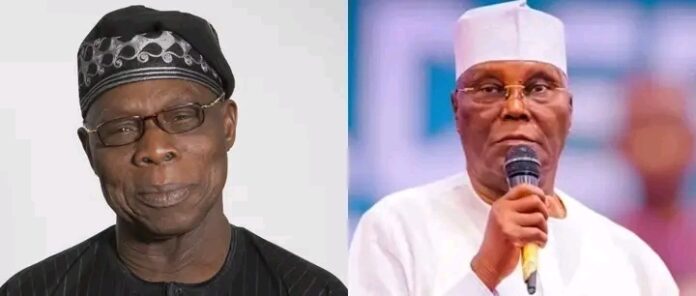
As the dust begins to gather ahead of 2027, the old war between two titans of Nigeria’s democracy has roared back to life. Former President Olusegun Obasanjo and former Vice President Atiku Abubakar, men who once held the soul of the nation in a single handshake, now throw words at each other like daggers across time.
It started again with a spark Obasanjo lit. In a recent interview, the former president alleged that Atiku had bribed the late Speaker Ghali Na’Abba with ₦5 million to engineer his impeachment. It was a grenade tossed into history. Atiku’s reply was swift, surgical, and soaked in pain. He asked why Obasanjo waited until the “principal witness” was in the grave before speaking, noting that graveyards do not serve as witness boxes. Then he traced the poison to its root: his refusal to support Obasanjo’s controversial third-term bid.
Obasanjo, never one to retreat, fired the deadliest shot yet. He called choosing Atiku as running mate in 1999 “one of my biggest regrets.” Atiku’s media aide, Phrank Shaibu, answered with a line that now circulates like scripture: “I cleaned you up when you needed me, I stood against you when Nigeria needed me.” No further interpretation needed. The mask is off.
To stand as judge between them is to stand on quicksand. Human relationships, especially those forged in power, rarely fit into neat boxes of right and wrong. Political psychologist Robert Jervis, in his theory of misperception in international politics, argues that leaders often remember the same event in completely opposing ways because ego and survival rewrite memory. What one man calls betrayal, the other calls patriotism. What one calls principle, the other calls ingratitude. Both Obasanjo and Atiku may be right, and both may be wrong, depending on which side of the throne you sat in 2003.
This is not just about two men. It is about how relationships, whether in romance, friendship, or politics, die slow deaths even after public forgiveness. Social scientists call it “cold forgiveness”, the performance of peace without the healing of wounds. Research from the University of Michigan on elite conflict shows that betrayals tied to status, humiliation, and lost ambition are the hardest to reconcile because they attack identity itself. When a partner becomes the reason you fell, forgetting becomes impossible. You may shake hands for cameras, but your nervous system never forgets.
Obasanjo has, for decades, appointed himself Nigeria’s moral conscience. He speaks with the authority of a man who handed power to civilians in 1979 and again in 2007.
That double act of transition gives Obasanjo a rare moral capital. Scholars like Prof. Adebayo Olukoshi have noted that Obasanjo’s post-presidency influence rests on this “founder’s privilege”, the belief that because he midwifed democracy twice, he earns the right to judge it. Yet that same privilege makes him inconsistent. He praises and buries the same men. He crowned Umaru Yar’Adua in 2007, who admitted later that the election was flawed, and watched Yar’Adua’s short, promising tenure end in tragedy. He anointed Goodluck Jonathan, campaigned for him in 2011 against Buhari, then wrote an 18-page public indictment in 2013 and tore his PDP card in 2015. He embraced Buhari, then wrote him two open letters urging him not to run again. Each time, the nation listens, then divides, depending on whose camp we are in at that moment.
Consider the arc. A man imprisoned by Abacha in 1995, released in 1998 after Abacha’s death and Abdulsalami’s transition, rose from Yola prison to Aso Rock in 18 months. It was not magic. It was kingmakers, backroom deals, and Atiku. Atiku, by every account, was the most powerful vice president Nigeria has had since 1999. He controlled governors. He could have challenged Obasanjo in 2003. Instead, he stepped back. Many analysts believe that moment of deference birthed a wound that never closed. The hope that after Obasanjo, it would be his turn. That hope slipped away, and since 2007 Atiku has run again and again, chasing what felt like a stolen destiny.
So when Obasanjo now endorses Peter Obi and criticizes Bola Tinubu, while Atiku runs again under ADC, the fight is not about policy. It is about memory. It is about the heartbreak of political divorce. Relationship therapists tell us that ex-lovers rarely forgive in the true sense. The pain is archived. A viral joke that made rounds online captured it perfectly: a boxing coach telling a fighter to “hit him like he’s your ex.” The crowd roared because we all know that feeling. A political coach on social media recently told single mothers, not to be too hurt to pray for the men who abandoned them, because “some of us are praying for that same helper even without marital bond”. Cruel, funny, and true. That is what Obj and Atiku are doing now, praying and fighting over the same helper called power.
The tragedy is that we, the public, are complicit. When Obasanjo turned on Jonathan, we quoted him like the Bible. When he turned on Buhari, we used him as proof of failure. Now that he attacks Atiku and questions Tinubu while praising Obi, those in Obi’s camp call him a prophet, and those outside call him bitter. We do not love truth. We love vindication.
Forgiveness is noble. Emotional intelligence is a virtue. But political science and lived experience tell us something harder: humiliation, public ridicule, and the collapse of a dream are wounds that do not close. They scar. And scarred partners, whether in love or in power, do not return to rebuild. They return for payback. They return to watch.
Obj and Atiku may never fight with guns. But their words are weapons, and 2027 is the battlefield. In the end, this is not just the story of two men. It is the story of Nigeria, a nation where yesterday’s allies become today’s accusers, and where we all choose which version of history to believe, depending on who we need to be right today.
Bagudu can be reached via bagudumohammed15197@gmail.com or 07034943575.


