spot_img
spot_imgspot_img
October 8, 2026 - 1:42 AM

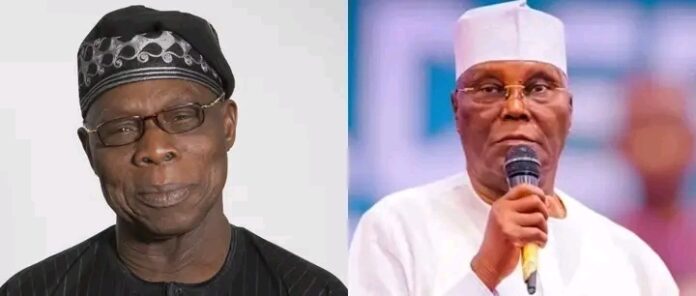
Obj vs Atiku: From Partners to Foes

—

As the dust begins to gather ahead of 2027, the old war between two titans of Nigeria’s democracy has roared back to life. Former President Olusegun Obasanjo and former Vice President Atiku Abubakar, men who once held the soul of the nation in a single handshake, now throw words at each other like daggers across time.


It started again with a spark Obasanjo lit. In a recent interview, the former president alleged that Atiku had bribed the late Speaker Ghali Na’Abba with ₦5 million to engineer his impeachment. It was a grenade tossed into history. Atiku’s reply was swift, surgical, and soaked in pain. He asked why Obasanjo waited until the “principal witness” was in the grave before speaking, noting that graveyards do not serve as witness boxes. Then he traced the poison to its root: his refusal to support Obasanjo’s controversial third-term bid.


Obasanjo, never one to retreat, fired the deadliest shot yet. He called choosing Atiku as running mate in 1999 “one of my biggest regrets.” Atiku’s media aide, Phrank Shaibu, answered with a line that now circulates like scripture: “I cleaned you up when you needed me, I stood against you when Nigeria needed me.” No further interpretation needed. The mask is off.


To stand as judge between them is to stand on quicksand. Human relationships, especially those forged in power, rarely fit into neat boxes of right and wrong. Political psychologist Robert Jervis, in his theory of misperception in international politics, argues that leaders often remember the same event in completely opposing ways because ego and survival rewrite memory. What one man calls betrayal, the other calls patriotism. What one calls principle, the other calls ingratitude. Both Obasanjo and Atiku may be right, and both may be wrong, depending on which side of the throne you sat in 2003.


This is not just about two men. It is about how relationships, whether in romance, friendship, or politics, die slow deaths even after public forgiveness. Social scientists call it “cold forgiveness”, the performance of peace without the healing of wounds. Research from the University of Michigan on elite conflict shows that betrayals tied to status, humiliation, and lost ambition are the hardest to reconcile because they attack identity itself. When a partner becomes the reason you fell, forgetting becomes impossible. You may shake hands for cameras, but your nervous system never forgets.


Obasanjo has, for decades, appointed himself Nigeria’s moral conscience. He speaks with the authority of a man who handed power to civilians in 1979 and again in 2007.


That double act of transition gives Obasanjo a rare moral capital. Scholars like Prof. Adebayo Olukoshi have noted that Obasanjo’s post-presidency influence rests on this “founder’s privilege”, the belief that because he midwifed democracy twice, he earns the right to judge it. Yet that same privilege makes him inconsistent. He praises and buries the same men. He crowned Umaru Yar’Adua in 2007, who admitted later that the election was flawed, and watched Yar’Adua’s short, promising tenure end in tragedy. He anointed Goodluck Jonathan, campaigned for him in 2011 against Buhari, then wrote an 18-page public indictment in 2013 and tore his PDP card in 2015. He embraced Buhari, then wrote him two open letters urging him not to run again. Each time, the nation listens, then divides, depending on whose camp we are in at that moment.


Consider the arc. A man imprisoned by Abacha in 1995, released in 1998 after Abacha’s death and Abdulsalami’s transition, rose from Yola prison to Aso Rock in 18 months. It was not magic. It was kingmakers, backroom deals, and Atiku. Atiku, by every account, was the most powerful vice president Nigeria has had since 1999. He controlled governors. He could have challenged Obasanjo in 2003. Instead, he stepped back. Many analysts believe that moment of deference birthed a wound that never closed. The hope that after Obasanjo, it would be his turn. That hope slipped away, and since 2007 Atiku has run again and again, chasing what felt like a stolen destiny.


So when Obasanjo now endorses Peter Obi and criticizes Bola Tinubu, while Atiku runs again under ADC, the fight is not about policy. It is about memory. It is about the heartbreak of political divorce. Relationship therapists tell us that ex-lovers rarely forgive in the true sense. The pain is archived. A viral joke that made rounds online captured it perfectly: a boxing coach telling a fighter to “hit him like he’s your ex.” The crowd roared because we all know that feeling. A political coach on social media recently told single mothers, not to be too hurt to pray for the men who abandoned them, because “some of us are praying for that same helper even without marital bond”. Cruel, funny, and true. That is what Obj and Atiku are doing now, praying and fighting over the same helper called power.


The tragedy is that we, the public, are complicit. When Obasanjo turned on Jonathan, we quoted him like the Bible. When he turned on Buhari, we used him as proof of failure. Now that he attacks Atiku and questions Tinubu while praising Obi, those in Obi’s camp call him a prophet, and those outside call him bitter. We do not love truth. We love vindication.


Forgiveness is noble. Emotional intelligence is a virtue. But political science and lived experience tell us something harder: humiliation, public ridicule, and the collapse of a dream are wounds that do not close. They scar. And scarred partners, whether in love or in power, do not return to rebuild. They return for payback. They return to watch.


Obj and Atiku may never fight with guns. But their words are weapons, and 2027 is the battlefield. In the end, this is not just the story of two men. It is the story of Nigeria, a nation where yesterday’s allies become today’s accusers, and where we all choose which version of history to believe, depending on who we need to be right today.


Bagudu can be reached via bagudumohammed15197@gmail.com or 07034943575.

0 0 votes
Article Rating
Subscribe
Notify of
0 Comments
Oldest
Newest Most Voted

Share post:

Subscribe

Latest News

More like this
Related

BREAKING: 20 NYSC Prospective Corps Members Freed After Kidnappers Demand N50m Each

Twenty prospective members of the National Youth Service Corps...

Improve welfare of Nigerian Teachers 

I was and I am a teacher. I was a Parents Teachers Association hired teacher at Oba Akinbiyi High School (II), Mokola, Ibadan in 1997. Apart from that stint, I also taught briefly at a private secondary school during my National Youth Service at Asaba, Delta State as well as at another private secondary school at Akowonjo area of Lagos state around 2001 / 2002. My late father, Deacon Isaac Oyeniyi Ojo taught for about 40 years across several primary schools in Oyo and Osun sates and retired as a headmaster in 1995. At present, I don’t just teach but train people across various democratic institutions namely election management bodies (INEC and SIECs), political parties, media, national and state legislative assemblies, police, and civil society organisations. Information gleaned from the website of UNESCO says “World Teachers’ Day is held annually on 5 October to celebrate all teachers around the globe. It commemorates the anniversary of the adoption of the 1966 ILO/UNESCO Recommendation concerning the Status of Teachers, which sets benchmarks regarding the rights and responsibilities of teachers, and standards for their initial preparation and further education, recruitment, employment, and teaching and learning conditions. In 2026, the Day marks the 60th anniversary of the Recommendation concerning the Status of Teachers.” In Nigeria, this year's celebration focused on five interconnected pillars: innovation, mobility, Artificial Intelligence, inclusion, and professional excellence. The Minister of State for Education, Prof. Suwaiba Ahmad, announced that the selection process for the 2026 World Teachers' Day awards was digitised to promote transparency, accountability, and efficiency. The celebration includes a symposium, a march-past featuring state flags and cultural attire, and the recognition of 14 awardees, including the first, second, and third best teachers receiving prestigious car gifts, while the best Federal Unity College received a bus. Other prizes include laptops. In commemoration of the World Teachers Day, Dr. Akin Ayeni and I were guests on a breakfast programme on Ekiti 91.5 FM, Ado Ekiti last Monday where we dissected the plights of Nigerian teachers and proffered solutions to them. The host was Ademola Adeleke. I enumerated some of the plights of Nigerian teachers to include: Low wages, insecurity, quackery, inadequate classrooms, lecture theatres, libraries and laboratories, high turnover of staff especially in private schools, high workloads, disrespects from parents, students and even government. I made a proverb on the programme. Elo ni teacher ngba, ti o ntuto s’owo ka’wo osu (meaning, how much does a teacher earn that he or she needs to use saliva to count salary). This was a random joke even among teachers when they used to collect their salary in cash. This day, they receive their wages via online money transfer. The proverb however is meant to drive home the paltry nature of the salaries and wages of teachers cum lecturers. I recall the sticker produced by Academic Staff Union of Universities many years ago which has the inscription “My take home pay cannot take me home”. That’s very instructive. On issue of insecurity, according to Daily Trust of October 1, 2022, “The registrar of the Teachers Registration Council of Nigeria, Professor Josiah Ajiboye, said attacks on schools by insurgents have claimed the lives of more than 2,295 teachers in the North East between 2009 and 2022.” The PUNCH in its June 5, 2026 online edition reported that “An estimated 603 students and teachers have been kidnapped in seven mass abductions across schools in Nigeria between March 2024 and May 2026 under President Bola Tinubu, despite the N145bn Safe Schools Initiative.” Recall that on May 15, 2026, a total of 46 persons – seven teachers and 39 students – were abducted from Community High School Ahoro-Esinele and Yawota Baptist Nursery and Primary School in Oriire Local Government Area of Oyo State. Thankfully, most of them were rescued though two teachers were murdered by the bandits.  Michael Oyedokun, was reportedly beheaded, while John Olaleye, was shot dead during the attack. It is noteworthy that some university lecturers have also been abducted in the past. The heavy workloads and low wages have resulted into brain drain and high turnover of teaching staff across our academic institutions. Many education graduates don’t want to teach. The lecturers in tertiary institutions are leaving in droves for greener pasters abroad. Many teachers today take the job as a last resort when better options are not available. Many of the private schools recruit untrained teachers. They side step the federal government policy of having every teacher certified by Teachers Registration Council of Nigeria. Recall that the TRCN regulates the teaching profession in Nigeria by setting standards, accrediting teacher education programmes, registering qualified teachers, and enforcing professional ethics.  It establishes national minimum standards for teacher education and monitors teacher training institutions, including Colleges of Education, university faculties, polytechnic schools of education, and the National Teachers Institute. Unlike in the 20th century when teachers in Nigeria were widely respected and seen as mini-God, in contemporary times, there have been situation where pupils and students openly abuse teachers, bully them and even beat them up. Some irresponsible parents have even gone to school to harass and molest teachers for caning or meting out corporal punishments to their wards and children. Thus, many teachers now work in an atmosphere of fear. Mrs. Comfort Fasunwon is a multiple award-winning teacher in Ondo State, here is an excerpt from what she wrote on her Facebook wall in commemoration of the 2026 World Teachers Day “To my fellow teachers, today.  Teaching is not always easy. There are days when the workload is heavy, resources may be limited, and the results of our efforts may not be immediately visible. Yet we continue to show up, teach, encourage, correct, inspire and believe in our students. Sometimes, the greatest reward of a teacher is not a certificate or trophy. It is seeing a child who once struggled begin to understand. It is watching a student grow in confidence. It is meeting a former student years later and hearing the words, “Ma or sir, you made a difference in my life.” My plead to government at all level as well as private schools’ owners is to ensure that their schools are well resourced and staff welfare is made paramount. Professionalism should be their watchwords. Teachers’ rewards shouldn’t be in heaven; a foretaste of that should be here on earth. Best wishes to fellow teachers and nation builders. Remember the popular song that says “Anyone who hates teachers will homeschool his or her  child” I.G: @jideojong  

Over 22,000 Arms Recovered Across Nigeria in 10 Years – NCCSALW

The National Centre for the Control of Small Arms...

NBA Calls for End to Torture, Deaths in Nigeria’s Detention Centres

The Nigerian Bar Association (NBA) has called for tougher...
Join us on
For more updates, columns, opinions, etc.
WhatsApp
0
Would love your thoughts, please comment.x
()
x