

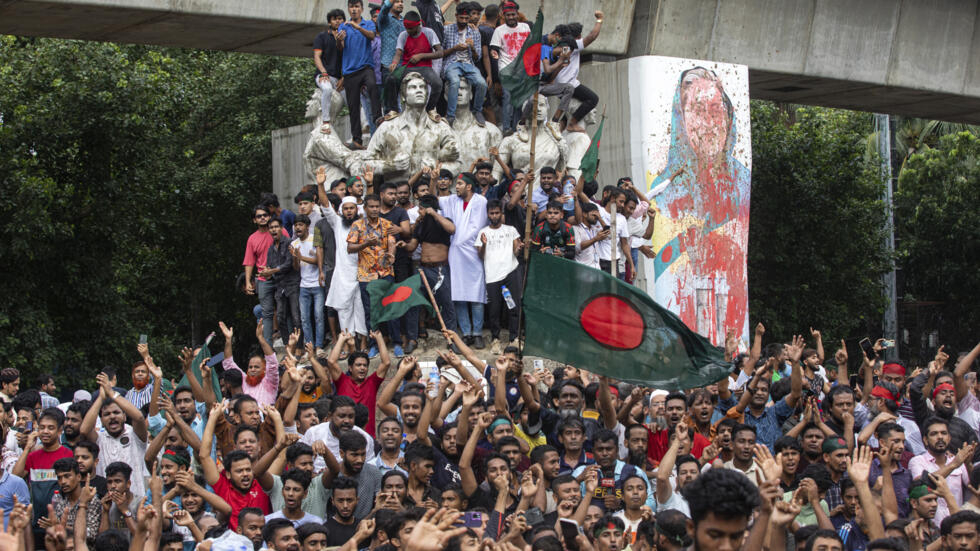
Bangladesh’s Prime Minister Sheikh Hasina has resigned and fled the country following weeks of student-led protests that turned into deadly nationwide unrest.
The 76-year-old leader departed on Monday via helicopter to India, after Thousands of protesters stormed her official residence in Dhaka, prompting her to flee. She landed at the Hindon airbase after Indian Air Force officials received her.
Sheikh Hasina departed from Bangabhaban at around 2:30 PM on Monday on a military helicopter, accompanied by her younger sister, Sheikh Rehana, for a “safer place.”
This unexpected resignation brings an abrupt end to Hasina’s reign, making her Bangladesh’s longest-serving Prime Minister with over 20 years in power.
Sheikh Hasina was born in 1947 to a prominent political family, being the daughter of Sheikh Mujibur Rahman, Bangladesh’s “Father of the Nation,” who led the country to independence in 1971. After surviving the assassination of her family in 1975, Hasina returned from exile to lead the Awami League in 1981. She first assumed office in 1996, spearheading major infrastructure projects and economic reforms.
Under Hasina’s leadership since 2009, Bangladesh experienced rapid economic growth, becoming one of the fastest-growing economies in the region, and saw substantial improvements in GDP and poverty reduction, primarily driven by the booming garment industry. However, her tenure has been tainted by allegations of corruption, human rights abuses, and increasingly autocratic rule.
The recent unrest began with student protests demanding the abolition of civil service job quotas but quickly expanded into a wider anti-government movement. The protests intensified due to rising inflation, economic instability, and perceived governmental corruption. The situation further escalated as security forces responded with live ammunition, tear gas, and mass arrests, leading to over 280 deaths.
The international community, including the UN’s human rights chief Volker Türk, condemned the violence and urged restraint. “The government must cease targeting those participating peacefully in the protest movement, immediately release those arbitrarily detained, restore full internet access, and create conditions for meaningful dialogue,” said Türk.
Despite Hasina’s initial defiance, the mounting pressure and violent clashes forced her to flee. Speaking after a meeting with security chiefs, she had called the protesters “terrorists” and vowed to “suppress these terrorists with a firm hand.”
Earlier in the day, Bangladesh Army Chief General Waker-uz-Zaman held a press conference confirming Hasina’s resignation. He stated that an interim government would be formed to run the country, acknowledging the massive economic suffering caused by the violent protests. He declared, “I am taking full responsibility,” dressed in military fatigues and a cap, though it was not immediately clear if he would lead a caretaker government.
Meanwhile, India has canceled all its train services to and from Bangladesh. The Border Security Force (BSF) issued a ‘high alert’ for all units along the 4,096 km India-Bangladesh border. Acting BSF Director General Daljit Singh Chawdhary and other senior officials have arrived in Kolkata to assess border security.
Asif Mahmud, a leading figure in the nationwide civil disobedience campaign, called on protesters to march on Dhaka, declaring, “The time has come for the final protest.”
Protests persist across the country, with calls for a shutdown of all factories and public transport.
The Bangladeshi military and security forces remain on high alert as the situation unfolds.


