

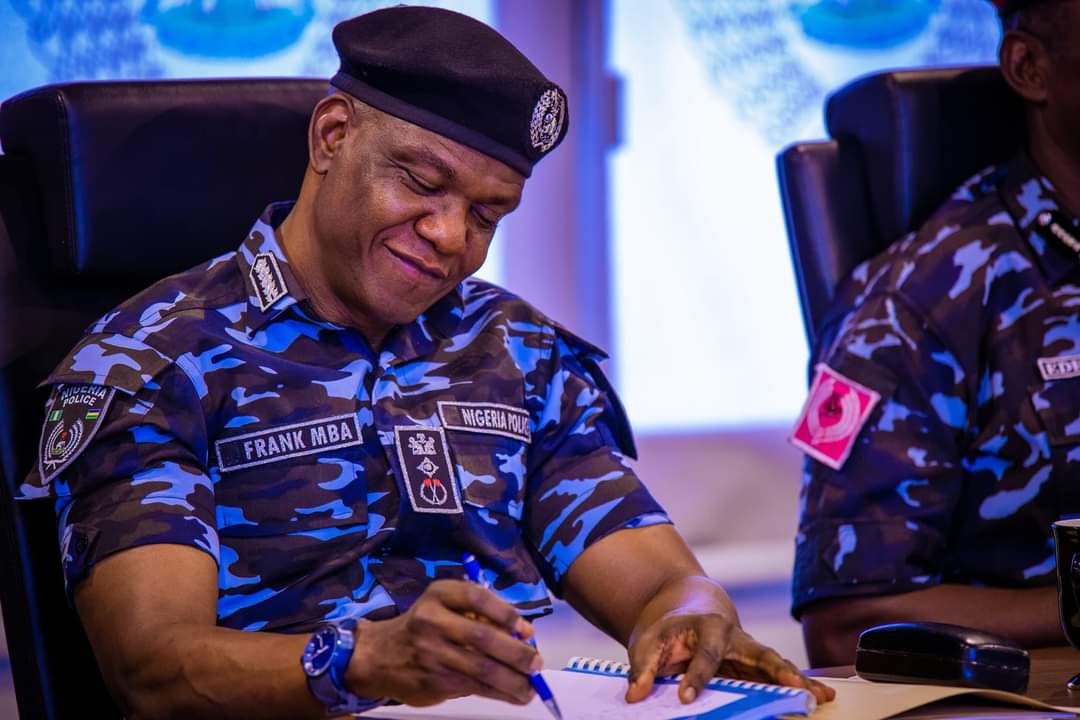
An officer works hard. He studies while others sleep. He sharpens his mind, polishes his craft, carries the uniform with discipline and visibility. He rises faster than his mates. He becomes one of the most recognisable faces of the Force. Competent. Articulate. Dependable.
Then, just when he reaches his peak, still strong, still sharp, still relevant, the system taps him on the shoulder and says thank you and goodbye.
Not because he is tired.
Not because he failed.
Not because he has nothing left to offer.
But because structure demands it.
That is the story wrapped around the exit of DIG Frank Mba. And whether you admire him or critique him, the bigger issue is not one man. It is the architecture that governs them all.
Yes, the President has the constitutional authority to appoint the Inspector General of Police. That power sits firmly in the hands of Bola Ahmed Tinubu today. It is legal. It is settled.
But when that single appointment automatically clears out experienced Deputy Inspectors General who are still in their prime, we must ask a simple, uncomfortable question. Who exactly benefits from this rigidity?
We say we want strong institutions.
We say we want continuity.
We say we want mentorship within the Force.
Yet we operate a structure that retires institutional memory at its strongest point.
Promotion, in Nigeria, too often feels like a countdown to forced exit. The higher you climb, the thinner the air. And sometimes, the closer you are to the ceiling, the closer you are to the door.
But history has memory.
For the record, Frank Mba joined the Nigeria Police Force in 1994 as a Cadet Inspector. Tunji Disu joined earlier, in 1992, as a Cadet ASP. In Course 17/1992, Disu was already ahead in the seniority ladder. By tradition and structure, he was Mba’s senior.
Then came accelerated promotions. Federal Character. Strategic appointments. Visibility. In January 2019, under then Acting IGP Mohammed Adamu, ACP Frank Mba was appointed Force Public Relations Officer, replacing DCP Moshood Jimoh. That appointment altered trajectories.
Today, Olorundare Moshood Jimoh serves as Commissioner of Police in Lagos State. Mba rose further, becoming a Deputy Inspector General. Disu climbed as well and now stands at the very top as Inspector General.
Every rank above Commissioner of Police carries fingerprints beyond merit alone. Influence. Timing. Federal balancing. Political calculations. That is not unique to one administration. It is woven into the system.
Frank Mba is, in many ways, a product of the same promotion architecture many critics condemn. He benefited from accelerated advancement. He became a symbol of reformist communication within the Force. He rose faster than some who had entered before him.
Now, that same structure has caught up with him.
The wheel turns.
But before we reduce this to personal rivalry or sectional argument, let us pause. Both men are fine officers. Both have records of competence. Tunji Disu’s work with the Lagos State Rapid Response Squad between 2015 and 2021 earned public respect. Mba’s years as Force PRO reshaped police communication in a digital era. These are not light achievements.
If our system ensures that when a new IGP is appointed, several experienced DIGs must automatically exit because they are senior in years or rank, then we are bleeding experience at the top every single time leadership changes.
We are a country that invests years and enormous public resources training its security personnel. We send them to courses, retrain them, expose them to international best practices, toughen them through field operations, and refine them through command responsibilities. We polish them until they become repositories of institutional knowledge.
Then just when that knowledge is fully matured, when experience has finally caught up with energy, structure intervenes abruptly and declares them surplus.
In one administrative sweep, decades of training are pushed to the sidelines. Not because capacity has diminished. Not because competence has faded. But because a rigid framework leaves no room for strategic retention.
No serious nation treats expertise as disposable. Institutional memory is not a ceremonial asset, it is a national security resource. When systems repeatedly eject their most seasoned minds at the height of their usefulness, they create a quiet vacuum. And vacuums, in governance, rarely remain empty for long.
Sometimes what leaves through the front door returns through the back, as frustration, as disengagement, as indifference, or as the silent erosion of trust in the system. When experience is not honoured with thoughtful continuity, the nation ultimately pays the price.
An institution as sensitive as the Nigeria Police Force cannot afford constant amnesia. Crime evolves. Security threats mutate. Technology changes the battlefield daily. You do not discard seasoned strategists casually in such an environment.
At the same time, we cannot ignore the distortion that accelerated promotions create. When officers leapfrog seniors through policy engineering, resentment brews quietly. Seniority becomes elastic. Morale becomes fragile. And when the pendulum swings back, it swings hard.
This is not about defending or attacking Frank Mba. It is about asking whether our promotion and retirement architecture truly serves institutional stability.
Because if excellence consistently leaves at its peak, then maybe, just maybe, the issue is not the officers.
It is the design.
Today it is Mba. Yesterday it was someone else. Tomorrow it will be another bright officer whose career arc collides with structural rigidity.
History will not only remember who rose. It will remember how they rose. And it will remember how they exited.
The question is whether we are brave enough to redesign a system where promotion does not double as a silent eviction notice, where merit does not breed resentment, and where experience is preserved rather than periodically purged.
Because a nation that keeps clearing its strongest minds at their peak should not be shocked when its institutions struggle to stand tall.
History has memory.
And it is watching.
Stephanie Shaakaa
08034861434


