

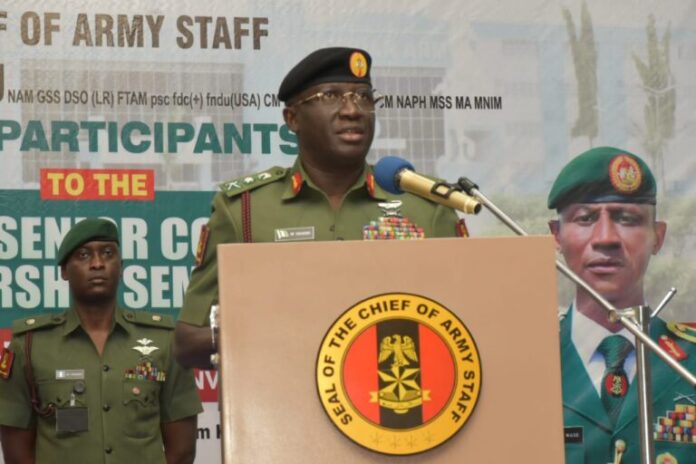
The Chief of Army Staff (COAS), Lt.-Gen. Waidi Shaibu, has said the effectiveness of the Nigerian Army will largely depend on the quality of leadership provided by its commanders.
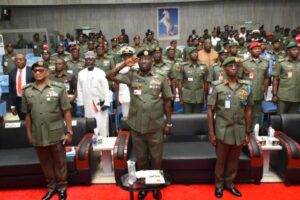
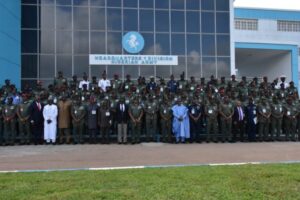
Shaibu made the assertion on Wednesday in Kaduna at the opening of the Second Senior Command and Leadership Seminar 2026, held at the Headquarters of 1 Division, Nigerian Army.
The seminar, themed “Strategic Leadership for Effective Command in an Evolving Security Environment,” brought together senior commanders and other stakeholders to deliberate on emerging security challenges.
The COAS described the seminar as an important professional forum for senior Army leadership to examine the evolving demands of command, share operational experiences and strengthen leadership competencies.
He said the changing nature of warfare required commanders to continuously learn, unlearn and relearn while adapting their leadership approaches to emerging realities.
According to him, although equipment, technology and force structure remain essential components of military capability, leadership ultimately determines how effectively those capabilities are deployed.
He said well-led formations adapt faster, remain cohesive under pressure, inspire confidence and are better positioned to translate tactical actions into lasting strategic outcomes.
Shaibu identified terrorism, insurgency, banditry, transnational organised crime, cyber threats, disruptive technologies and information warfare as challenges reshaping military operations.
He urged commanders to remain intellectually agile, operationally innovative, and morally courageous while making sound decisions in uncertain, rapidly changing environments.
The Army chief said strategic leadership goes beyond the exercise of authority, noting that it requires commanders to shape organisational culture, develop future leaders, anticipate change, preserve institutional credibility and align tactical actions with national objectives.
He also highlighted the growing threat posed by misinformation and malign influence operations, warning that adversaries could seek to undermine the military by eroding public confidence and distorting perceptions of its activities.
Shaibu urged commanders to consider the information environment in campaign design, operational planning and the conduct of activities within their areas of responsibility.
He stressed the importance of timely, accurate and credible communication, adding that military actions must remain professional, lawful, properly documented and capable of withstanding public scrutiny.
The COAS further emphasised discipline, respect for human rights, protection of civilians and strict adherence to the Rules of Engagement, noting that tactical conduct could have strategic consequences.
He said the recent expansion of the Army’s force structure from eight to 12 divisions, alongside additional formations and units, had created new opportunities as well as greater leadership responsibilities.
Shaibu charged senior commanders to transform the newly established formations into credible fighting organisations by enforcing high standards, developing leaders, promoting professionalism and building institutional resilience.
He expressed appreciation to President Bola Tinubu for supporting the expansion, welfare, operational capability and institutional transformation of the Nigerian Army.
READ ALSO: Hausa People Are Key to Nigeria’s Unity, Progress — Tinubu
Earlier, the Chief of Training (Army), Maj.-Gen. Valentine Okoro said the seminar provided a robust platform for capacity building and for strengthening the competencies of commanders at the operational and strategic levels.
Okoro said the Department of Army Training would continue to collaborate with corps, formations and training institutions to ensure realistic, progressive and mission-oriented training tailored to contemporary operational environments.
In his welcome address, the General Officer Commanding 1 Division, Maj.-Gen. Abubakar Wase, described the seminar as timely, saying it would provide an opportunity to examine strategic leadership and command within Nigeria’s evolving security environment.
Wase urged participants to engage in frank discussions, share experiences and develop practical recommendations to strengthen command effectiveness and operational outcomes across the Nigerian Army.
He charged commanders to lead with integrity, courage, humility, and strategic foresight; build cohesive teams; develop successors; and encourage innovation, while translating lessons from the seminar into tangible improvements in command and operations.
(NAN)


