

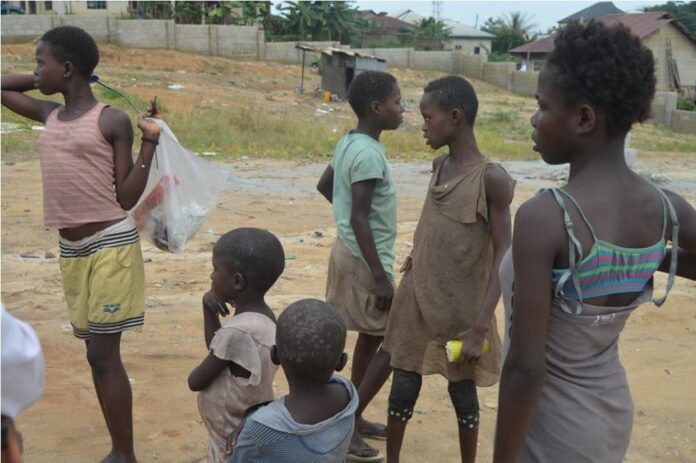
As the global community commemorates the 2026 International Day for Street Children, a rights group, the Center for Human Rights Advocacy and Wholesome Society (CEHRAWS), has called on the Abia State Government to ensure the effective implementation of the Child Rights Act, as domesticated in the state.
The group is demanding that the government move beyond policy declarations to practical enforcement, particularly in safeguarding street-connected children.
The International Day for Street Children was designed by the United Nations as a solemn occasion to reflect on the plight, rights, and dignity of street-connected children, arguably among the most vulnerable yet overlooked populations in society.
The year’s theme for the celebration is “Access to Justice: Protect, Not Punish.”
According to the Executive Director of the CEHRAWS, Chuka Okoye, the theme speaks directly to the lived realities of thousands of children across Nigeria, particularly within Abia State, where many children continue to survive on the streets under conditions that expose them to abuse, exploitation, stigma, and systemic neglect.
He insisted that no child should be criminalized for circumstances rooted in poverty, displacement, or systemic failure, adding that street-connected children are not offenders, but victims of structural inequalities and, above all, holders of inalienable rights.
Okoye said access to justice for street-connected children must go beyond mere legal formalities to encompass protection from abuse, exploitation, and arbitrary detention, as well as access to child-friendly justice systems and legal representation.
“It must guarantee humane and respectful treatment by law enforcement authorities, ensure that the voices of children are heard in decisions affecting them, and provide genuine pathways for rehabilitation and reintegration into society.
“When children are punished for survival behaviors, such as hawking, scavenging, or sleeping in public spaces, the system abdicates its moral and legal responsibility. Such responses neither address the root causes of the problem nor offer sustainable solutions; rather, they exacerbate the vulnerability of these children,” he said.
The CEHRAWS boss acknowledged and commended the Abia State Government for the visible transformation and developmental strides recorded across critical sectors, but noted that true development must be measured not only by physical infrastructure but also by the extent to which human dignity, especially that of children, is protected and upheld.
He advocated the immediate constitution of a multi-stakeholder technical committee comprising relevant government ministries and agencies, legal practitioners, judicial actors, civil society organizations, and the Abia State Child Protection Network, to undertake a comprehensive review of the State’s Child Rights Law with a view to making it more responsive and aligned with the socio-cultural realities of Abia State.
Okoye also advocated for the revival of existing destitute homes or the establishment of new, functional rehabilitation centers across the three senatorial zones of the state, to provide safe shelter, psychosocial support, educational opportunities, and structured reintegration pathways for street-connected children.
“This represents a pragmatic and humane approach to addressing the growing population of children on the streets who, if left unattended, remain at risk of exploitation and may inadvertently contribute to broader social challenges.
“Street-connected children are not a nuisance to be displaced; they are citizens to be protected and potentials to be nurtured. Their presence on the streets reflects systemic gaps that require urgent, coordinated, and compassionate intervention.
“On this International Day for Street Children, CEHRAWS reiterates that justice must protect, not punish. A society that fails to safeguard its children ultimately undermines its own future. We therefore call for deliberate, sustained action to ensure that every child, regardless of circumstance, is afforded dignity, protection, and the opportunity to thrive,” Okoye concluded.


