

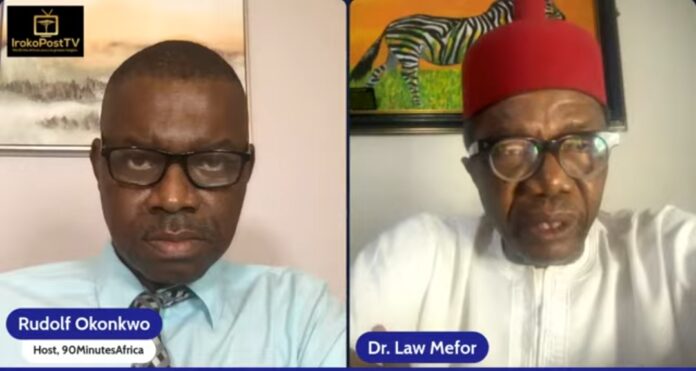
The Anambra State Commissioner for Information and Value Reorientation, Dr. Law Mefor, has dismissed suggestions of a personal rift between Governor Chukwuma Soludo and the presidential candidate of the Nigeria Democratic Congress (NDC), Peter Obi, saying the relationship between the two politicians should be understood within the context of political interests and the longstanding approach of the All Progressives Grand Alliance (APGA) to working with the Federal Government.
Mefor provided clarification during an exclusive interview with Rudolf Okonkwo on 90MinutesAfrica, in which he also addressed the controversy over the financial liabilities that successive Anambra State administrations inherited from the government of Peter Obi.
According to the commissioner, there is no personal animosity between Soludo and Obi. Rather, he argued that both men are politicians who are pursuing policies consistent with their individual political interests.
“There is no rift between Governor Soludo and Peter Obi. They are both in politics and they have their interests to defend,” Mefor said.
He argued that Soludo’s approach was not fundamentally different from the political strategy Obi had pursued when he was governor of the southeast state.
READ ALSO: Vice President Shettima’s United Nations General Assembly Speech (A Rejected Draft)
Mefor recalled that Obi, while serving as governor under APGA, maintained a working relationship with the Federal Government led by former President Goodluck Jonathan of the Peoples Democratic Party (PDP). He noted that Obi subsequently served as a presidential adviser to Jonathan.
The commissioner also cited Obi’s successor, Willie Obiano, as another example of an APGA governor who maintained a relationship with the Federal Government, despite the Federal Government being controlled by another political party.
According to Mefor, Soludo’s relationship with President Bola Tinubu should therefore be viewed within the same political framework.
“Governor Soludo is just following the same policy. He is working with President Bola Tinubu. So long as that policy remains, nobody should blame the governor for following the policy that was introduced by Peter Obi,” he said.
The commissioner also rejected the suggestion that the Anambra State government’s scrutiny of Obi’s financial records was intended to diminish his achievements as governor or his chances in next year’s presidential election.
He acknowledged that Obi performed well during his tenure but said the present disagreement centered specifically on Obi’s repeated assertion that he left no liabilities for succeeding administrations in the state.
“The intention of the Anambra State government is not to indict Peter Obi,” Mefor said, adding that “Peter Obi did well as governor.”
According to him, the government’s objective is to clarify the state’s financial records rather than engage in a political confrontation with the former governor.
“Our interest is to set the record straight. There’s nothing adversarial,” he said.
Mefor, however, disputed Obi’s claim that he left behind no financial liabilities, arguing that records available to the state government indicated otherwise.
A major point raised by the commissioner was Obi’s claim that he left N2.13 billion in an ecological fund account with First Bank at the University of Nigeria, Awka (UniZik) branch.
Mefor said the state government investigated the claim by requesting the relevant account statement from the bank, but could not find evidence of the alleged balance.
“Peter Obi told us that he left N2.13bn ecological fund in a First Bank account at the UniZik branch. We went to the bank and demanded the account statement. There was no N2.13bn in that account, either as an inflow or a balance at any time,” he said.
The commissioner challenged Obi to publish the relevant bank statement if he believed the government’s account was inaccurate.
According to Mefor, the state government did not originate the claim regarding the account or provide its details. He maintained that the information was attributed to Obi himself.
“We can’t see the money. I think it is fair enough to say that if he thinks that we are lying, he should print it out and publish it,” Mefor said.
He added that anyone seeking an explanation concerning the alleged funds should direct the question to Obi, who, according to him, originally made the claim.
Mefor further challenged Obi’s claim that his administration left no loan liabilities for subsequent governments.
According to the commissioner, Obi’s administration obtained eight loans and drew down on some of them, with repayments left for succeeding administrations.
“Nobody is against a government taking loans. Peter Obi took loans and we are not saying it’s wrong. He took eight loans and he drew down on some of them. He did not repay, so he passed it down to the successive governments,” Mefor said.
He maintained that taking loans was not inherently wrong, particularly where borrowed funds were deployed to projects capable of producing significant public benefits.
Mefor cited education, malaria control, agriculture, and erosion management as examples of the objectives for which, according to him, Obi’s administration borrowed funds.
“We agree that these were noble reasons but he shouldn’t say he didn’t take loans,” he said.
The commissioner also referred to records of the Debt Management Office (DMO), claiming that Anambra State’s domestic debt at the time Obi left office amounted to billions of naira.
Mefor also sought to distinguish Soludo’s decision not to borrow since assuming office from a blanket opposition to government borrowing.
He said Soludo had established conditions under which his administration could consider taking loans.
According to Mefor, such borrowing would have to be project-specific, while the project itself would need sufficient economic viability to generate the resources required for repayment.
“Although Governor Soludo has not taken any loan, that does not mean that a loan is bad,” he said.
The commissioner stressed that Soludo’s position did not imply that previous administrations were necessarily wrong to borrow.
By the same reasoning, Mefor said Obi should not be faulted simply for obtaining loans to finance development projects. Rather, the point of contention was Obi’s assertion that his administration did not leave loan liabilities behind.
The commissioner also defended the state government’s appointment of Ken Emeakayi, who is accused of being involved in the 2002 murder of Chief Barnabas Igwe and his wife in Onitsha, as Special Adviser on Community Security. Mefor argued that the governor was not in any way shielding Mr. Emeakayi from justice, but was only adhering to the principle that the accused remains innocent until a competent court finds him guilty of the crime.


