

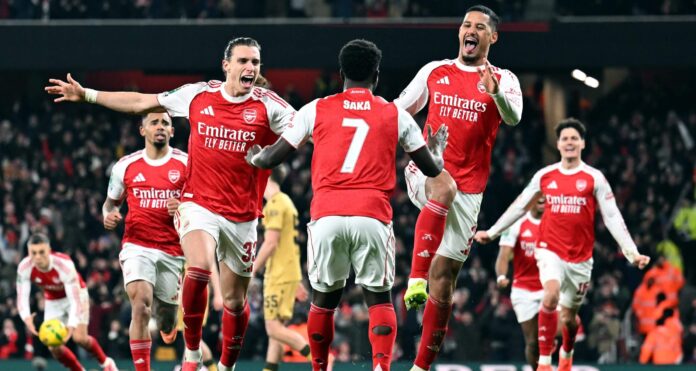
Long before trophies are lifted, football announces its miracles in quieter ways.
In the trembling voice of a father calling his son after the final whistle. In strangers embracing outside stadium gates as though they have survived something together. In supporters staring at league tables with guarded eyes because disappointment has educated them into caution. Football’s greatest moments rarely begin with celebration. They begin with disbelief.
Somewhere in North London last night, there is an Arsenal supporter old enough to remember Highbury who cried before the final whistle because hope had become too dangerous to trust completely.
Arsenal did not just end a title drought, they ended a generation that learned how to love a club through disappointment.
For more than two decades, Arsenal supporters lived like citizens of a fallen empire, surviving mostly on stories about what the club used to be. They remembered marble halls and impossible football. They remembered Arsène Wenger standing on touchlines with the calm certainty of a man who believed beauty itself could defeat power. They remembered Thierry Henry moving through defenders like memory made physical. They remembered a time when Arsenal did not merely win matches, they shaped what football looked like.
Then history moved on.
Or at least it appeared to.
The cruelest thing about football is that hope survives intelligence. Even when supporters know better, they still believe. Even after collapse follows collapse, they return each season carrying a faith they can no longer logically defend. Arsenal supporters knew this feeling too well. Seasons began with hope and ended in familiar silence. Promising teams dissolved at the exact moment belief became dangerous. Around them, English football transformed into an empire of financial power and relentless efficiency while Arsenal drifted between nostalgia and reinvention, never fully belonging to either.
The Emirates Stadium became the perfect symbol of that contradiction. It was built for the future, but for years Arsenal supporters filled it carrying the ghosts of another stadium. Highbury never truly left them. It lingered in chants, in conversations, in old footage watched late at night like a ritual of remembrance. Fathers described Wenger’s Arsenal to their children like myth. Entire generations inherited memories they never personally lived through.
Every Arsenal supporter inherited unfinished grief.
And over time, that grief became ridicule. Arsenal turned into modern football’s favorite joke. The club that collapsed in spring. The club that could not sustain greatness. The club that played beautiful football in an age that rewarded brutality. Even hope itself became something to hide. Supporting Arsenal often felt like defending memory in a room full of laughter.
Then came Mikel Arteta.
At first, he looked like another idealist walking toward inevitable failure. But he understood something deeper than tactics. He understood restoration.
Not just rebuilding a squad. Rebuilding emotional legitimacy.
Modern football has lost patience with time. Projects are abandoned before they mature. Managers are discarded before foundations settle. Social media turns every mistake into permanent judgment. In that environment, Arsenal choosing belief over panic felt almost defiant.
“Trust the process” became a phrase people mocked because they feared what it demanded: patience.
But beneath the ridicule was something real.
Faith.
Slowly, Arsenal began to change.
Bukayo Saka grew from academy talent into emotional anchor. Martin Ødegaard became a captain defined not by volume but by calm authority. William Saliba brought control. Declan Rice brought steel. David Raya brought composure. And together they formed a team that no longer played like it was haunted by pressure.
They looked educated by it.
That is when everything shifted.
Previous Arsenal sides feared failure before it arrived. This team had already survived enough disappointment to stop fearing it. Near misses against Manchester City and Liverpool no longer broke them. They refined them. Every collapse became instruction. Every setback became structure.
The final confirmation came on the southern coast, where AFC Bournemouth held Manchester City to a result that ended the race and confirmed Arsenal as champions of England again after twenty two years.
But what happened next cannot be explained by points or tables.
Because football is never really about mathematics.
Somewhere in North London, in homes where old scarves still sit folded in drawers, there are people who waited half a lifetime for this moment. There are fathers who once told their children stories about Arsenal greatness while quietly wondering if those stories had become fiction. There are children who grew up defending a club they had never seen truly dominate. And there are names that never made it to this moment, voices that would have shaken with joy if time had allowed them to remain.
There are supporters who did not survive the wait.
Football never forgets that kind of absence.
Football clubs are not built in stadiums or transfer windows.
They are built in the invisible architecture of waiting.
Every supporter lives inside a structure made of seasons, near misses, almost moments, and inherited memory. And when a club finally wins after decades, it is not victory that shocks the world. It is the realization that an emotional structure everyone assumed was temporary was actually holding itself together all along.
History never truly disappears. It waits.
It waits in old scarves. In fading photographs. In fathers telling children about matches they never saw. In supporters who continue believing long after belief stops appearing rational.
And now another horizon opens.
The double.
Not just another trophy, but the transformation of endurance into immortality. Domestic titles restore power. European triumph sanctifies it. That is the difference between success and legacy.
Arsenal, once mocked for trusting a process, now stands at the edge of something larger than redemption.
Perhaps that is why this feels heavier than football.
Because somewhere beneath the fireworks across North London, beneath the noise, beneath the tears and disbelief, Arsenal are no longer chasing trophies alone.
They are chasing reconciliation with history.
For twenty-two years, they lived in the shadow of who they once were.
Now the shadow is beginning to chase them back.
And last night, in pubs overflowing into rain-soaked streets, in living rooms lit by exhausted joy, in phone calls between fathers and sons who finally share the same moment, football whispers a final question into the dark.
Can Arsenal get double for their trouble?
If they do, this will no longer be remembered as a season.
It will be remembered as the moment a club stopped being remembered for what it lost, and started being remembered for what it endured.
Stephanie Shaakaa
08034861434


