

By Olusegun Aribike, News Agency of Nigeria (NAN)
For two weeks, Africa captured the fancy of the football world. At the 2026 FIFA World Cup, the continent produced its strongest collective performance in history, with nine of its 10 representatives advancing beyond the group stage.
It was a remarkable achievement that reflected years of investment in coaching, youth development and player development.
However, as the knockout rounds unfolded, celebration gradually gave way to disappointment.
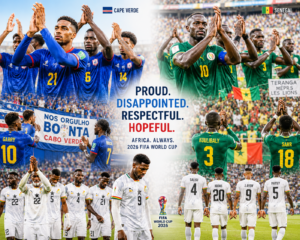
One after another, African teams exited the competition.
Some players collapsed on the pitch in disbelief. Others applauded travelling supporters before making the long walk back to the dressing room.
The scenes differed, but the lesson remained the same.
Historical FIFA World Cup records shows that while Africa has never possessed greater depth, its greatest challenge remains overcoming football’s traditional powers when every mistake can end a dream.
For the first time, Africa fielded 10 teams at the FIFA World Cup.
Nine progressed beyond the group stage, the highest number ever achieved by the continent.
The Confederation of African Football (CAF) President Patrice Motsepe, described the performances as “hard-earned and well-deserved,” saying they reflected the “global competitiveness and world-class quality of African football.”
Since Morocco became the first African nation to qualify for the knockout stage in 1986, African teams have progressed beyond the group stage at an average rate of 29 per cent.
In 2026, that figure rose dramatically to 90 per cent.
Across the previous seven FIFA World Cups that featured at least five African representatives, the average progression rate stood at just 22.3 per cent.
The latest campaign therefore represents not merely improvement but a significant transformation in Africa’s competitiveness. Even Africa’s opponents acknowledged the progress.
After Argentina survived Cape Verde following extra time, captain Lionel Messi admitted his side still had “many” things to improve on and cautioned against underestimating African opposition.
Cape Verde, making its FIFA World Cup debut, had earlier drawn with Spain and Uruguay before stretching the defending champions to extra time.
Although their tournament ended, their performances earned widespread respect.
Collectively, Africa has never appeared stronger on football’s biggest stage. However, the expanded 48-team FIFA World Cup also requires historical context.
Unlike previous tournaments, which moved directly from the group stage to the Round of 16, the 2026 edition introduced a Round of 32.
The additional knockout round created another opportunity for qualification but also another hurdle.
Teams now required one extra knockout victory to reach the stage previous generations entered immediately after surviving the group phase.
Africa embraced the opportunity. It then encountered the obstacle with seven African teams exiting in the Round of 32.
Only Morocco and Egypt progressed to the Round of 16, with Morocco subsequently advancing to the quarter-finals.
The eliminated teams lost to established football nations.
Algeria fell 2-0 to Switzerland, DR Congo lost 2-1 to England, Côte d’Ivoire were beaten 2-1 by Norway, Cape Verde lost 3-2 after extra time to Argentina, Ghana suffered a 1-0 defeat to Colombia, Senegal lost 3-2 to Belgium, while South Africa fell 1-0 to Canada.
Consequently, Africa’s collective progression declined from a record 90 per cent getting to the Round of 32 to 20 per cent advancing beyond it.
The decline was sharp. It was also revealing.
Nevertheless, historical comparison still places Africa’s 2026 campaign among its strongest.
This shows that across previous comparable FIFA World Cup tournaments, only 8.08 per cent of African teams get to the second knockout round.
This year, the figure has increased to 20 per cent. The expanded tournament explains part of that improvement.
It does not explain all of it. History also highlights where Africa’s greatest challenge persists.
Since Morocco first reached the knockout stage in 1986, African teams have played 27 FIFA World Cup knockout matches.
As of July 6, they have recorded only eight victories, three coming via penalty shootouts, while suffering 19 defeats.
That represents a knockout success rate of 29.6 per cent. Another statistic reinforces the challenge.
Since Africa returned to the FIFA World Cup in 1970, its teams have faced former world champions on 24 occasions.
They have won only five matches, drawn seven and lost 12.
These numbers illustrate how often African dreams have ended against football’s most experienced nations.
Europe and South America continued to dominate the latter stages because they have spent generations mastering knockout football. Africa is still developing that tradition.
Democratic Republic of Congo Head Coach Sébastien Desabre believes the continent’s recent progress reflects years of sustained investment rather than favourable circumstances.
He described Africa’s performances as “a source of great pride” and credited improvements in youth development, coaching and football structures.
According to Desabre, Africa’s first FIFA World Cup title is “only a matter of time.” Available evidence lends support to that optimism.
African teams now defend with greater tactical organisation. Their technical discipline has improved considerably.
More African footballers are competing regularly in Europe’s elite leagues than ever before. The performance gap continues to narrow.
The final barrier, however, remains defeating football’s traditional powers consistently in knockout competition. That is the defining paradox of Africa’s modern FIFA World Cup story.
The continent has never enjoyed greater collective strength. Morocco has once again demonstrated that another historic breakthrough is possible.
Egypt still has an opportunity to write another chapter. Whatever happens next, the images that defined Africa’s knockout campaign remain instructive.
The applause.The embraces.The long walk back to the dressing room.
They serve as reminders that progress alone is not the destination. The numbers tell the same story.
Africa produced a record 90 per cent group-stage qualification rate at the 2026 FIFA World Cup.
Yet, as of July 6, African teams have won only eight of their 27 World Cup knockout matches, representing a success rate of 29.6 per cent.
Observers say closing that final gap, rather than proving that the continent belongs to football’s elite, has become Africa’s greatest World Cup challenge.
Source: NAN


