

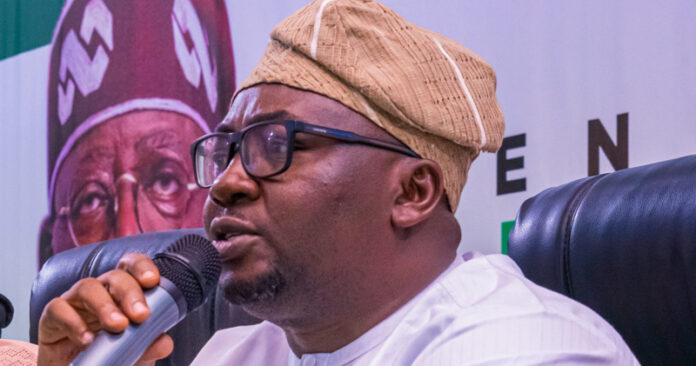
At a time when many Nigerians are at a loss over the cause of the recent electricity outage, coming amid intense heat, economic strain, and the rising cost of petrol needed for alternatives, I came across what appears to be an intervention by the outspoken former senator, Dino Melaye, attempting to offer an explanation. This was followed by a different account from the Minister of Power, Adebayo Adelabu, just as the month of April approaches.
In discussing both perspectives with Nasiru Mohammed, who sought my view, I noted that Melaye may not be entirely objective, while the minister, on his part, may be cautious, perhaps even restrained in admitting government shortcomings. Between the two, one is left to wonder who is playing to public sentiment: the voice amplifying despair through accusations of negligence, or the one offering reassurance, attributing the outages to factors beyond government control, appealing for patience, offering apology and promising solutions.
Dino’s assertions paint a troubling picture. He argues that Nigeria has been generating electricity since 1896, yet still struggles to deliver reliable power, with frequent grid collapses. He points to an installed capacity of about 13,000MW, of which only a fraction is usable due to grid limitations and vandalism.
Comparisons are drawn with countries like South Africa and Egypt, where generation capacity far exceeds Nigeria’s, despite smaller or comparable populations. He highlights a massive debt burden in the power sector, linking it to gas supply shortages and worsening outages. He further claims that Nigerians spend billions annually on generators, suggesting their combined capacity dwarfs that of the national grid, while also stressing the economic toll of persistent power failures. The underlying tone is clear: a crisis rooted largely in governance failure, contrasted with perceived progress in other African nations.
In contrast, Adebayo Adelabu presents a more technical and immediate explanation. He attributes the outages to disruptions in gas supply, challenges in pipeline maintenance, liquidity constraints affecting payments to suppliers, and broader structural issues such as ageing infrastructure and transmission bottlenecks. While acknowledging the inconvenience, he frames the situation as largely beyond direct government control and assures Nigerians that efforts are underway to stabilize supply within a short period.
A closer look at the claims reveals a mix of truth, exaggeration, and selective framing. The statement that Nigeria has generated electricity since 1896 is historically correct in a narrow sense, but it is misleading when used to suggest over a century of continuous, nationwide development, as early electricity supply was limited to small, localized systems. Similarly, while the gap between installed and available capacity is real, describing unused capacity as simply “wasted” ignores the technical constraints, particularly gas shortages and transmission limitations that align with the minister’s explanation. Figures about grid collapses and cumulative failures, though rooted in real instability, are often presented in ways that blur the distinction between partial disturbances and total system failures, thereby amplifying the perception of constant breakdown.
Financial claims about sectoral debt and generator usage also contain elements of truth but are framed in ways that heighten alarm without sufficient nuance. The comparison with countries like South Africa and Egypt, while rhetorically powerful, overlooks differences in infrastructure, investment history, and energy systems. Likewise, the suggestion that the grid cannot sustain output beyond a certain threshold oversimplifies a more complex reality in which capacity fluctuates but has, at times, exceeded such limits.
What emerges is a clear tension between two narratives. One emphasizes waste, neglect, and systemic failure, placing responsibility squarely on the government’s shoulders. The other highlights constraints, both structural and external, portraying the crisis as a combination of technical challenges and temporary disruptions. The contradiction lies not in the existence of a problem which both sides agree, but in how its causes and severity are framed.
In truth, the evidence supports a position somewhere between these extremes. Nigeria’s electricity crisis is both structural and immediate, shaped by long-standing governance issues as well as operational challenges like gas supply and infrastructure limitations. The more alarmist narrative captures public frustration but stretches facts for impact, while the official response is grounded in technical realities yet tends to understate the depth of systemic weaknesses.
Electricity remains Nigeria’s enduring albatross, and any leader who successfully resolves it would attain a legacy far beyond rhetoric or regional acclaim. The power sector demands not just competence but an almost defiant commitment to results, an insistence on performance that leaves no room for illusion. It is the kind of responsibility that would test even the most accomplished figures, individuals with the boldness and track record of names like late Prof Dora Akunyili, Nasir El-Rufai, or prof Ishaq Oloyede of JAMB In a sector where the difference between darkness and light is unmistakable, performance cannot be disguised, and reputations are either forged or broken in the glare of public reality.
Bagudu can be reached via bagudumohammed15197@gmail.com or 07034943575.


