

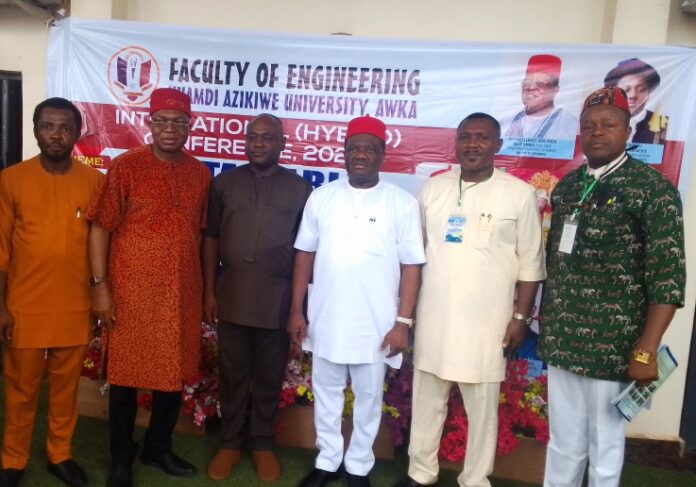
The Federal Minister of Works, Engr Dave Umahi, has called on Southeast States and the South East Development Commission (SEDC) to start adopting nanotechnology solutions in highway constructions to safeguard huge investments in road developments.
According to him, such a move would prevent life’s premature road failures currently being witnessed.
Umahi made the call during the 2026 International (HYBRID) Conference of the Faculty of Engineering, Nnamdi Azikiwe University, Awka, Anambra state, with the theme, “Sustainable Engineering for A Resilient Future.”
The Minister noted that the the theme of the Conference aligns with the vision and mission of the present federal administration, led by President Bola Ahmed Tinubu, aimed at ensuring large-scale infrastructure renewal with durability, sustainability in mind, economic diversification, climate-resilient developments, and inclusive growth.
He said his Ministry is vigorously implementing transformative infrastructure projects across the country, guided by principles of sustainability, durability, and value for money.
“Engineering, in all its branches, remains central to achieving these national objectives.
“Sustainable engineering is no longer optional; it is the pathway to resilience, competitiveness, social inclusiveness, and long-term prosperity of citizens.
“Nationwide, we are constructing and rehabilitating major critical roads and bridge networks to enhance connectivity, promote regional integration, and stimulate economic activities.
Most of the critical major artery roads are being changed to Rigid Pavements as the next resilient alternative to the usual flexible pavements constructed by the Federal Ministry of Works.
“These are becoming unsustainable for the major roads due to many factors, including poor pavement designs, poor construction, inadequate highway drainage systems, abuse of highways, inadequate maintenance, and insufficient funding.
“For both types of pavements, we are executing, emphasis is laid on having a very stable subgrade’s topmost layer with well-graded rock materials from boulders down to fines, and or correct subsoil drainage structures.
“Some sections fail more frequently due to the effect of underground water problems. We are mindful of the fact that the stress bulb/circle under standard axle loads used for designs does not exceed the usual 1 – 1.2m.
“However, we make sure that such pervious stabilized top of subgrades being executed connects to reinforced concrete side drains for lateral discharge of water to the side open drains instead of stabilizing only within the carriageway width of the roadway,” Umahi noted.
Also speaking, the lawmaker representing Aguata Federal Constituency at the National Assembly, Engr. Dom Okafor charged Engineering scholars to evolve from being builders of structures to architects of sustainability.
He also challenged the scholars to insist on designs not just for strength, but for longevity, adaptability, and ecological harmony.
Regretting the consequences of unsustainable development, such as rising sea levels, collapsing infrastructure, energy crises, and widening inequality being witnessed across the globe, Okafor expressed confidence that the intellectual crucible would offer opportunity for ideas to be forged, solutions tested, and collaborations born.
He said, “Resilience is not merely the ability to withstand shocks; it is the capacity to transform adversity into opportunity. In Nigeria, we face infrastructural deficits, energy instability, and environmental degradation. Yet, within these challenges lie the seeds of innovation.
“As engineers, we must embrace green technologies, circular economies, and smart infrastructure. We must champion renewable energy, sustainable urban planning, and inclusive design.
“We must also ensure that our engineering solutions are not only technically sound but socially equitable. There’s also the need for stronger bridges between research and policy, between laboratories and legislative chambers.”
While pledging commitment to fostering policies that empower innovation, fund research, and protect intellectual property, the lawmaker urged both students and young professionals to see engineering not just as a career, but as a calling to serve humanity, to protect the planet, and to shape the future.
Declaring the Conference open, Vice-Chancellor Prof. Ugochukwu Anyaehie applauded the organizers for their remarkable research output, stressing that their work has not only advanced knowledge but also has the potential to transform industries and communities.
Anyaehie, represented by Deputy Vice Chancellor Prof Hilda Osisioma, challenged the faculty to take further steps by patenting their products and innovations, which he said would not only protect their intellectual property but also open up opportunities for commercialization and impact.
While noting that the conference theme resonates deeply with his administration’s vision for UNIZIK, Anyaehie assured continued commitment to foster an environment of academic excellence, innovation, and collaboration.
Earlier, Dean, Faculty of Engineering, Engr. Prof. Ugochukwu Okonkwo described the conference theme as timely, especially at a time global challenges are increasing, like resource scarcity, climate change, rapid urbanization, and degradation of the environment, among others.
Okonkwo emphasized the role of engineering in building a sustainable future and the importance of rethinking, redesigning, and rebuilding available systems to drive global revamping and sustainability.
He expressed optimism that the ideas and knowledge gained at the conference would provide direction and enhance the use of the institution’s abundant but untapped natural resources.
Prof Michael Ngadi from McGill University, Canada, and Dr. Eni Oko from Newcastle University, England, were among the Lead Paper Presenters at the conference.


