

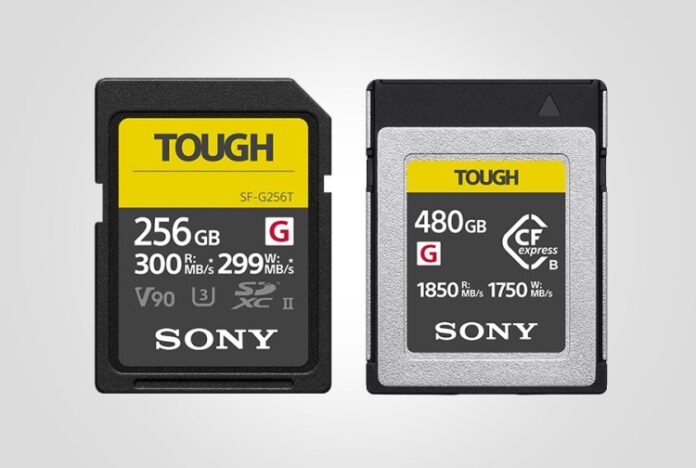
In Tokyo, Sony made a decision that might have been unthinkable a decade ago. The company announced it would “temporarily suspend the acceptance of orders” for most of its SD and CF express memory cards.
This pause affects both consumers and authorized dealers, with no clear date for resumption.
The reason, according to Sony’s official statement, is direct: “Due to the global shortage of semiconductors (memory) and other factors, it is anticipated that supply will not be able to meet demand… for the foreseeable future.”
At first glance, this sounds like a supply problem. But the situation is more layered than that.
Memory cards were once essential. In the early 2010s, they powered digital cameras, expanded phone storage, and carried files between devices. A small plastic card could hold a person’s photos, music, and documents, but that role has been shrinking for years.
Modern smartphones rarely include memory card slots. Instead, they rely on internal storage that is faster and tightly integrated. At the same time, cloud services have changed how people think about storage. Files are no longer something you carry; they are something you access.
Laptops and gaming consoles now depend on built-in solid-state drives rather than removable storage. As a result, memory cards have gradually moved from everyday use into more specialized fields such as professional photography and video production.
What makes the current moment unusual is that demand has not simply declined. Supply has also come under pressure.
The shortage Sony refers to is part of a wider constraint in the global production of memory chips. These chips are the core of all modern storage devices, from memory cards to high-performance servers.
One major factor is the rapid expansion of artificial intelligence systems. Training and running these systems requires vast amounts of high-speed memory. Data centers are being built at scale, and each one consumes enormous quantities of storage components.
Industry estimates suggest that AI-related infrastructure can drive component cost increases of 20 to 35 percent in related hardware markets. Memory producers are now focusing on supplying enterprise-grade components, which are more profitable and urgently needed.
In simple terms, the same raw materials used to make a memory card are now being used elsewhere, on a much larger and more demanding scale.
Sony’s statement also refers to “other factors,” which may be linked to ongoing supply chain disruptions. These include geopolitical tensions affecting the availability of key materials, such as helium, which is used in semiconductor manufacturing processes.
When such inputs become scarce or expensive, production slows. Even a small disruption can affect global output because semiconductor manufacturing operates at extremely high precision and scale.
For consumers, the effects are already visible.
Retail prices for memory cards have risen sharply in recent months. Popular models, especially high-speed and high-capacity cards, are becoming harder to find. Sony’s decision suggests that existing stock may be sold through without immediate replacement.
The company acknowledged the uncertainty in its announcement, stating it would “consider” resuming orders while “monitoring the supply situation.”
Despite the disruption, memory cards are unlikely to disappear entirely. Cameras, drones, and professional equipment still depend on them.


