

A new generation of artificial intelligence hardware from NVIDIA has brought some of the biggest rivals in AI into the same supply chain at the same time.
On Tuesday, May 19, 2026, NVIDIA announced that it had delivered the first units of its new Vera CPU platform to partners including OpenAI, Anthropic, SpaceX, and Oracle.
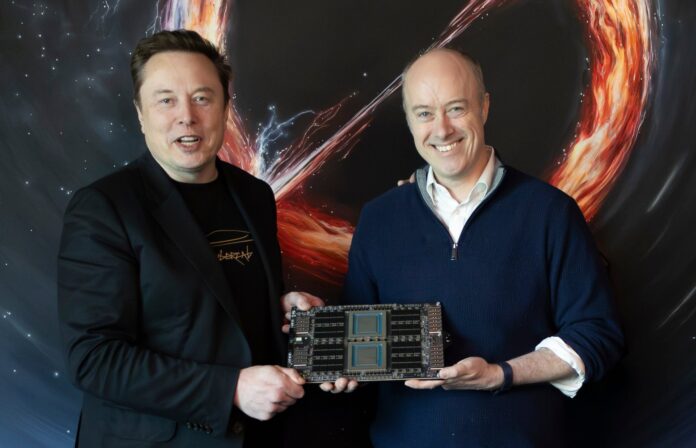
The deliveries were personally handled by NVIDIA vice-president Ian Buck, who appeared in company posts carrying a Vera motherboard during customer visits.
The announcement immediately drew attention because it placed billionaire entrepreneur Elon Musk and OpenAI in the same AI hardware rollout despite Musk’s ongoing legal and public feud with OpenAI chief executive Sam Altman.
What Is NVIDIA’s Vera Chip?
According to NVIDIA, Vera is the company’s first custom-built CPU designed specifically for what the industry now calls “agentic AI.” These are systems that can perform multi-step tasks more independently, including writing code, running simulations, managing software tools, and coordinating workflows.
The processor reportedly contains 88 Arm-based Olympus cores and a memory bandwidth of about 1.2 terabytes per second. NVIDIA says the chip is designed to work alongside its upcoming Rubin AI GPUs.
In simple terms, NVIDIA is trying to move beyond selling graphics processors alone and become the company providing the entire computing infrastructure for advanced AI systems.
That matters because AI companies increasingly need enormous amounts of computing power not just for chatbots, but also for robotics, engineering simulations, autonomous systems, and scientific research.
The most surprising name in the announcement for many was SpaceX.
Although SpaceX is mainly known as a rocket company, Musk has increasingly pushed AI into several of his businesses, including xAI, Tesla’s autonomous driving systems, and robotics development.
Posts circulating on X claimed SpaceX plans to use Vera chips for reinforcement learning in rocket design simulations. Reinforcement learning is a branch of AI in which systems improve through repeated trial and error.
That could allow AI systems to test thousands of virtual rocket designs, flight conditions, and engineering adjustments far faster than traditional methods.
Musk reacted to NVIDIA’s announcement with a short post on X:
“Vera nice, Vera nice …”
NVIDIA is currently exerting growing influence on the global AI industry.
Almost every major AI company, including OpenAI, Anthropic, xAI, Google, and Meta, depends heavily on NVIDIA chips to train and operate advanced AI systems.
The company already dominates the GPU market for AI training. Now it is expanding into CPUs, networking, and memory infrastructure as demand for AI computing continues to rise.
Some analysts believe NVIDIA wants to control the entire “AI factory” stack: the chips, servers, networking systems, and software needed to run future AI models.
That is why Vera matters beyond just another processor launch.
Musk’s Fight With OpenAI Continues
Currently, Elon Musk and Sam Altman are in a heated legal war.
Musk helped co-found OpenAI in 2015 alongside Altman and others. At the time, OpenAI was established as a non-profit research organization focused on developing AI “for the benefit of humanity.”
Musk later left the organization in 2018 after disagreements over leadership and direction.
As OpenAI became commercially successful through ChatGPT and large investments from Microsoft, Musk accused Altman and OpenAI executives of abandoning the company’s original mission and transforming it into a profit-driven business.
This dispute led to a major lawsuit filed by Musk against OpenAI, Altman, and Microsoft.
However, on Monday, May 18, a California jury rejected Musk’s claims after concluding that he waited too long to bring the lawsuit under legal time limits known as statutes of limitation.
The jury did not rule directly on whether OpenAI violated its original mission. Instead, it ruled that the claims had expired legally.
Following the verdict, Musk posted on X:
“There is no question to anyone following the case in detail that Altman & Brockman did in fact enrich themselves by stealing a charity.”
He added:
“I will be filing an appeal with the Ninth Circuit.”
Musk also argued that the ruling could create “a free license to loot charities” if cases are delayed long enough.
OpenAI rejected Musk’s accusations and described the verdict as a victory.
Outside the courthouse in Oakland, California, OpenAI spokesman Sam Singer said:
“This was nothing but an effort by Mr. Musk to slow down a competitor.”
During the trial, Altman testified that Musk himself had previously supported making OpenAI a for-profit business and had sought long-term control of the organization.


