

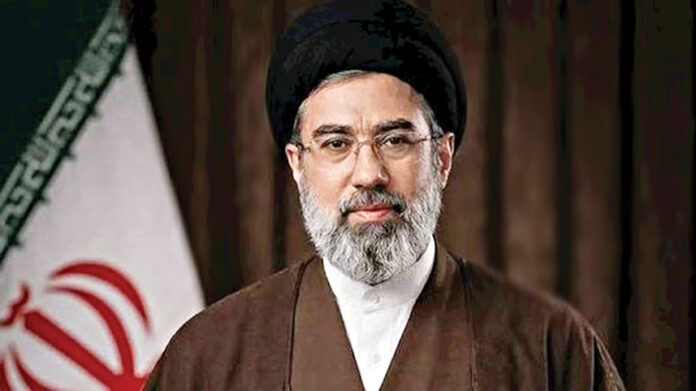
His father dead.
He is injured.
He is on the run.
He lacks legitimacy.
Which leaves a question echoing across the Middle East tonight.
Who is running Iran?
Power in the Islamic Republic was designed to look immovable. For decades the system projected the image of iron discipline. One supreme leader at the summit, a network of clerics, intelligence services and revolutionary guards beneath him, all bound together by the authority of a single center.
The structure was never democratic. But it was clear.
Authority flowed downward from one unquestioned figure.
That clarity is now beginning to fracture.
The name suddenly hovering over the system is Mojtaba Khamenei. For years he lived in the shadows of power, the son of the supreme leader rather than the holder of the title. Inside Iran’s opaque political machinery his influence was often whispered about but rarely discussed openly.
Now the whispers have become unavoidable.
Yet the prospect of his rise exposes a profound contradiction inside the Islamic Republic. The revolution that created modern Iran promised to bury monarchy forever. It claimed to replace hereditary rule with a system guided by religious authority and revolutionary legitimacy.
A transfer of power from father to son would look less like revolutionary continuity and more like dynastic succession.
And in the middle of war, legitimacy becomes a strategic resource.
When authority at the top of an authoritarian system begins to look uncertain, every institution beneath it starts recalculating. Rival factions test their strength quietly. Security services hedge their loyalties. Political elites begin asking the most dangerous question in such systems.
Which direction is power really moving?
Leadership transitions are always delicate. In systems built around one dominant figure they can become explosive.
Iran now faces that transition in the middle of one of the most volatile moments the region has seen in years.
Across the narrow waters of the Persian Gulf, governments are watching the drama unfold with a mixture of anxiety and cold realism. The financial districts of Doha, the energy terminals of Abu Dhabi, the command centers of Riyadh and the skyscrapers of Dubai all depend on a fragile assumption.
That instability inside Iran can be contained.
Geography, however, rarely cooperates with political hopes.
Just off Iran’s southern coast lies the Strait of Hormuz, the narrow maritime corridor through which a vast portion of the world’s oil and liquefied natural gas must pass. Tankers leaving the fields of Saudi Arabia, Kuwait, Qatar and the United Arab Emirates all funnel through this stretch of water before reaching global markets.
That geography gives Iran a peculiar kind of leverage.
Even a weak Iran can disrupt the strait. Even an unstable Iran can rattle global markets. Missiles do not have to sink tankers to create panic. The possibility alone can send insurance costs soaring, shipping routes shifting and oil prices surging within hours.
In energy markets fear itself becomes a commodity.
For the Gulf states this produces a strange paradox. Rising tensions often push oil prices upward, briefly filling government coffers. Yet the same instability that boosts revenue also threatens the infrastructure that generates it.
Refineries, export terminals and desalination plants line the Gulf coastline. They are enormously valuable and dangerously exposed.
A single missile landing in the wrong place could ripple through the global economy within hours.
This vulnerability explains why Gulf governments have spent decades anchoring their security to outside powers, particularly the military umbrella of the United States. American naval patrols, missile defense systems and regional bases form the backbone of the Gulf’s security architecture.
But every escalation with Iran introduces an uncomfortable possibility.
What happens if the conflict spins beyond anyone’s control?
Washington’s strategic priorities do not always move in perfect alignment with those of Israel, whose confrontation with Tehran follows a different rhythm and a far more urgent sense of threat. Meanwhile the Gulf monarchies sit directly between the two, geographically close to Iran yet strategically tied to its adversaries.
They are not observers watching events unfold on television.
They are the neighborhood.
And neighborhoods tend to feel the explosion first.
Yet the most unsettling scenario for Gulf leaders may not be a strong Iran acting aggressively. That is a reality they have managed for decades.
The truly dangerous possibility is something else entirely.
A confused Iran.
The deeper concern quietly circulating in diplomatic circles is that moments like this rarely remain contained within a single country. Power vacuums have a way of inviting ambition. Rival factions inside Iran may compete for control, but outside actors are watching just as closely. Intelligence agencies, regional rivals and global powers all understand that instability inside Iran could reshape the balance of power across the Middle East. In geopolitics uncertainty is never empty space for long. Someone eventually moves to fill it.
A leadership struggling to assert authority.
Power centers competing quietly behind closed doors.
Military institutions acting with partial autonomy.
Decisions made in moments of pressure rather than calculation.
That kind of uncertainty is far harder to manage than deliberate hostility.
Markets hate it. Governments fear it. Diplomats lose sleep over it.
Because when no one is entirely sure who is steering the ship, every action carries the risk of catastrophic miscalculation.
The Persian Gulf has witnessed revolutions, invasions, tanker wars and political upheavals before. History has repeatedly reminded the world that an astonishing portion of modern prosperity depends on a very small and very volatile corner of geography.
Today that reality is once again impossible to ignore.
A leadership struggle in Iran does not remain contained within Iran’s borders. It sends ripples through energy markets, military alliances and diplomatic calculations stretching far beyond the Middle East.
The Gulf’s glittering cities may appear distant from the uncertainty across the water. Their skylines project confidence, wealth and permanence.
But geography tells a different story.
When the house next door catches fire, the entire street stays awake.
And tonight the most important question in the Middle East remains brutally simple.
Who is running Iran?
Stephanie Shaakaa
08034861434


