

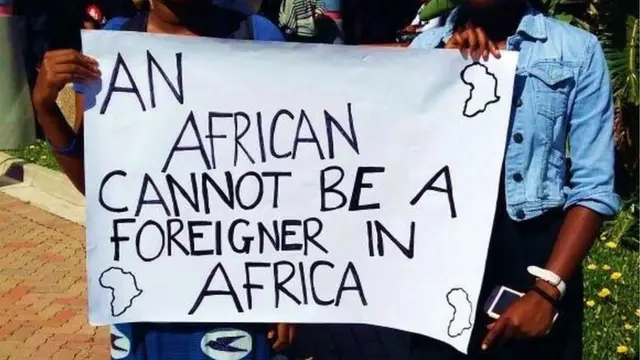
Few tragedies are as unsettling as a liberation learning to fear those who once helped sustain it.
In South Africa, that irony is no abstraction. It lives in the uneasy space where continental solidarity collides with recurring hostility toward African migrants, where a freedom once imagined in expansive moral terms sometimes appears to narrow under the pressures of economic frustration and wounded national expectation.
That contradiction should disturb far more than South Africa, because it reaches beyond the politics of immigration into a larger question about memory, belonging, and the moral afterlife of liberation itself. What becomes of a freedom struggle when it begins, even in fragments, to look upon former allies as intruders.
That is not merely a political question.
It is a civilizational one.
South Africa’s democratic victory was never solely South Africa’s achievement. It was sustained across borders, in exile communities, in solidarity campaigns, in African capitals that housed those fleeing repression, in ordinary citizens across the continent who understood apartheid not simply as a South African burden, but as an African wound.
Freedom in South Africa was not born in isolation.
It was carried.
And that memory should matter.
Not as nostalgia.
As political ethics.
Because nations do not lose themselves only when they forget their enemies.
Sometimes they lose themselves when they forget their allies.
That may be the hardest truth shadowing the current moment.
To speak honestly about xenophobic violence is not to deny social strain, unemployment, crime, weak institutions, or the anxieties migration can provoke in unequal societies. Those pressures are real and deserve serious treatment.
But xenophobia is rarely only about foreigners.
It is often economic despair wearing the mask of nationalism.
It is grievance speaking through the wrong target.
And that is where tragedy begins.
For when structural frustrations go unresolved, anger often searches not for the most powerful object, but for the nearest vulnerable one. The migrant then ceases to be a person and becomes a symbol, a vessel into which broader disappointments are poured.
This is one of history’s oldest evasions.
When societies cannot fully confront the architecture of their distress, they sometimes attack those least responsible for constructing it.
And in doing so, they mistake scapegoating for sovereignty.
That mistake has consequences.
Because the migrant is often easier to fight than inequality.
Easier to blame than broken governance.
Easier to confront than the long afterlife of structural exclusion.
And so a disturbing question emerges.
Why does public fury so often travel downward.
Why is the outsider cast as invasion while deeper concentrations of power and inherited inequity generate less sustained political rage.
Why is the foreign trader a target while systems that reproduce abandonment often survive with remarkable resilience.
These are not accusations.
They are democratic questions.
And democracies decay when such questions cannot be asked.
This is partly why the contradictions within South Africa matter so much. They force reflection not merely on migration, but on selective confrontation itself.
Why, for example, do some forms of perceived encroachment trigger moral panic while other forms of exclusion, older and structurally embedded, are endured with strange familiarity.
Why is one boundary fiercely defended while another is normalized.
Power often hides in what outrage chooses not to see.
That is not a South African problem alone.
It is a human one.
Yet for South Africa it carries particular weight, because liberation movements are often tested less by the oppression they resist than by the moral horizons they preserve once power is won.
Sometimes the deepest test of freedom begins after freedom.
And perhaps that is where this moment sits.
For the question is no longer merely whether South Africa faces xenophobia.
It plainly does.
The question is whether a liberation can remain faithful to the breadth of imagination that made it possible.
Can freedom remain expansive under pressure.
Can hardship resist shrinking solidarity.
Can the wounded refuse the temptation to wound sideways.
These are not abstract questions.
They may determine whether liberation matures or contracts.
History is unsparing here.
A freedom that begins to narrow its circle of belonging often does not stop where it first intends.
Exclusion has a habit of expanding.
And societies that normalize hostility toward the vulnerable often discover too late that they have legitimized a politics far more dangerous than grievance.
Because resentment rarely remains where it begins.
It travels.
That is why this conversation is larger than South Africa.
It asks whether Pan African solidarity was only useful in the age of struggle, or whether it still possesses moral meaning in the age of disappointment.
That is the real argument.
And it is an argument about Africa itself.
Because if Africans begin to imagine one another principally as demographic threats rather than participants in a shared historical destiny, something older than migration politics starts to fracture.
An idea begins to erode.
The idea that freedom on this continent was never meant to end at borders.
The idea that colonial partitions did not define the limits of solidarity.
The idea that shared struggle created obligations deeper than convenience.
Those ideas matter.
Perhaps more now than ever.
Because memory is not decorative in politics.
Memory is protective.
It reminds societies who stood beside them when survival was uncertain.
It protects nations from mistaking fear for realism.
It guards against moral amnesia.
And without it, freedom can become narrower than the struggle that birthed it.
Victory risks becoming smaller than the vision that achieved it.
That line should haunt us.
Because it names a danger larger than xenophobia.
It names the possibility of liberation forgetting itself.
And perhaps that is what makes this moment feel so consequential.
Not because anti immigrant hostility is new.
But because every recurrence raises the same unsettling question.
What happens when the heirs of solidarity begin to distrust solidarity.
What happens when the memory of shared struggle grows thin.
What happens when a people once scattered across the continent begin to speak of fellow Africans as intrusion.
Those are not minor tensions.
They are warnings.
A liberation that forgets who stood beside it does not simply wound solidarity.
It risks diminishing the meaning of freedom itself.
And history has rarely been gentle with nations that confuse exclusion with strength.
Freedom seldom betrays its ideals all at once.
It recedes through smaller permissions.
One scapegoat tolerated.
One resentment normalized.
One solidarity abandoned.
One memory thinned.
Until what once looked temporary begins to resemble political character.
And by then the argument is no longer about migrants.
It is about the moral boundaries of freedom.
That is always a dangerous place for any democracy to stand.
And perhaps that is why this must be said plainly.
The foreigner is not always the deepest threat a nation faces.
Sometimes forgetting is.
Sometimes fear is.
Sometimes the gravest danger to a liberation is not what comes from outside its borders, but what hardens quietly within them.
That may be the most urgent lesson of all.
Because a freedom worthy of its history should be large enough to remember who helped make it possible.
And wise enough not to turn against them.
Stephanie Shaakaa
08034861434


