

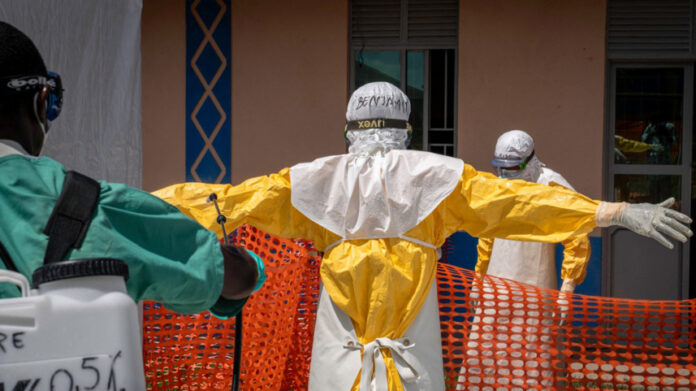
The United States has announced additional funding and support for the Ebola response in the Democratic Republic of Congo (DRC) and Uganda as health officials work to contain an outbreak caused by the rare Bundibugyo strain of the virus.
In a media note released on Friday, June 5, 2026, the U.S. Department of State said it is providing nearly $38 million in new funding, bringing its direct contribution to the Ebola response to more than $200 million.
The department said this is separate from $350 million in Ebola response and humanitarian assistance for the DRC, South Sudan and Uganda, which forms part of the United States’ $1.8 billion contribution to the United Nations Office for the Coordination of Humanitarian Affairs (OCHA) announced on May 14.
“The United States continues to be the largest financial contributor to the Ebola response,” the department said.
The U.S. said its efforts are focused on protecting Americans and supporting regional health authorities through partnerships with the U.S. Centers for Disease Control and Prevention (CDC), the governments of the DRC and Uganda, and international organisations.
In the DRC, U.S.-funded partners are supporting contact tracing, airport screening, infection prevention, community education and treatment efforts. The International Organization for Migration (IOM) has procured thermo-scanners, communications equipment and sanitation supplies for airports, while UNICEF has distributed water, sanitation and infection control materials to three Ebola treatment centres and 28 high-risk health facilities.
The department also said U.S.-funded partners recently identified and reached dozens of contacts linked to confirmed Ebola cases in Bunia. World Vision has reached more than 400,000 people through awareness campaigns and trained nearly 400 community volunteers and health workers on Ebola detection and prevention.
Momentum Integrated Health Resilience is training more than 1,500 healthcare workers, sanitation workers, teachers, religious leaders, traditional healers and community leaders in Goma and five other health zones near border areas.
In addition, International Medical Corps (IMC) has trained 125 frontline and community health workers and supported clinics that have screened 540 people for Ebola. The World Food Programme is providing food assistance to patients, caregivers, contacts and healthcare workers in treatment and isolation centres.
Uganda is also receiving support as authorities seek to prevent further spread of the virus. The IOM has deployed more than 100 screeners and data clerks at 13 border entry points to strengthen health screening and surveillance.
Meanwhile, the World Health Organization (WHO) and the Africa Centres for Disease Control and Prevention (Africa CDC) have launched a $518 million six-month emergency response plan for the DRC, Uganda and neighbouring countries.
WHO Director-General Tedros Adhanom Ghebreyesus called for greater international support to stop the outbreak.
“The World Health Organization chief announced a $518 million six-month joint plan to fight Ebola on Friday, calling for money and political commitment to halt the spread of an outbreak that is already the fourth biggest on record,” a Reuters report said.
Africa CDC Director-General Jean Kaseya described the situation as “the most serious Bundibugyo Ebola outbreak recorded to date.”
According to figures cited by WHO and Africa CDC, the DRC has recorded 381 confirmed Ebola cases and 62 deaths, while Uganda has reported 19 confirmed cases and two deaths. WHO later revised the DRC figures released by Congolese authorities on June 1 to 321 confirmed infections, 48 deaths and six recoveries.
Health officials say the Bundibugyo strain presents additional challenges because there is no approved vaccine or specific treatment. They also cited delays in laboratory testing, community resistance and attacks on burial teams and treatment centres as obstacles to containing the outbreak.
The outbreak was declared a global health emergency on May 17, 2026, after cases were confirmed in Ituri Province in the DRC and cross-border spread was later reported in Kampala, Uganda.
The Ebola response has also affected regional trade. On June 6, traders at the Uganda-DRC border told Al Jazeera that tighter health restrictions had left trucks stranded and perishable goods rotting, causing significant financial losses as authorities stepped up measures to prevent the virus from crossing into Uganda.
Despite the regional outbreak, the Nigeria Centre for Disease Control and Prevention (NCDC) says no confirmed Ebola case has been recorded in Nigeria, while the Federal Airports Authority of Nigeria (FAAN) has continued screening and surveillance at international airports as a precaution.


