

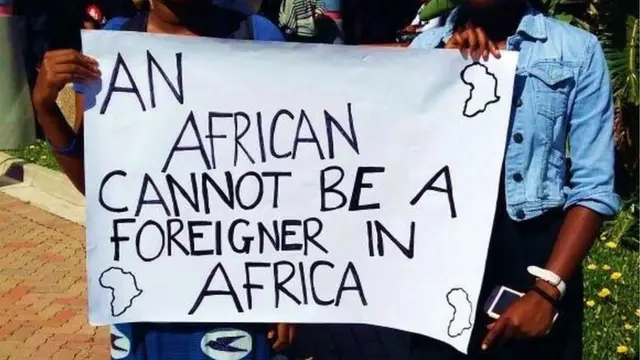
For decades, Nigeria has provided the fertile soil upon which South African corporate giants have built their global empires. From the digital signals of our telecommunications to the retail aisles of our burgeoning cities, Nigerian patronage is the lifeblood of South African commercial expansion. Yet, a bitter contradiction has emerged that threatens the very fabric of continental integration: while Nigerian naira is embraced with open arms in Johannesburg’s boardrooms, Nigerian bodies are too often met with hostility and fire on its streets. We are forced to confront a hard truth: a relationship that demands our markets but rejects our people is not a partnership,it is a paradox that can no longer be ignored.
The depth of this paradox is revealed in the sheer, unrivaled scale of Nigerian loyalty.
Consider the landscape of our daily lives and the economic oxygen we provide. There is no mobile network in this country more patronized than MTN, which commands over 50 percent of the market with nearly 94 million subscribers. For MTN, Nigeria is not a mere “territory”; it is the engine of its global profit, a lifeline that has sustained the group even when its home economy faltered. In the world of media, there is no platform more patronized than MultiChoice, where DStv and GOtv have made Nigerian living rooms the most lucrative territory in their portfolio. From the financial corridors where Stanbic IBTC manages the nation’s wealth, to the retail floors of Shoprite and PEP, South African brands enjoy a level of dominance that local competitors envy. They are woven into the fabric of our daily lives, kept standing by the hard-earned money of a people who have offered them unparalleled hospitality and market access.
However, the most painful part of this narrative is not just the external hostility, but the internal indifference of the Nigerian state. The recurring waves of xenophobic attacks, the lives extinguished and the businesses worth millions of dollars reduced to ash did not start today. They have become a grisly, predictable cycle. Yet, we are met with a deafening silence from the Nigerian government and its diplomatic missions. It is a staggering irony that President Bola Ahmed Tinubu currently chairs the African Union, a body founded on the ideals of “one Africa.” What stops a “Giant of Africa” from using that influence to demand accountability, to impose sanctions, or to downgrade diplomatic ties as a signal that an attack on a citizen is a direct assault on the nation’s sovereignty?
One is tempted to conclude that the reason for this silence is that the political elite remains insulated from the reality of the streets. Their loved ones do not walk the precarious paths of Pretoria’s outskirts, and their business interests remain protected by high-level bilateral agreements. It is a tragic indictment of our leadership that they only seem to find their voice when their own comfort is threatened. It appears there is no nation on earth with less regard for the sanctity of its citizens’ lives than this colonial-era creation we call home. If our government will not rate us, the citizens, then we are left with no choice but to rate ourselves.
This is a fundamental crisis of the “African Dream.” If the African Continental Free Trade Area (AfCFTA) is to mean anything, it cannot be a one-way bridge where South African capital flows north while Nigerian lives are hunted in the south. We are told that the future of the continent depends on the free movement of goods, services, and people. Yet, in practice, we see a disturbing hierarchy.South African goods move freely, but Nigerian people move at their own peril. Relationships between nations must be governed by the iron-clad principle of reciprocity. It is the unspoken contract of diplomacy: I open my doors to your capital, and you ensure the safety of my people. You cannot systematically reject a people in your streets while simultaneously embracing their money in your markets.
These corporate giants MTN, MultiChoice, Stanbic possess immense lobbying power in Pretoria. They are not mere bystanders; they are stakeholders in the South African state. If their bottom lines are tied to Nigerian peace and patronage, they have a moral and financial obligation to ensure their home government protects the very people who fund their dividends. Until a Nigerian can walk through Johannesburg with the same ease that a South African business operates in Lagos, the “Pan-African brotherhood” remains a hollow marketing slogan, a tool for corporate PR rather than a lived reality.
Respect is the currency of international relations, and for too long, Nigeria has been operating with a deficit. We do not seek a trade war, but we must demand a peace that includes us. We must remind both our leaders and our “partners” that patronage is not a birthright,it is an earned privilege. When the respect is no longer mutual, the patronage must no longer be automatic. If the Nigerian consumer is the king of the African market, then it is time for the king to demand the dignity that his crown deserves.
#BoycottSAownedbusinessesNow
Stephanie Shaakaa
08034861434


