


In the marble halls of the Nigerian Senate, where the air is cool and the chairs are upholstered in leather, a story of profound betrayal is unfolding. It is a story about money—hundreds of billions of naira—and it is a story about children.
On Wednesday, December 10, 2025, the calm veneer of a Senate Ad-hoc Committee hearing was shattered. The subject was the Safe Schools Initiative (SSI), a program born from the collective heartbreak of a country after 276 schoolgirls were stolen from Chibok in 2014. The initiative was a promise: never again. It was a vow backed by the world, funded by global powers, and entrusted to the Nigerian government to build a fortress around the country’s most vulnerable citizens.
But more than a decade later, that fortress is a mirage.
Senator Orji Uzor Kalu, the committee chairman, did not mince words. Facing Hajia Halima Iliya, the National Coordinator of the Financing Safe Schools office, he demanded answers to a simple, devastating question: Where did the money go?
The hearing exposed a catalogue of financial chaos. The committee raised alarms over “questionable consultancy spending” and a lack of verifiable records. In 2023 alone, the Federal Government released ₦15 billion for the project. The breakdown of this disbursement is a study in bureaucratic opacity: ₦6.225 billion to the Police, ₦3.362 billion to the Civil Defence Corps, ₦2.250 billion to the Defence Headquarters.
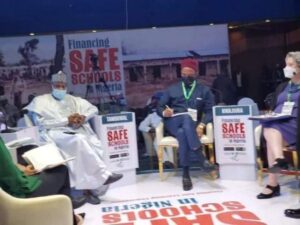
Yet, as the senators grilled the coordinator, a tension bordering on hostility filled the room. When Senator Oluranti Idiat questioned why nearly half of a ₦4.44 billion tranche appeared to have been swallowed by “consultancy and operational costs”—money spent on talking about safety rather than building it—the response was defensive, leading to a sharp rebuke.
“You’re not doing us a favour,” Senator Idiat fired back. “Please withdraw that statement.”
This parliamentary drama is not just political theatre. It is the echo of a national tragedy. While officials in Abuja argue over spreadsheets and consultancy fees, the reality on the ground is a landscape of terror.
Since the Chibok abduction, the attacks have not stopped; they have accelerated. Bandits and terrorists have turned schools into hunting grounds. In the last decade alone, over 2,000 students have been kidnapped. Approximately 800 schools in the northern region have been forced to shut down, their classrooms empty, their playgrounds silent.
The promise of the Safe Schools Initiative was safety. The reality is a generation of children learning to listen for the sound of gunfire.
A History of High Hopes and Broken Promises:
To understand the depth of this scandal, one must look back at the optimism that birthed it. The SSI was launched with fanfare, a coalition of Nigerian business leaders working alongside global heavyweights like former British Prime Minister Gordon Brown. The world opened its wallet.
The financial trail is immense. In 2014, the Presidential Committee on North-East Intervention raised ₦80 billion. Contributions flowed in from everywhere: $1.5 million from Norway, $1 million from the African Development Bank, £1 million from the UK, $10 million from Nigerian businesses. In 2015, Switzerland, the US, and Qatar added millions more.
By 2020, reports indicated that at least $30 million had been specifically raised for the SSI. The government claimed success, citing 2,000 students in the North-East benefiting from the scheme.
But these numbers crumble under scrutiny.
Data from the government’s own National Financing Plan reveals a shocking gap between the funding and the infrastructure. Across northern Nigeria, more than 42,000 primary and secondary schools remain without perimeter fencing. They are wide open.
In Bauchi alone, 574 secondary schools are unfenced. In Kano, 500. In Katsina, the ex-President Buhari’s home state, 145 schools stand vulnerable. The situation at the primary level is even more dire, with nearly 39,000 schools lacking basic walls.
This is not just a lack of funds; it is a failure of deployment. How can billions of naira be released for “safe schools” when the most fundamental safety measure—a wall—is missing from tens of thousands of institutions?
The “Consultancy” Trap:
The Senate hearing peeled back the layers of this failure, revealing a systemic rot. Senator Kenneth Eze raised fears of “possible misappropriation,” noting that the financial submissions from the agency lacked “clarity and authenticity.”
The issue of “consultancy” is particularly galling. In the development sector, consultancy fees are often the black hole where project funds vanish. Senator Idiat’s query—why half of a multi-billion naira allocation went to operational costs rather than tangible security—strikes at the heart of the problem.
It suggests a program that has become an industry unto itself, feeding a network of contractors and consultants while the beneficiaries—the children—are left exposed.
Hajia Iliya, in her defense, outlined the contributions and the plans. She spoke of a ₦144.8 billion investment plan for 2023-2026. She listed the donors: the African Development Bank, the German Government, UNICEF. She detailed the 2023 disbursements to security agencies.
But she also revealed a stunning bureaucratic failure: the Safe Schools Financing Office had no budgetary allocation for 2024 and 2025 because its request was “submitted too late.”
In a country where children are being kidnapped weekly, the agency responsible for their safety missed the budget deadline.
The Human Cost of Bureaucracy:
While the Senate demands a “full reconciliation” of accounts, the human toll continues to mount. The timeline of abductions is a relentless drumbeat of horror.
From the 59 boys burned alive in Buni Yadi in 2014 to the 276 girls of Chibok. From the 110 girls of Dapchi to the 300 boys of Kankara. From the students of Kagara to the girls of Jangebe. The list goes on—Bethel Baptist, Tegina, Birnin Yauri, Kuriga.
Each name on that list represents a child traumatized, a family broken, and a community living in fear.
Recently, another 303 students and teachers were reported kidnapped in Niger State. In Kebbi, 25 schoolgirls were taken. The response from the government has been a retreat. Across the north, governors are ordering schools to close. In Zamfara, Katsina, Niger, and Benue, education has been suspended.
This is a victory for the terrorists. Their ideology—that “western education is forbidden”—is being achieved not by winning hearts and minds, but by making the cost of education too high to bear.
Parents are now faced with an impossible choice: send their children to school and risk them being taken, or keep them home and deny them a future.
A Crisis of Coordination:
Experts point to a fundamental structural flaw in the SSI. Who is actually in charge?
The National Safe Schools Response Coordination Centre is led by the Nigeria Security and Civil Defence Corps (NSCDC). But the Nigeria Police Force holds the constitutional power for internal security. The military intervenes in mass abductions. State governments own the school infrastructure. Communities are asked to provide intelligence.
This overlapping web of responsibility has created a vacuum of accountability.
“Let me not pretend to even know how many schools were ever touched at all,” says legal practitioner Kunle Ayeni, reflecting the public’s cynicism. “Let alone what the components of such safety were meant to be.”
According to data. John Obunde, a security expert, questions why the Ministry of Finance is overseeing a security and education initiative. He argues that this financial-first approach has sidelined the educational expertise needed to make schools truly safe. The lack of a unified, clear chain of command means that when an attack happens, the response is often chaotic and slow, allowing bandits to operate for hours with impunity.
The Demand for Answers:
The Senate has vowed that “no further steps would be taken” until complete records are provided. Senator Kalu has ordered a forensic audit of the CBN Trust Fund account.
This is a necessary first step. But for the parents of the missing, and for the millions of children currently out of school, it is not enough.
Civil society groups like “Education for All” are demanding more. They want a public accounting of every dollar and every naira. “With over $20 million in donations and pledges,” says leader Emily Owoeye, “Nigerians deserve to know how the funds were used.”
The Safe Schools Initiative was meant to be a shield. Instead, it has become a sieve. The money has poured in, and the money has poured out, but the walls remain unbuilt, the guards remain absent, and the children remain vulnerable.
As the Senate investigation deepens, the question is no longer just about financial irregularity. It is a question of moral complicity. Every naira diverted from a school fence into a consultant’s pocket is a breach in the defenses of a child. Every bureaucratic delay that leaves a school unguarded is an invitation to tragedy.
The Chibok girls were the spark that lit this initiative. A decade later, their legacy is being squandered in committee rooms and bank transfers. The Nigerian government must now answer: is the Safe Schools Initiative a program to protect children, or is it just another “business as usual” scheme built on their suffering? The answer will determine the future of education in Nigeria. And for thousands of children, it is already a matter of life and death.
Onwumere is Chairman, Advocacy Network On Religious And Cultural Coexistence (ANORACC)


