

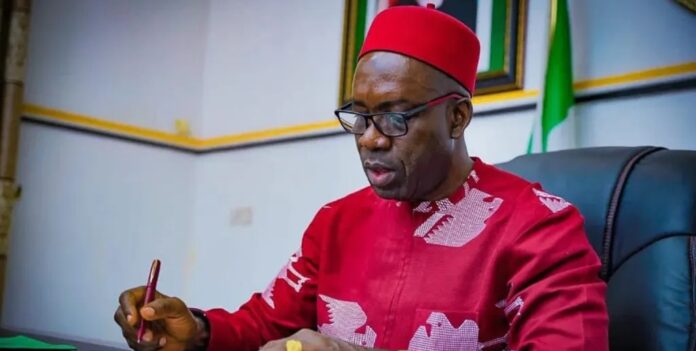
There is an old saying that intelligence can open doors, but wisdom determines which doors are worth entering. Few Nigerian public officials embody this paradox more profoundly than Professor Charles Chukwuma Soludo, the Governor of Anambra State.
By every measurable standard, Soludo is an intellectual giant. A former Governor of the Central Bank of Nigeria, distinguished economist, professor, public policy strategist, and one of the most celebrated technocrats of his generation. He entered the political arena with an enviable reputation. To many Nigerians, particularly Ndi Anambra, his emergence as governor in 2022 symbolised the triumph of competence over mediocrity.
Today, however, a troubling question confronts many observers of Nigerian politics: what happens when a technocrat begins to mistake eloquence for wisdom, visibility for leadership, and political theatre for statesmanship?
The answer may well lie in Governor Soludo’s increasingly controversial interventions in national politics, the latest being his now infamous “cow-tail” metaphor delivered during a gathering of political leaders in Abakaliki on Nigeria’s Democracy Day.
The Anambra governor joined a chorus of political voices endorsing President Bola Ahmed Tinubu of the All Progressives Congress (APC) for a second term in office. While political endorsements are not unusual in a democracy, it was Soludo’s justification that ignited controversy.
According to the governor, Ndigbo should embrace political reality. Rather than miss the “cow” entirely, he argued, it would be wiser to cut and preserve the “tail.” The statement was simple; its implications were profound.
For many Nigerians, particularly in the Southeast, the metaphor sounded less like political strategy and more like political surrender. It suggested a troubling philosophy: that Ndigbo should recalibrate their aspirations downward, abandon the pursuit of the presidency, and settle for whatever fragments the existing political arrangement is willing to concede.
The metaphor immediately raised a disturbing question: if the tail is the objective, who then owns the cow?
Political groups do not rise by normalising limitations. They rise by expanding possibilities. No ambitious people have ever secured their future by playing second fiddle. The tragedy of the “cow-tail” doctrine is not merely its symbolism; it is the dangerous psychology beneath it.
For decades, the Southeast has complained about political marginalisation, exclusion from strategic decision making, and unequal access to power. Yet, instead of challenging these realities, Soludo’s proposition appeared to many as an invitation to accommodate them.
History offers few examples of peoples who achieved political relevance by embracing permanent second-class aspirations. The Southwest did not secure its present influence by negotiating for tails; it pursued the entire cow. The North has never organised its politics around fragments. Neither has the Southwest. Why then should the Southeast adopt a philosophy of political leftovers?
Perhaps even more troubling is the contradiction between Soludo’s intellectual pedigree and the message he now appears to champion. This is the same Soludo whose public career was built on challenging conventional wisdom. The same Soludo who once represented innovation, ambition, and transformative thinking.
Today, however, he appears less interested in expanding political possibilities than in managing political expectations. That transformation explains why many critics increasingly describe him as a political contrarian rather than a reformer.
There is nothing inherently wrong with being contrarian. Independent thinking is often essential for leadership. However, contrarianism becomes problematic when it appears detached from the aspirations and sentiments of the people one seeks to lead.
Governance is not theatre, and leadership is not performance art. Several years into his tenure as governor, a more complicated picture of Soludo’s leadership emerged. The debate surrounding him is no longer about whether he is brilliant. That question was settled long ago. The real question is whether intellectual brilliance automatically translates into political wisdom.
Increasingly, many Anambra citizens and political observers are beginning to conclude that the two are not necessarily the same. History ultimately judges leaders not by the brilliance of their metaphors but by the substance of their convictions. This is where Soludo’s critics find cause for concern.
Beyond governance controversies lies an even more consequential issue: his increasingly public disagreements with Peter Obi, former Governor of Anambra State and the presidential candidate of the Nigerian Democratic Congress (NDC) in the coming election.
His recent comments regarding Obi have created the impression of a politician engaged in a prolonged effort to diminish the appeal of a fellow son of Anambra. Whether dismissing Obi’s presidential prospects, questioning his proposals, or criticising positions he advances on national issues, Soludo often appears unwilling to acknowledge the scale of a political movement that has attracted millions of supporters across ethnic, religious, and regional divides.
Peter Obi’s appeal today extends far beyond the narrow confines of ethnic politics. Millions of Nigerians support him not because he is Igbo, but because they perceive him as embodying values they believe are missing in contemporary governance: prudence, accountability, transparency, and fiscal discipline.
One may disagree with Obi’s proposals, including his one-term presidency proposition. One may question aspects of his political strategy. Yet reducing his movement to an ethnic project risks misunderstanding its national character.
The conversation Nigeria is having is not fundamentally about which region produces the next president. It is about competence. It is about credibility. It is about trust. In that conversation, metaphors about tails and fragments appear strikingly out of place.
The deeper issue is that Soludo’s comments reveal a widening gulf between political calculation and popular aspiration. While ordinary citizens grapple with inflation, insecurity, unemployment, declining purchasing power, and economic hardship, political elites remain preoccupied with succession arrangements, future alliances, and positioning for offices that are not yet vacant. The optics are damaging. Citizens want solutions; politicians debate permutations. Citizens seek hope; politicians offer metaphors.
Perhaps that is why the Abakaliki episode resonated so negatively. It reinforced a growing perception that many political leaders have become detached from the economic and emotional realities confronting the people they govern.
Even more striking is the contrast between Soludo’s current political posture and the strategic vision associated with the late Ikemba Nnewi, Dim Chukwuemeka Odumegwu Ojukwu, Eze Igbo Gburugburu.
Ojukwu understood the importance of coalition building. He recognised that political power in Nigeria requires negotiation, alliances, patience, and strategic compromise. Yet he never advocated the abandonment of a people’s aspirations. There is a profound difference between strategic compromise and psychological surrender. One seeks the best route to a destination, while the other abandons the destination altogether. That distinction appears increasingly blurred in the current debate.
The greatest disappointment for many observers is not that Soludo has taken a political position. Politicians are entitled to political positions. The disappointment lies in the perception that one of Nigeria’s brightest technocratic minds has increasingly chosen political spectacle over intellectual leadership.
Political leadership demands more than superior intellect. It requires empathy, emotional intelligence, coalition building, consensus management, and an instinctive understanding of how policies affect ordinary people.
Another issue that illustrates this tension is the recurring controversy surrounding urban renewal and demolition exercises across Anambra State. Critics contend that some of the administration’s initiatives have been implemented with insufficient consultation and inadequate sensitivity to the economic realities of affected citizens.
The controversy surrounding the demolition of shops in Onitsha Main Market became a flashpoint in public discourse. Traders, market leaders, and stakeholders appealed to the government to reconsider aspects of the exercise, warning of severe economic consequences for thousands of families whose livelihoods depended on the affected structures.
The government of Professor Soludo maintained that the exercise was necessary for urban renewal and the removal of illegal structures. Yet the backlash exposed a growing disconnect between policy objectives and public sentiment. This pattern has become a recurring feature of the Soludo administration.
Many of his policies may be technically sound on paper, but politics is rarely governed by spreadsheets and economic models alone. People do not experience government through policy documents. They experience it through consequences, through livelihoods and through survival.
This is where the distinction between intellectual brilliance and political wisdom becomes most visible. A technocrat often asks, “Is this policy correct?” A political leader must also ask, “Can the people live with it?” The two questions are not always the same.
What makes these developments particularly unfortunate is that Soludo once represented a rare bridge between intellectual excellence and public trust. He was seen as a thinker capable of rising above petty political rivalries, a statesman capable of elevating public discourse, and a leader able to bring uncommon depth to governance.
Today, however, many observers worry that the professor is gradually allowing partisan calculations to overshadow the statesmanship expected of him. The danger of exceptional intelligence is that it sometimes breeds excessive confidence.
Governance demands something more: wisdom, humility, restraint, and a willingness to listen. It requires the ability to recognise that even the most elegant argument can fail if it loses touch with human realities.
This is not to diminish Soludo’s accomplishments. Anambra has witnessed significant investments in infrastructure, security initiatives, and urban development under his administration. His intellectual contributions to national discourse remain substantial, and his economic credentials remain formidable.
But intellectual brilliance alone does not guarantee political wisdom. Sometimes, the greatest threat to gifted leaders is not their enemies. It is the seductive belief that they can never be wrong.
And when that belief takes hold, the line between statesmanship and showmanship becomes dangerously thin.
The tragedy, therefore, is not merely Soludo’s controversial metaphor. The tragedy is watching a respected technocrat risk his legacy in a dance with hubris while the public wonders whether the performance has begun to overshadow the purpose of leadership itself.
The question that remains unanswered is whether wisdom will ultimately prove equal to his intellect.
For in politics, as in life, the brightest minds do not always leave the greatest legacies.
More often, it is those who understand people as deeply as they understand ideas.
Kalu Okoronkwo is a communications strategist, a leadership and good governance advocate dedicated to impactful societal development and can be reached via kalu.okoronkwo@gmail.com.


