

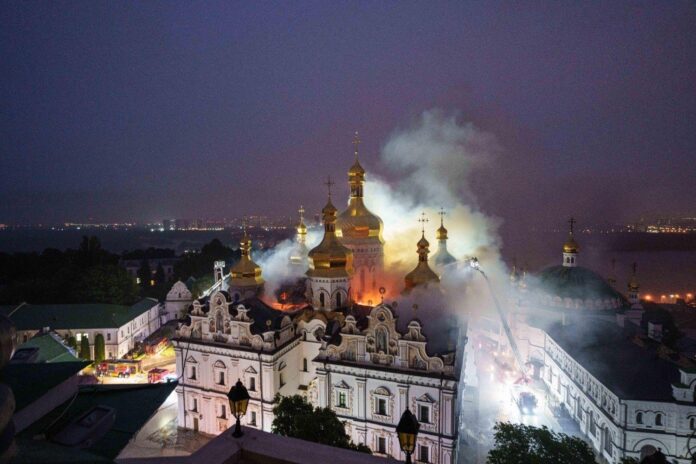
A large Russian missile and drone attack damaged one of Ukraine’s most important religious and cultural landmarks on Monday, setting the Dormition Cathedral at the Kyiv Pechersk Lavra monastery on fire and killing at least nine people across the country.
The monastery, founded in 1051, is nearly 975 years old and is listed as a UNESCO World Heritage Site. It is regarded as one of the birthplaces of Eastern Orthodox Christianity in the region and remains a symbol of Ukrainian history and identity.
According to Ukrainian authorities, Russian missiles and drones struck central Kyiv during one of the heaviest attacks on the capital in two weeks.
The strike ignited the roof of the Dormition Cathedral, leaving part of the structure destroyed and creating a large hole in one wall. Firefighters surrounded the complex with more than a dozen fire engines and aerial platforms to bring the blaze under control.
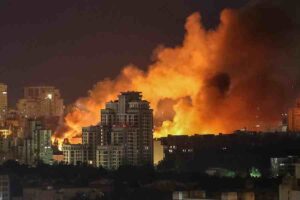
The attack also damaged nearby apartment buildings, markets and electricity infrastructure, leaving around 140,000 residents without power.
Emergency officials said four people died in Kyiv, while five rescue workers were killed in a second strike in Kharkiv after they arrived to fight earlier fires.
The Kyiv Pechersk Lavra is one of Ukraine’s oldest monasteries and a major center of Orthodox Christianity.
Its importance has grown beyond religion since Russia launched its full-scale invasion in 2022. The Orthodox Church of Ukraine formally broke away from the Russian Orthodox Church that year, and the Ukrainian government later banned the branch linked to Moscow.
The Russian Orthodox Church has openly supported Russian President Vladimir Putin and his military campaign in Ukraine.
Russia has not said it deliberately targeted the monastery.
Ukraine says the cathedral suffered a direct strike during the missile barrage.
Head of Kyiv’s military administration Tymur Tkachenko described it as a “direct strike” on a UNESCO site.
Prime Minister Yulia Svyrydenko condemned the attack, writing on X:
“A brutal assault on our people and our heritage. This is the true face of Russia’s Orthodox values.”
Metropolitan Epiphanius, head of the Orthodox Church of Ukraine, called the strike:
“A crime against humanity, history and Christianity.”
Russia has consistently denied deliberately targeting civilian or cultural sites throughout the war, saying it attacks military objectives. Reuters noted that it could not independently verify the competing claims.
The latest Russian assault came as Ukraine continued its own attacks inside Russia.
Officials in Russia’s Tula region said a Ukrainian drone strike killed three people and injured three others, including a one-year-old child.
Ukraine has also increased attacks on Russian energy and industrial facilities in an effort to reduce the revenues that help finance Moscow’s war effort.
Both countries continue to exchange drone and missile attacks almost daily.
Peace efforts remain slow
The attacks happened one day after Ukrainian President Volodymyr Zelensky and Russian President Vladimir Putin separately spoke with US President Donald Trump.
Zelensky said the conversation covered “things that could help bring about peace now,” while the Kremlin said Trump stressed that ending the conflict was important and offered to help.
Despite those contacts, negotiations have made little progress.
Diplomatic attention has recently focused on the Middle East, where the United States and Iran announced a peace framework expected to be signed on June 19 in Geneva.
Is there no end to the war?
More than four years after Russia launched its full-scale invasion in February 2022, neither side appears close to achieving its military objectives.
Ukraine continues to demand the restoration of its territorial integrity and stronger security guarantees, while Russia maintains control over occupied areas and has rejected proposals for direct ceasefire talks backed by Ukraine and several European countries.
For now, the war remains Europe’s largest armed conflict since World War II, with no comprehensive peace agreement in sight and civilians on both sides continuing to suffer the cost.


