

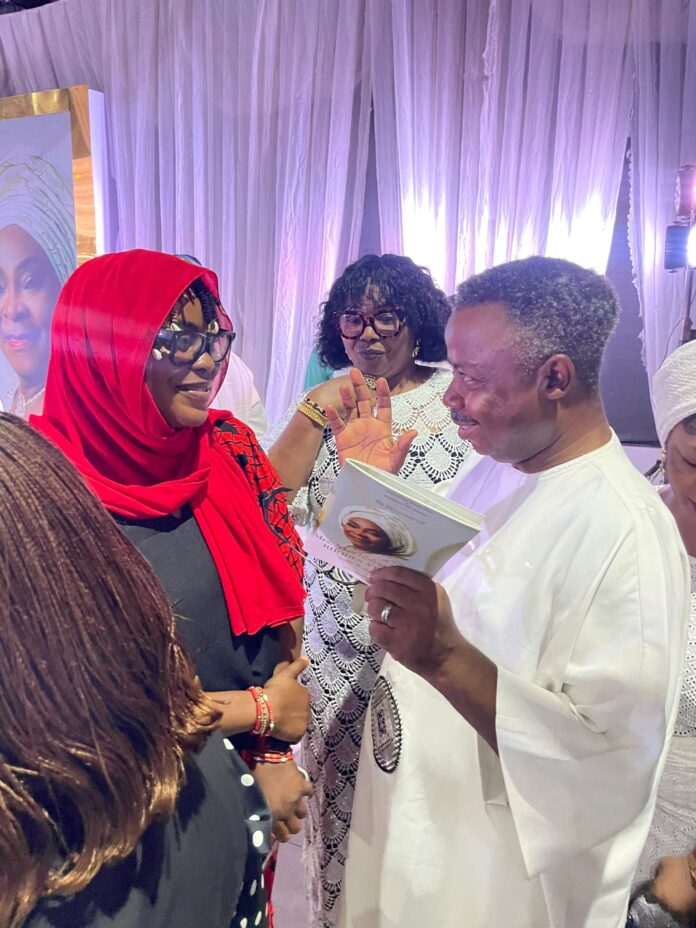
I attended the Service of Songs and Night of Tributes in honour of the late Mrs. Nkechinyere Rhodes-Vivour, the beloved mother of Gbadebo Rhodes-Vivour.
It was an evening filled with dignity, laughter, tears, memories and lessons that stretched far beyond one family. Beautiful tributes flowed from every direction, each revealing another layer of a woman whose life quietly united people across ethnic, political and social divides.
Earlier that same day, I had appeared on the maiden edition of WHOODX, the new podcast hosted by Olaemma Opara, popularly known as Signature. One of our conversations centred on what I described as “elder worship” and, inevitably, the discussion drifted to the divisive politics of 2023.
Many will remember how Gbadebo Rhodes-Vivour suddenly became “Chinedu” in political propaganda. His maternal ancestry was weaponised in an attempt to erase his paternal heritage and indigenous identity as a Lagos Island son. It was one of the lowest moments of our political culture. When politics descends to questioning a man’s identity because of his mother, society has travelled too far from decency.
Thankfully, grace prevailed, and he weathered the storm.
Yesterday, it was that very mother we had gathered to honour.
Mrs. Nkechinyere Rhodes-Vivour (16 June 1957 – 10 July 2026) represented something far greater than political labels. She was a matriarch in every sense of the word, a grassroots mobiliser, a political force, and a rallying point for many people from the South East and South South residing in Lagos. Yet she was equally embraced by her Yoruba in-laws on Lagos Island and beyond.
Throughout her life, she built friendships wherever she went—through school, work, family, and community. She became, in many respects, a miniature Nigeria. There was room in her heart for everyone.
But the most unforgettable tribute of the evening came from her sister-in-law, Mrs. Peju Rhodes-Vivour.
Peju, a proud Yoruba woman married to an Igbo husband, narrated one of the earliest cultural “crises” in her marriage.
One day, she lovingly prepared beans for her husband.
His response?
“No! No!! No!!!”
“This is not how beans are cooked.”
“This is not how beans are eaten.”
One would have thought constitutional amendments were about to begin over a plate of beans.
Determined to save both the marriage and the menu, Peju turned to Nkechi.
“Nkechi, please teach me how Igbo people cook beans.”
Lessons began. Adjustments were made. Peace returned to the dining table.
Then history decided to demonstrate its impartiality.
Not long afterwards, Nkechi herself prepared beans for her husband, Wale Rhodes-Vivour, a proud freeborn Lagos Island Yoruba gentleman.
The aroma was excellent.
The presentation was beautiful.
The love behind it was unquestionable.
Then came the verdict.
“No! No!! No!!!”
“This is not Yoruba beans.”
Apparently, even beans possess citizenship.
This time, it was Nkechi who became the student while Peju assumed the role of teacher.
The Yoruba way was learnt.
Peace returned once again.
As everyone laughed at the story, I realised something profound.
Many of the conflicts we elevate into ethnic battles are, in reality, little more than disagreements over how we cook our beans.
The tragedy is not that our methods differ.
The tragedy is that we often refuse to learn from one another and embrace better ways of doing things.
If only our Pejus would willingly learn from our Nkechis, and our Nkechis would gladly learn from our Pejus, Lagos would become what it has always been destined to be: not a battlefield of identities, but a melting pot where every culture contributes its own flavour to a richer Nigerian experience.
Looking around the hall, one could almost smell the imaginary aromas of Yoruba beans, Igbo beans and perhaps even Hausa wake. Distinguished personalities from different political persuasions, professional backgrounds and ethnic identities sat side by side in honour of one remarkable woman whose life had quietly built bridges where others often erected walls.
Among those present were AIG Zone 2, Olohundare Moshood Jimoh; Pastor Ituah Ighodalo of Trinity House; Bishop Oscar Ossai; the APC deputy governorship candidate for the 2027 Lagos State election, Damilola Sonayon-James; Peter Obi’s senior media strategist and communications aide, Zakir Ibrahim; the ever-energetic Precious Oruche, fondly called Mama Pee; and Peter Akah, popularly known as Peter4Nigeria. The trio are affectionately known within the Obidient Movement as the “Three Musketeers.” With my usual sense of humour, I teased my companions that I preferred another title: the Asiwajus of the Obidient family.
Peter Obi himself was also present.
Watching everyone laugh together reminded me that ordinary human fellowship often succeeds where political rhetoric fails. Around that hall, nobody cared whether another person’s beans were cooked the Yoruba way, the Igbo way or the Hausa way. What mattered was that everyone had come together to celebrate a life that had touched them all.
Then another thought crossed my mind.
Democracy proudly celebrates majority rule.
But majorities can sometimes become so dominant that they unintentionally silence remarkable minorities.
Imagine organising a national contest for the best beans.
Yoruba beans would naturally have loyal supporters.
Igbo beans would command passionate voters.
Hausa wake would certainly have its constituency.
Yet before the voting even begins, one extraordinary contestant may never even make the ballot.
What if nobody remembered Aganyin beans?
That famous delicacy, whose roots can be traced to Aganyin in present-day Benin Republic, could quietly be the finest plate of beans on the continent, yet lose—not because it lacked quality, but because it lacked numbers.
Therein lies one of democracy’s greatest paradoxes.
Popularity is not always the same as excellence.
Numbers do not always produce the best choice.
That is why mature democracies constantly strive to create room for merit, ensuring that excellence is not permanently overwhelmed by arithmetic.
Perhaps that is also why history occasionally surprises us.
There was a time when many believed only the familiar could lead America. Yet a man of African heritage, carrying a different story, emerged to become President of the United States. Merit found a pathway where many believed only tradition could prevail.
Africa must embrace that philosophy.
Our leadership choices should increasingly ask not, “Who comes from my tribe?” but, “Who best serves our collective future?”
And so I leave Peter Obi, Bola Ahmed Tinubu, Atiku Abubakar, Omoyele Sowore, Prince Adewole Adebayo, and every aspiring presidential candidate with one light-hearted but serious question.
If Nigeria were to conduct a presidential election—not for people, but for beans—which beans would you vote for as the best?
Would you vote for the beans of your tribe?
Or would you vote for the beans that simply taste best?
Perhaps, after all the campaigns, debates and manifestos, Aganyin beans might quietly carry the day—not because they belong to the largest tribe, but because they offer the finest taste.
If that ever happens, Nigeria—and indeed Africa—would have learnt a timeless lesson.
The highest calling of leadership is not to enthrone the familiar.
It is to recognise and choose the best, wherever excellence is found.
Perhaps our politics, like our beans, would taste much better when we learn to appreciate one another’s recipes.
And perhaps that was the greatest lesson Mrs. Nkechinyere Rhodes-Vivour left behind. She did not merely build a family; she built bridges. She demonstrated that our differences need not become our divisions, and that the richest societies, like the finest meals, are not made by one ingredient alone, but by many, each contributing its own unique flavour to a common table.
If her life teaches us anything, it is that Nigeria’s future will not be secured by asking, “Who belongs to my tribe?” Rather, it will be secured by embracing all who are willing to build, to serve, and to leave society better than they found it.
That, perhaps, is the true recipe for nationhood.
May her gentle soul continue to rest in perfect peace, and may the enduring lessons of her life inspire us to become better neighbours, better citizens, and, above all, a better nation.


