

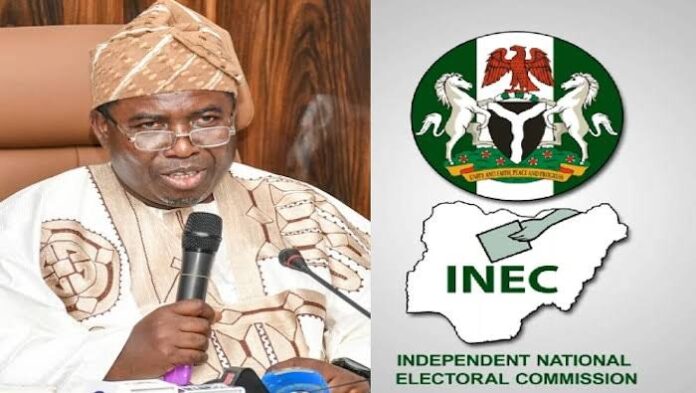
The Chairman of the Independent National Electoral Commission (INEC), Prof. Joash Amupitan, has declared that the Commission has no preferred candidate or political party ahead of the 2027 general elections, reaffirming its commitment to conducting a free, fair and credible electoral process.
Amupitan also urged members of the Armed Forces who will be deployed for election security to remain politically neutral, uphold the rule of law and discharge their responsibilities with professionalism and impartiality.
He made the remarks at a seminar titled, “The Role of the Armed Forces of Nigeria Personnel in Conducting Free, Fair and Credible Elections: The 2027 General Elections in Perspective,” organised by the Defence Headquarters in Abuja.
Represented by INEC’s Director of Legal Services, Mr. Al-Hassan Umar (SAN), the INEC chairman said the credibility of the 2027 elections would depend not only on efficient electoral administration but also on the professionalism, neutrality and constitutional compliance of all institutions involved in the electoral process.
“The Commission has no candidate in any election. Our allegiance is solely to the Constitution, the Electoral Act and the freely expressed will of the Nigerian people,” he said.
Amupitan stressed that military personnel assigned to election duties must remain non-partisan, respect citizens’ fundamental rights and conduct themselves with discipline and accountability throughout the electoral process.
“The Armed Forces serve the Nigerian State and the Constitution, not any political party, candidate or individual. Every interaction between military personnel and citizens during elections should reflect courtesy, discipline, restraint and professionalism,” he added.
The INEC chairman identified five critical priorities for delivering credible elections: stronger collaboration among election security stakeholders, enhanced election-specific training and simulation exercises, intelligence-led security operations, strict adherence to the Code of Conduct and Rules of Engagement, and unwavering professionalism, transparency and accountability.
He noted that election security must be proactive, driven by effective intelligence gathering, inter-agency coordination, strategic communication and timely deployment of security personnel.
Amupitan also highlighted Nigeria’s evolving security threats—including insurgency, banditry, kidnapping, organised political violence, cyberattacks, misinformation, disinformation and attacks on critical national infrastructure—which he said require coordinated responses from all security agencies.
He said INEC would continue to work closely with security agencies through the Inter-Agency Consultative Committee on Election Security (ICCES) to assess emerging risks, coordinate operational plans and ensure effective responses to security challenges before, during and after the elections.
READ ALSO: JUST IN: Ex-Finance Minister Alhaji Abubakar Alhaji is Dead
According to him, the military’s airlift capability has helped ensure that difficult terrain does not prevent eligible Nigerians from exercising their voting rights.
Earlier, the Chief of Defence Staff (CDS), General Olufemi Oluyede, described the seminar as timely, given the country’s prevailing security challenges and preparations for the 2027 general elections.
Represented by the Chief of Defence Training, Rear Admiral Abolade Ogunleye, the CDS reaffirmed the Armed Forces’ commitment to supporting civil authorities strictly within the provisions of the Constitution.
He said military personnel would continue to uphold professionalism, political neutrality and respect for human rights while carrying out election security duties.
Oluyede added that lessons from recent off-cycle governorship elections and by-elections in Ekiti, Kano, Kebbi, Rivers, Nasarawa, Enugu and Ondo states would strengthen inter-agency collaboration and enhance operational preparedness ahead of the 2027 general elections.
He noted that the success of Operation SAFE CONDUCT 2027 would not only be measured by the absence of violence but also by the military’s strict adherence to the principles of impartiality, neutrality and respect for human rights during election security operations.


