

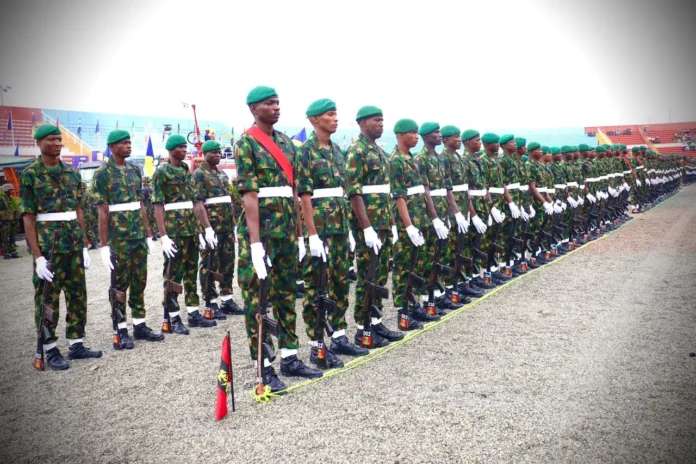
When military commanders, officers, soldiers and defense stakeholders converged in Port Harcourt for the Nigerian Army Day Celebration (NADCEL) 2026, the event marked more than another anniversary. It celebrated 163 years of service, honored fallen heroes, and showcased the Army’s determination to adapt to an increasingly complex security landscape.
From its establishment in 1863 as the Glover Hausas, the Nigerian Army has grown into one of Africa’s largest and most experienced land forces. Its journey has mirrored Nigeria’s history—from the civil war and regional peacekeeping missions to today’s battles against terrorism, insurgency, banditry, kidnapping, oil theft and other emerging threats.
Operating across the country’s six geopolitical zones, the Army now confronts largely asymmetric warfare, relying on intelligence-driven operations, joint military campaigns and enhanced inter-agency collaboration to disrupt criminal networks and safeguard lives and critical national assets.
Regional security takes center stage
One of the highlights of NADCEL 2026 was the hosting of the Third African Land Forces Forum, which brought together army chiefs and defense leaders from 17 African countries to discuss terrorism, insurgency and other cross-border security challenges.
Chief of Army Staff, Lt.-Gen. Waidi Shaibu, said integrating the forum into the celebration underscored Nigeria’s commitment to strengthening military diplomacy, regional cooperation and Africa’s collective security architecture.
According to him, the evolving nature of terrorism, organized crime and other transnational threats demands closer collaboration among African militaries.
Shaibu noted that Nigeria’s counter-terrorism experience has reinforced the importance of adaptive strategies, intelligence-led operations, effective air support, rigorous training and regional partnerships.
He cited the achievements of the Multinational Joint Task Force (MNJTF) in reclaiming territories within the Lake Chad Basin as proof that collective action delivers meaningful security gains.
He expressed confidence that the forum would deepen interoperability, encourage knowledge sharing, and generate practical solutions to tackle Africa’s security challenges.
Professionalism and people-centered service
For the Army Chief, NADCEL 2026 also highlighted the institution’s ongoing transformation agenda.
He said the nationwide activities reflected the Army’s commitment to professionalism, operational excellence and national unity while reinforcing its constitutional mandate to defend Nigeria’s territorial integrity.
Shaibu said this year’s theme, “Protecting the Nation and Serving the People: A Way Forward for the Nigerian Army,” captures the Army’s resolve to combine operational effectiveness with improved service delivery to citizens.
He paid tribute to fallen heroes whose sacrifices continue to inspire the quest for a safer Nigeria and reaffirmed the Army’s commitment to improving personnel welfare and operational readiness.
Tinubu pledges continued support
Speaking through Vice-President Kashim Shettima, President Bola Tinubu described the Nigerian Army as a critical pillar of national security, whose professionalism has helped preserve Nigeria’s unity and contributed to peace and stability across Africa.
The President acknowledged that evolving security threats require a modern, agile and highly motivated military.
He assured that his administration would continue investing in personnel welfare, training, modern equipment and operational capabilities to strengthen the Armed Forces.
Tinubu also reaffirmed his commitment to supporting the families of fallen heroes, stressing that a motivated military remains essential to national peace, security and development.
He urged Nigerians to complement the efforts of security agencies through patriotism, intelligence sharing and cooperation, describing national security as a shared responsibility.
‘Soldier First’ and civil-military relations
Observers say the President’s commitment aligns with the Army’s “Soldier First” initiative introduced by Shaibu, which prioritizes improvements in accommodation, healthcare, education, training, and modern equipment for personnel.
Military analysts believe the initiative has boosted morale by recognizing that well-equipped and motivated soldiers perform better in demanding operational environments.
Beyond kinetic operations, the Army has also expanded civil-military engagements through medical outreaches, educational support, environmental sanitation exercises and community development projects aimed at strengthening public trust.
Security experts say intelligence supplied by local communities has become one of the military’s most effective tools in combating terrorism, banditry and kidnapping, making stronger civilian cooperation increasingly vital.
Challenges remain
Despite notable operational successes, analysts say the Army faces increasingly sophisticated threats.
Terrorist groups and criminal networks now deploy drones, improvised explosive devices (IEDs), encrypted communications and online propaganda, requiring sustained investment in emerging technologies, intelligence capabilities and specialized training.
Experts also advocate stronger coordination among security agencies and deeper regional partnerships to improve intelligence sharing and coordinated responses to transnational threats.
They argue that military operations alone cannot eliminate insecurity, pointing to poverty, unemployment, weak governance, poor education and communal conflicts as factors that continue to fuel recruitment into extremist and criminal groups.
According to them, while security operations create the environment for development, lasting peace ultimately depends on good governance, economic opportunities and social inclusion.
Retired military officers also stress the need for professionalism, accountability and strict adherence to rules of engagement, noting that public confidence grows when military operations respect human rights and the rule of law.
Looking ahead
Nigeria’s contributions to United Nations, African Union and ECOWAS peacekeeping missions remain one of the defining features of the Army’s history, earning international recognition while enriching the operational experience of its personnel.
As the Army marks 163 years of service, defense experts say sustained investment in modern equipment, digital technologies, intelligence, indigenous defense production and leadership development will be critical to meeting future security challenges.
They also believe hosting the African Land Forces Forum alongside NADCEL reflects Nigeria’s growing leadership role in promoting regional military cooperation against terrorism, insurgency and organized crime.
For many Nigerians, the annual celebration is more than colorful parades and ceremonial displays. It is a moment to honor the sacrifices of fallen heroes, recognize serving personnel and appreciate the families who continue to bear the burden of military service.
Ultimately, analysts say the Nigerian Army’s relevance will depend not only on its battlefield successes but also on its ability to remain professional, adaptive and people-centered while working with government, citizens and regional partners to safeguard Nigeria’s peace, unity and sustainable development.
SOURCE: NAN


