

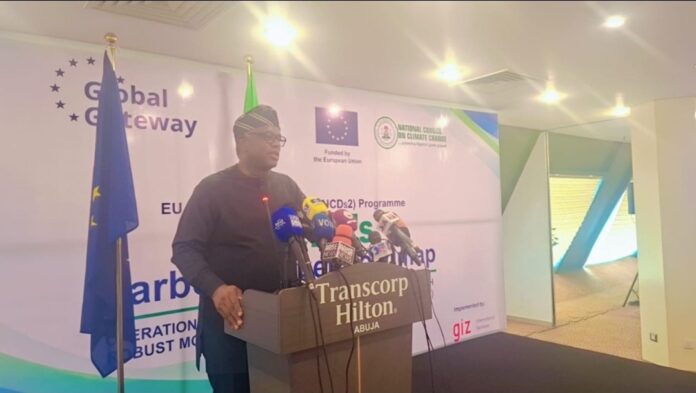
The National Council on Climate Change (NCCC) has called for stronger carbon verification systems to improve the credibility and integrity of Nigeria’s emerging carbon market.
The Director-General of NCCC, Mrs Omotenioye Majekodunmi, made the call on Tuesday in Abuja at a high-level roundtable on carbon markets organized by the NCCC in collaboration with the European Union Climate Dialogues.
Majekodunmi, represented by the Director of Energy, Transportation and Infrastructure at NCCC, Mr Michael Ivenso, said Nigeria must translate its climate ambitions into tangible, bankable and verifiable actions to drive sustainable economic growth and attract climate finance.
She said the National Carbon Markets Framework had established the institutional and regulatory architecture for governing carbon market activities, including Article 6 cooperation, voluntary carbon markets and national oversight.
According to her, the NCCC is also operationalizing a unified national carbon registry while promoting digital Measurement, Reporting and Verification (MRV) systems that use remote sensing, Internet of Things (IoT) sensors, geospatial data, and distributed ledger technologies.
She said the technologies would improve the accuracy, transparency and reliability of carbon market activities.
Majekodunmi called for stronger collaboration among government agencies, private-sector developers, financial institutions, development partners, civil society organizations and academia to develop bankable projects and strengthen local verification capacity.
She identified the finalization of carbon market regulations, the publication of sector-specific MRV guidelines, and the establishment of local capacity-building hubs as key priorities for positioning Nigeria as a destination for high-integrity carbon investments.
Also speaking, Jop Weterings, Policy Professional and Team Member at the European Commission’s DG CLIMA Task Force on International Carbon Pricing and Markets, said the European Union had adopted a legally binding target to cut emissions by 40 percent by 2040.
Weterings said the target included at least 85 percent domestic emissions reductions and up to 5 percent high-quality international carbon credits under Article 6 from 2036.
He said quality, transparency, and robust accounting were essential to expanding carbon markets, urging countries to strengthen methodologies, ensure fair transactions and equitable benefit-sharing, and protect domestic climate priorities.
Weterings said EU support for carbon pricing and international carbon markets was increasing, adding that cooperation with Nigeria presented opportunities to operationalize the country’s carbon market framework and strengthen high-integrity markets.
The Director of Forestry, Ministry of Environment, Mrs Halima Bawa-Bwari, urged Nigeria to strengthen forest inventories, monitoring systems, remote sensing, satellite technology and artificial intelligence for carbon monitoring.
Bawa-Bwari said satellite data should complement ground measurements and field verification, while forestry institutions needed stronger capacity to collect, manage and utilize reliable data for carbon markets.
She called for coordinated, transparent and independently verifiable forest-carbon data, warning against the development of parallel systems.
She stressed the need for clearly defined responsibilities, accountability, technical credibility and stronger stakeholder collaboration to build high-integrity carbon markets.
Similarly, the Head of Green and Digital Economy at the EU Delegation to Nigeria and ECOWAS, Ms Yolanda Jose, said credible carbon markets required robust systems that guaranteed transparency, accountability and environmental integrity.
Jose said Nigeria’s adoption of the National Carbon Markets Framework had established a structured legal and institutional system for domestic and international carbon trading under relevant climate agreements.
She said the EU Climate Dialogues roundtable would help stakeholders align on the implementation of Nigeria’s framework, strengthen MRV practices, mobilize investment and support the country’s transition to a low-carbon economy.
The Country Facilitator of the Nationally Determined Contributions (NDC) Partnership, Mr Huzi Mshelia, said robust MRV systems were essential for building trust and investor confidence in carbon markets.
Mshelia welcomed the convergence of stakeholders at the roundtable, saying it provided an opportunity to establish common national standards and a shared understanding of carbon market operations.
READ ALSO: EFCC Opposes Diezani’s Bid to Present UK Acquittal Evidence in Nigerian Court
He stressed the importance of collaboration among the NCCC, finance, budget and national planning institutions to ensure that climate actions remained aligned with Nigeria’s broader development priorities.
He added that sustained technical support would be critical to strengthening Nigeria’s MRV system and positioning the country to participate effectively in the global carbon market.


 has called for stronger carbon verification systems to improve the credibility and integrity of Nigeria’s emerging carbon market.)