

A scientist who studied algae, a plant biologist, and a physicist who drilled into South Pole ice have won the first two Nobel Prizes of 2026 this week. Two of the six prizes are now announced.
On Monday, Oct. 5, the Nobel committee gave the prize in physiology or medicine to Karl Deisseroth, Peter Hegemann and Georg Nagel. They won for their work on optogenetics, a method that uses light to switch nerve cells on and off. Researchers now use it to find which brain cells control pain, hunger, thirst, social behavior, reward and attention.
Deisseroth is a professor at Stanford University in the United States. Hegemann teaches biophysics at Humboldt University in Berlin. Nagel teaches plant physiology at the University of Würzburg in Germany.
The news surprised at least two of them. Nagel said he was “very surprised” and told the Nobel Institute he thought it was “too early to get this prize in medicine, optogenetics.” He believes other medical discoveries have helped more people. Hegemann said he felt “overwhelmed.” Deisseroth said he “couldn’t be happier.”
Deisseroth said the three winners cover the whole story, from early studies of algae to advanced brain experiments. “This prize really captures the full journey of discovery,” he said.
Per Svenningsson, chair of the Nobel Committee for Physiology or Medicine, said the method gives scientists a way of “mapping the brain in a way that we could once only dream of.”
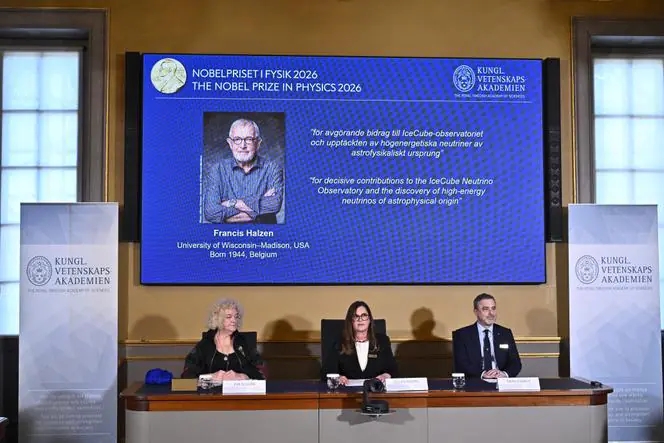
On Tuesday, Oct. 6, the Royal Swedish Academy of Sciences gave the physics prize to Francis Halzen, a professor at the University of Wisconsin-Madison. He won alone for his work on the IceCube Neutrino Observatory and the discovery of high-energy neutrinos from space.
Neutrinos are tiny particles with no electric charge. They pass through most matter, so they are very hard to detect. Halzen proposed using the clear ice at the South Pole to catch them. IceCube has thousands of light sensors buried in that ice. They record the faint flashes of light that appear when a neutrino hits another particle. Soon after the observatory was finished, it detected the first high-energy neutrinos from distant galaxies.
Halzen learned of the prize while at a science festival in Bergamo, Italy, where he was working on a funding proposal. “I hope it helps to get it funded,” he told the Nobel Institute.
He said the ice is what makes the experiment work. It is “ancient snow that fell on Antarctica 50,000 years ago,” he said, and it is so pure that blue light travels hundreds of meters through it.
READ ALSO: Three Years After October 7, Israelis Mourn and Gaza Waits
Mark Pearce, chair of the Nobel Committee for Physics, said Halzen led an international team of researchers and engineers. His “tenacity and scientific vision” opened a new kind of astronomy, Pearce said.
The announcements continue through next week:
- Chemistry: Wednesday, Oct. 7 (today)
- Literature: Thursday, Oct. 8
- Peace: Friday, Oct. 9, with 287 nominees this year
- Economic sciences: Monday, Oct. 12
Each winner receives a diploma, a gold medal and 12 million Swedish kronor, about $1.2 million. Winners who share a prize split the money. The formal ceremonies take place in Stockholm and Oslo on Dec. 10.


