

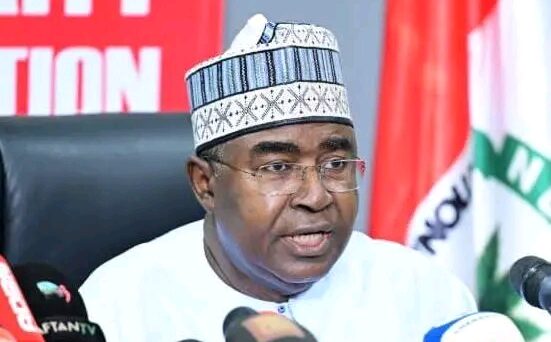
In a society increasingly uneasy about what lies beneath everyday normalcy, the Chairman of the National Drug Law Enforcement Agency (NDLEA), Mohamed Buba Marwa, has pushed forward a bold policy: drug testing for new and returning students in tertiary institutions. Backed by the Minister of Education, Olatunji Alausa, the initiative reflects a shift from denial to detection, grounded in the logic of early intervention, deterrence, and public health rather than punishment. In line with the Biopsychosocial Model, it treats drug abuse as a complex condition shaped by environment, psychology, and biology, with rehabilitation, not expulsion as its core response.
Yet beyond policy, the “Marwanic drug test” speaks to a deeper fear: that danger often hides in plain sight. From crime to social breakdown, many now suspect that distorted judgment, sometimes fueled by substance abuse, quietly drives insecurity. But if this is true, why limit scrutiny to students? Public life itself has offered enough moments to question whether some leaders would pass the same test.
At the same time, a parallel anxiety is rising in the digital space. Countries like the United States now require visa applicants to submit years of social media history, reflecting what scholars call Digital Footprint Theory, the idea that our online traces reveal who we truly are. This evolving scrutiny, here described as the “Amupitanic social media test,” evokes the experience of Joash Amupitan, where past expressions become evidence for present judgment.
Public figures like Femi Fani-Kayode, Reno Omokri, Daniel Bwala, and Sheikh Ahmed Gumi have shown how fragile reputation becomes when words are permanently recorded and reinterpreted. As Erving Goffman would suggest, the line between private and public self has collapsed.
What both tests ultimately reveal is a society turning inward, probing the mind through substances and the soul through speech. The quiet lesson is simple but unsettling: in an age where both your bloodstream and your timeline can be examined, moderation, civility, and self-discipline are no longer optional, they are survival.
Bagudu can be reached via bagudumohammed15197@gmail.com or 07034943575.


