

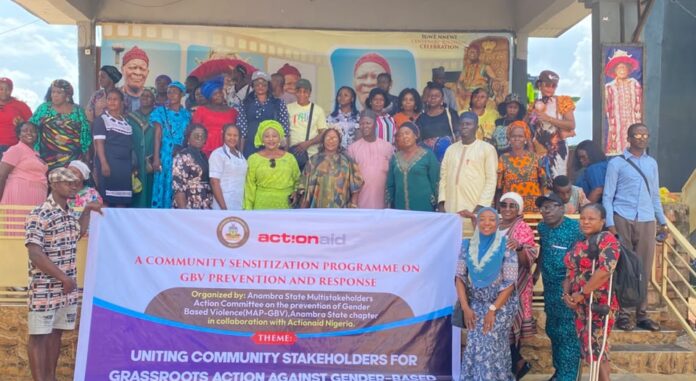
A one-day community sensitization program on Gender-Based Violence prevention and response for communities in Nnewi North and South Local Government Areas of Anambra State has ended with a call on community leaders and other critical stakeholders to amplify the message to drive concerted efforts towards mitigating the rising GBV cases in the state.
The program was organized by the Anambra State Multi-Stakeholders Action Committee on the Prevention of Gender-Based Violence (MAP-GBV), Anambra State Chapter, in collaboration with ActionAid Nigeria.
With the theme ‘Uniting Community Stakeholders for Grassroots Action against Gender-Based Violence in Nnewi North and South’, the event held at Igwe Orizu Palace, Nnewi, featured talks and expositions on GBV and how communities can unite to fight the anomaly.
Addressing the assemblage, the Chairman of the Committee and traditional ruler of Olumbanaasaa in Anambra West Council Area, Igwe Pius Omachonu, noted that gender issues arise because partners remain fixated on traditional and cultural stereotypes that existed in the past, even though society has evolved.
He observed that, due to socialization and contemporary dynamics, it has become important for society to evolve to protect the rights and privileges of both those entering relationships.
“Roles have changed, and partners must learn to support each other in family roles. These are the things that cause problems, and partners cannot afford to remain insensitive to each other’s plights.
“When the partner responds in an inappropriate manner, it may lead to problems and violence,” he said.
The monarch explained that the event is meant to inform the people that times have changed and that society must jettison habits that do not promote peaceful coexistence.
He stressed the need to change the attitudes that drive GBV, especially the fixed views on roles in the family, adding that flexibility is what it takes for partners to have successful relationships.
In an overview of GBV in Anambra, a member of the MAP-GBV, representing the NASFAT muslim community, Hajia Musbaudeen Medinat explained that Gender-Based Violence are harmful acts perpetrated against an individual by someone more powerful or better-placed than they.
She identified some forms of GBV to include physical violence, emotional violence, psychological violence, financial violence, childhood/ forced marriage, negative widowhood practices, inheritance denial, and sexual harassment, among others.
Hajia Medinat urged the stakeholders not to hesitate to speak up against GBV, warning that attempts to conceal and protect such actions embolden people who perpetrate them.
She further revealed that there are several platforms for the reportage of GBV, including the Ministry of Women Affairs, FIDA, and the National Human Rights Commission, NHRC
In her remarks, Mrs Favor Abarah highlighted some triggers of GBV to include poor communication, jealousy and suspicion, drug addiction, poverty and financial stress, and lack of education, while the Director, Population Program and former Gender Coordinator, State Ministry of Health, Mrs Ngozi Ekeh urged stakeholders to place emphasis on prevention, rather than reaction, when the cases occur.
For his part, the State Chairman, Joint National Association of Persons with Disabilities, JONAPWD, Comrade Ugochukwu Okeke observed that PWDs are the most affected in the matter of GBV, noting that findings have shown that the blind and the deaf are being violated and abused sexually in the state.
“Most times, these PWDs are violated because they cannot reveal the identities of their violators.
“Again, when they want to even report their ordeal, they cannot because of accessibility issues and lack of interpreters to narrate their cases. So, it is important that the society adopts proactive strategies to prevent such abuses against PWDs,” he said.
Okeke harped on the need for communities to amplify PWDs’ voices when they are facing such attempts and when violated, observing that the silence is the reason why PWDs are raped and sexually abused today without their stories being heard.


