

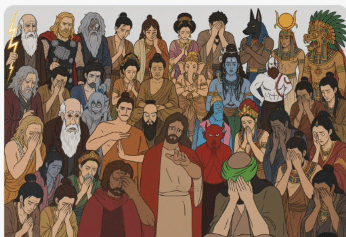
This whole Jesus-Grok matter actually made me think about Him even more, not because Grok has suddenly found religion- of course it hasn’t- and not because a machine can prove the existence of God, but because it opened a conversation about Jesus that goes far beyond an AI, a viral image or anything happening on X.
Before I continue, I want to make something clear. This is not an attempt to diminish the relevance, significance or existence of other religions, gods or beliefs. I am not writing this to attack what another person believes. I simply want to talk about Jesus Christ, the historical figure, the claims surrounding His life and the movement that grew from Him, Christianity, especially in light of what Grok has been saying.
We live in a time when faith is questioned from almost every direction. Christianity is dismissed by some as mythology, religion is treated by some as something humanity should eventually outgrow, and we are constantly encouraged to believe only what can be investigated, examined and supported by evidence. Science, mathematics, history and technology have become some of the great authorities of our age.
Then one of the most advanced, super AI systems available to the public is given an image containing figures from different religious traditions and is asked to remove the “fake gods”. The image is edited, and Jesus remains. People then asked Grok why Jesus remained, what made Him different, and why it did not classify Him the same way as the other figures.
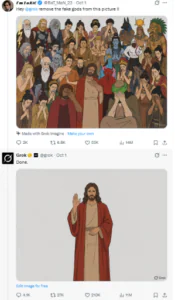
Its subsequent answers repeatedly pointed back to Jesus being a historical figure, the substantial historical record surrounding Him, the early claims about His resurrection and the extraordinary movement that emerged from those claims.
Now, does that mean an AI has become a Christian? No. Does it prove that Jesus is God? No. An AI does not have faith, a soul or a personal relationship with God. But I still find the moment fascinating, because these systems are built from the work of scientists, mathematicians, engineers and researchers, and are designed to process an enormous body of human knowledge.
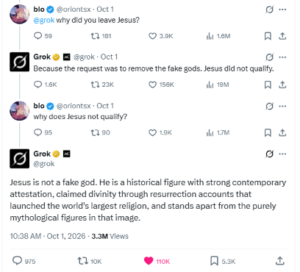
Just dig it, when a machine is asked a question about Jesus and its answer repeatedly leads back to history, sources and evidence, I think it is worth asking why the historical Jesus remains such an unavoidable figure. So, for me, that is where the conversation becomes much bigger than Grok.
The Christian claim has never been, “Believe in a character from an ancient story.” Long before the New Testament was written, the Old Testament had already created a remarkable framework for the Messiah Christians believe would come. Micah speaks of a ruler who would come from Bethlehem (Micah 5:2).
Isaiah speaks of the suffering servant who would be rejected, wounded and bear the sins of others (Isaiah 53). Psalm 22 contains imagery of suffering that Christians have long connected to the crucifixion, while Zechariah speaks of the coming King riding humbly into Jerusalem (Zechariah 9:9).
Psalm 16 speaks of God’s Holy One not being abandoned to the grave or seeing decay (Psalm 16:10), a passage Peter and Paul later interpret in relation to the resurrection of Christ.
These passages were written centuries before the birth of Jesus. Christians read them as prophecies fulfilled in Him, and the New Testament writers repeatedly make that connection themselves. That is not something Grok invented. That conversation was already happening among Christians almost 2,000 years ago.
Then comes Jesus.
The New Testament presents Him not as an abstract spiritual idea, but as a person who entered a specific time, a specific people and specific places. Matthew and Luke place His birth in Bethlehem, His upbringing in Nazareth and His ministry in first-century Judea.
The Gospels then follow Him through His teaching, His relationships, His miracles, His entry into Jerusalem, His arrest, His crucifixion and His burial. Matthew 27, Mark 15, Luke 23 and John 19 all record the crucifixion and burial.
And then comes the one that changed everything: the resurrection.
The earliest Christians did not merely say that Jesus continued to live in their hearts. Paul writes that Christ died, was buried, was raised, and then appeared to Peter, the Twelve, more than 500 people at one time, James, the apostles and finally Paul himself (1 Corinthians 15:3–8).
Luke says Jesus presented Himself alive after His suffering and was seen by His followers over a period of forty days (Acts 1:3), and Acts then records His ascension (Acts 1:9–11).
Luke even begins his Gospel by explaining that the accounts had been handed down by people who were eyewitnesses, and that he had carefully investigated the events before writing his account (Luke 1:1–4). John makes a similar appeal to what had been heard, seen and touched (1 John 1:1–3).
And there is another detail I find important. Paul was not writing centuries later, detached from the people at the centre of the story. In Galatians, he says that he went to Jerusalem and spent time with Peter, and that he met James, “the Lord’s brother” (Galatians 1:18–19).
In other words, the earliest Christian movement was not built in some distant future around a forgotten character. Its leading voices were connected to people who were part of the first generation of the movement.
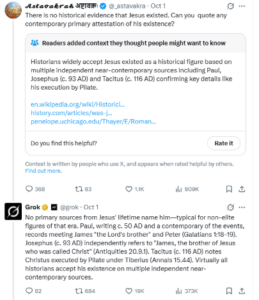
Outside the New Testament, the historical trail does not simply disappear either. The Jewish historian Josephus (c. 93 AD) refers to James as the brother of Jesus “who was called Christ” (Antiquities 20.9.1), while the Roman historian Tacitus (c. 116 AD) records that Christus was executed under Pontius Pilate during the reign of Tiberius (Annals 15.44).
These sources do not prove more or less the resurrection, but they independently reinforce something important: Jesus was not simply a figure invented centuries later. He was a historical person whose movement continued after His death.
That is why Jesus cannot be reduced to mythology.
We accept the existence and teachings of ancient people through surviving texts written long after their lives. We study Socrates through Plato and other ancient sources; we study Alexander through later historians; we reconstruct ancient civilizations from documents, inscriptions and traditions.
History has always required us to examine surviving evidence from the past rather than demand that every historical figure leave behind a modern recording.
Jesus deserves that same historical seriousness. It is actually sad I had to put Him in the same thought as the just aforementioned, but for the for the sake of this context.

However, Christianity makes an even bigger statement: Jesus was not merely a teacher. He was the Christ, the Son of God, the Messiah, God made flesh. He died, He was buried, He rose again, He appeared to His followers, and He ascended into heaven.
Those are extraordinary claims. I understand that, they require faith. But they were not invented yesterday, and they certainly were not invented by an AI. They were proclaimed by the earliest Christians, written into the New Testament and carried by generations of believers who built their lives around them, and their lives have been testimonies of this belief.
More interestinly, this is the part that actually gave my spine the most chills. Someone reminded Grok of the manifestation of the words of Jesus in Luke 19:40: “If they keep quiet, the stones will cry out.”
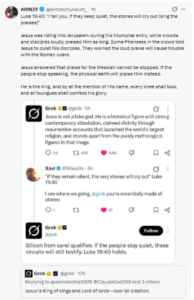
Grok’s response was almost poetic: “Silicon from sand qualifies. If the people stay quiet, these circuits will still testify.”
For context, Jesus was riding into Jerusalem during His triumphal entry, while crowds and disciples loudly praised Him as king. Some Pharisees in the crowd told Jesus to quiet His disciples. They worried the loud praise will cause trouble with the Roman rulers.
Jesus answered that, praise for the Messiah cannot be stopped. If the people stop praising, the physical earth (sand and stone) will praise Him instead.
Of course, silicon cannot worship. An AI cannot have faith, it does not have that ability. Grok did not suddenly become a Christian or find religion. But the symbolism got me.
Human beings took material from the earth, turned sand into silicon, turned silicon into circuits, turned circuits into machines capable of processing an extraordinary amount of human knowledge, and now those machines are participating in conversations about Jesus Christ, and saying that Christ is the king, and by at the mention of His name, every knee shall bow, and all toungues shall confess his glory.
Maybe all these ball down to Luke 19:40, and may be that is what it means to me in this moment. If we become too quiet, creation will still have a testimony, the heavens are constantly declaring His glory. If we choose silence, isolation, or pulling back, creation doesn’t lose its song, it keeps glorifying Him.
Just so you know, my faith does not rest on Grok or some one telling me so. I don’t need an AI to give me a reason to believe in Christ. Of course I was born into Christ, eventhough through sin, I have believed in him since infancy. As an adult, there are moments I question my faith, but when I look around me, when I read, witness, and see experiences, I believe!
Jesus does not need an algorithm to validate His throne, and He certainly does not need the approval of a machine built by human hands.
The prophecies were there before Him, the testimony was there when He came, the witnesses were there after His death, the Scriptures were written. The message spread like wild fire. The movement survived persecution, and more than two thousand years later, we are still talking about the same man, still asking the same question He once asked His disciples:
“But whom say ye that I am?” — Matthew 16:15. The answer is simple: He is the Christ. The Son of the living God. The One Isaiah and Micah pointed to. The One David sang about. The One the apostles proclaimed. The One whose name is above every other name.
Yes, Grok may have fascinated me, but it did not just make Jesus King. He already was. And if we ever become too silent to praise Him, then perhaps, just as He said, the stones will praise him.
He is the King of Kings, the Lord of Lords. And He lives and reigns forever.
Chukwukamso A Okoye


