

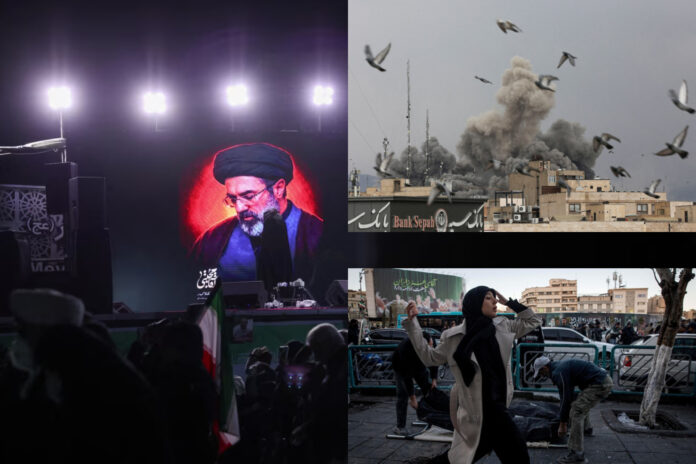
Iran has named the late Ali Khamenei’s son, Mojtaba Khamenei, as its new Supreme Leader following the death of his father.
The announcement was made on Monday morning in Tehran, where authorities called on citizens to gather later in the day in central squares across the country to pledge allegiance to the new leader.
Iran’s political and military leadership quickly gave their support. Sadeq Larijani, head of the Expediency Council, said Mojtaba Khamenei’s appointment would reassure the public during the war.
“The appointment helps soothe the public’s distress during the war and reaffirms the need to continue in the luminous path of the Islamic revolution,” Larijani said, according to Iranian state media.
Mojtaba Khamenei, who previously managed his father’s office, assumes leadership during one of the most serious challenges the Islamic Republic has faced since the 1979 revolution.
Former United States ambassador Gary Grappo said the new leader is likely to adopt a hardline position.
“He’s most definitely a hardliner and facing what I think is truly an existential crisis, unlike anything the country has faced in its forty-seven-year history,” Grappo said.
“He’s powerful because he ran his father’s office… you could consider it to be akin to the chief of staff with his hands on intelligence, economic policy, security policy and political affairs.”
The Israeli military said on Monday that it had launched “an additional wave of strikes” on Iranian military infrastructure, including missile launch sites and a rocket-engine production facility.
Explosions were reported across Tehran early Monday. Journalists in the capital said several loud impacts were heard shortly after dawn while smoke continued to rise from fuel storage sites struck earlier in the conflict.
Iranian officials say the toll from the attacks is rising quickly.
Deputy Health Minister Ali Jafarian said more than 1,255 people have been killed and 12,000 injured during the past nine days of fighting.
“The majority of those killed have died in explosions,” Jafarian said. “The injured people mostly have two types of injuries: burns and crush injuries.”
He added that victims ranged “from eight months to eighty-eight years old.”
Military activity has also been reported across several Middle Eastern countries.
In Bahrain, a drone strike wounded at least 32 people in the town of Sitra. The country’s national oil company, BAPCO, later declared force majeure on operations after its refinery complex was damaged.
Video footage showed thick smoke rising from the industrial zone housing the refinery.
Missiles and drones were also intercepted over Abu Dhabi, where authorities said two people were injured by falling debris after air defence systems shot down incoming projectiles.
The Israeli military confirmed strikes in Beirut, targeting what it described as Hezbollah-linked infrastructure in the southern suburbs of the Lebanese capital.
So far, the conflict has not lingered without economic consequences.
Oil prices climbed above $100 per barrel on Sunday, the highest level since the 2022 war in Ukraine, amid fears that shipping routes through the Strait of Hormuz could be disrupted.
Peter McGuire, chief executive of Trading.com Australia, said the speed of the increase was striking.
“The most important thing at the moment is the velocity of what we have seen as far as movements to the upside,” McGuire said.
“As recently as Thursday, prices were between seventy-five and eighty dollars. Now we have seen spikes above one hundred dollars.”
He warned that further disruptions could push prices even higher.
“If more countries in the Gulf shut down oil and gas production, then you are going to see a spike to the upside, and one hundred and forty to one hundred and fifty dollars is very achievable,” he said.
Stock markets across Asia reacted sharply to the developments. Japan’s Nikkei 225 index fell 5.2 percent, while South Korea’s Kospi dropped 6 percent.
South Korean President Lee Jae Myung announced emergency measures to limit fuel costs.
“For petroleum products that have been excessively increased recently, the maximum price system should be quickly introduced and boldly implemented,” Lee said during a government
The appointment of Iran’s new leader has also drawn international response.
China’s Foreign Ministry said the decision was an internal matter for Iran.
“This is a decision by the Iranian side based on its constitution,” spokesperson Guo Jiakun told reporters.
But the leadership transition has raised concern in Washington and Jerusalem.
U.S. President Donald Trump had previously warned that Mojtaba Khamenei becoming Supreme Leader would be “an unacceptable choice.”
In the Gulf region, Sheikh Mohammed bin Abdulrahman Al Thani, Prime Minister of Qatar, criticised Iran’s missile attacks on neighbouring states.
“There is a big sense of betrayal,” he said, noting that some Gulf countries had tried to remain neutral in the conflict.
Stay connected for more updates.


