

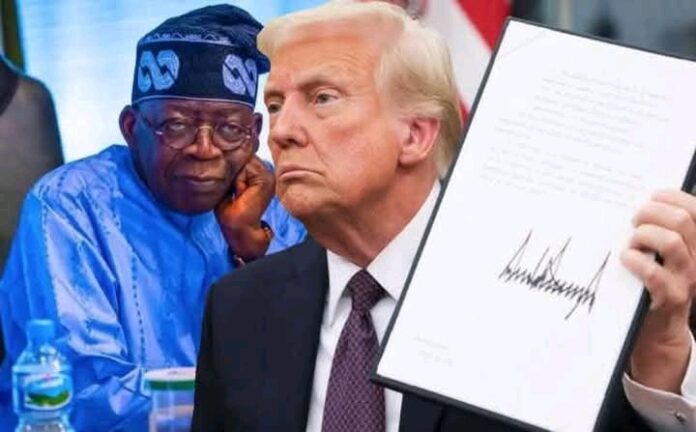
Speculations about a possible invasion of Nigeria by the United States may seem remote, but in the context of global geopolitics, such scenarios are often built on layered motives including political, economic, humanitarian, and religious interests. In recent years, international attention has been drawn to reports of violence against Christian communities in parts of northern Nigeria, with Western advocacy groups and media framing these incidents as evidence of religious persecution.
While Nigeria’s security challenges are complex and often driven by a mix of ethnic, economic, and political factors, the religious framing of the crisis in international discourse has created fertile ground for external intervention narratives. A U.S. invasion, if it were ever to occur, could easily be justified under the banner of protecting human rights or defending persecuted religious minorities. Yet beneath such a moral façade could lie deeper strategic interests, particularly in Nigeria’s solid mineral sector, one of Africa’s most resource-rich frontiers.
Over the last decade, the United States has intensified its focus on Africa’s critical minerals, responding to China’s growing influence across the continent. Lithium, cobalt, tin, and rare earth elements, which are key ingredients for electric vehicles, defense technologies, and clean energy systems, are increasingly defining the global power struggle. Nigeria, with its vast reserves of lithium, gold, columbite, and tantalite, has emerged as a crucial player in this contest.
In the event of a U.S. intervention, religious protection could serve as the public justification, while strategic control over mineral resources becomes the underlying goal. The combination of humanitarian rhetoric and economic ambition has historically shaped Western interventions across the developing world, from the Middle East to Latin America.
Any U.S.-led invasion would have immediate and devastating effects on Nigeria’s economy. The solid minerals sector, already struggling with insecurity and illegal mining, would face massive disruption. Ongoing exploration and processing projects would halt, foreign investors would withdraw, and local communities dependent on mining for livelihood would be displaced.
Revenue streams from minerals like tin, lead, and gold would dry up, while infrastructure in mining regions could be destroyed in the conflict. The National Integrated Mining Policy, which aims to formalize and expand the sector’s contribution to GDP, would be derailed, setting Nigeria back decades in its diversification agenda.
In Washington and other Western capitals, religious freedom has long been used as a policy lens for engagement with Nigeria. Human rights reports frequently highlight killings of Christians, attacks on churches, and sectarian violence, framing Nigeria as a crisis zone requiring international attention. While these concerns are legitimate and demand justice, the danger lies in the instrumentalization of religion for geopolitical purposes. If the United States were to use the protection of Christians as a pretext for intervention, it could risk inflaming religious divisions within Nigeria while masking a deeper struggle for strategic mineral control and regional dominance.
A U.S. incursion into Nigeria would transform West Africa into a new theatre of global competition. China, which has heavily invested in Nigeria’s mining infrastructure, would see such a move as a direct threat to its economic interests. Regional stability could unravel as neighboring countries like Ghana, Niger, and Mali, each with their own mineral resources, become entangled in a wider proxy contest. The result would not only be economic paralysis but also a polarization of regional alliances, some leaning toward Western powers, others toward emerging Eastern blocs.
Beyond military consequences, Nigeria’s sovereignty over its mineral wealth would be at risk. Post-invasion arrangements could lead to unequal mining agreements favoring American or allied corporations. This would echo the colonial-era resource extraction patterns that enriched foreign entities while impoverishing local populations. Nigeria’s efforts to build a locally driven, transparent mining industry could be replaced by foreign-controlled structures, undermining national ownership and sustainability.
Regions rich in minerals such as Nasarawa, Plateau, and Zamfara would likely bear the brunt of violence and displacement. Civilian populations could face military occupation, destruction of farmlands, and environmental degradation. The environmental costs of war, coupled with mining-related pollution, would deepen the humanitarian crisis, undoing years of community development efforts.
While the idea of a U.S. invasion remains hypothetical, it highlights Nigeria’s urgent need to address internal security issues and religious tensions that could serve as justifications for external interference. The government must demonstrate firm control over both its territory and resources, ensuring that no foreign power can exploit its internal divisions.
Nigeria’s future lies in building inclusive governance, protecting religious freedom domestically, and strengthening institutions that can manage its mineral wealth transparently and independently. If the nation fails to take ownership of its narrative politically, economically, and morally, others may be all too willing to define it for their own interests.


