

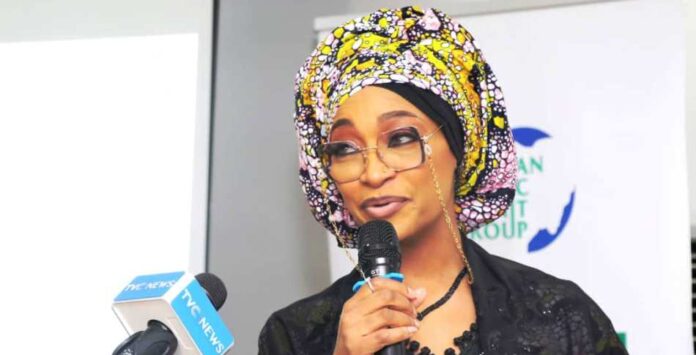
The Minister of Art, Culture, Tourism and the Creative Economy, Hannatu Musa Musawa, has lately demonstrated a striking understanding of Nigerian social realities. Her intervention reads less like polished creative idealism and more like cultural realism, grounded in how people actually think, vote, fear, hope, and negotiate power. Ironically, this realism, rather than abstraction or artistic flourish, is what has made some of her recent comments controversial, especially for a woman entrusted with shaping narratives, symbols, and the softer language of culture.
BusinessDay NG reports that Musawa warned the APC against altering the Tinubu–Shettima ticket ahead of 2027. She cautioned that dropping Vice President Kashim Shettima, or replacing him with a running mate who is not a Northern Muslim from the core Hausa, Fulani, or Kanuri bloc, could weaken the party’s electoral prospects, particularly in the North West and North East. Her argument rested on political orientation and voter psychology, how people relate to power, identity, and expectation, and how politics, for many, is not a daily civic duty but a four-yearly moment of emotional bargaining.
Unsurprisingly, the comments triggered a mix of awe and shock. Part of the reaction stemmed from the bluntness of the delivery, and part from the messenger herself. Such raw statements are rarely expected from a young woman, let alone one heading the creative economy, a sector associated with storytelling, nuance, metaphor, and coded speech. Many expected the same message to be dressed in allegory, humour, or layered symbolism, the kind that leaves even an opponent smiling, reflective, and disarmed rather than provoked.
Nigerian creative traditions have long mastered this subtlety. Filmmakers and writers often confront social vices without frontal assault, preferring humour, irony, and human frailty as entry points. Films like The Wedding Party poke at classism and materialism through laughter, while Phone Swap unsettles ethnic prejudice by switching perspectives. Omo Ghetto: The Saga uses street humour to humanise life amid violence and poverty, while novels such as Purple Hibiscus and Things Fall Apart deliver quiet but devastating critiques of extremism and harmful tradition. These works succeed because they create empathy before judgment, inviting reflection without accusation. As Chinua Achebe once implied in his essays, the writer’s duty is not to preach but to make society see itself clearly.
Yet, dismissing Musawa’s intervention purely on stylistic grounds risks missing its substance. Truth does not always arrive wrapped in sweetness. Sometimes it demands discomfort. Political correctness can soften language, but it can also dilute urgency. In this sense, Musawa’s bluntness raises an uncomfortable question: should truth always be disguised to spare emotions, or does realism sometimes require saying what people recognise privately but avoid publicly?
One clear insight from her comments is that Nigeria’s crisis is fundamentally tribal before it is religious. Religion often serves as a convenient veil, a moral cloak for ethnic ambition and competition. Across states like Plateau and Benue, where communities largely share the same faith, allegations of marginalisation, resentment, and even violent clashes persist. This reality suggests that religious teachings of tolerance, justice, and peace are frequently overshadowed by ethnic calculations and power struggles.
Reports of victimisation and rivalry among people of the same religion but different tribes further reinforce this point. Even within single ethnic groups, inter-communal conflicts abound, as seen across parts of the South East and other regions where people share both tribe and faith. These conflicts are rarely framed as existential threats or conspiracies, precisely because they lack the religious label that often amplifies fear and suspicion elsewhere. Conflict, as scholars remind us, is not inherently evil. Ken Sande defines it as a disagreement or tension arising from differences in values, interests, or goals. In that sense, conflict is inevitable wherever scarce resources, power, and recognition are contested, even within families.
This reality explains Musawa’s political logic. She is not inventing identity politics; she is describing how it already operates. Voting population, demographic weight, and shared identity become bargaining tools in the struggle for power. Any region, state, or ward would naturally leverage its strengths against perceived weaknesses of rivals. Nigerian politics, for better or worse, rewards such calculations.
Her intervention is therefore courageous in its honesty. Musawa frames electoral outcomes as predictable, shaped largely by identity and numbers rather than lofty ideals. At the same time, it offers a sobering clarification to those who interpret exclusion purely through a religious lens. By emphasising Hausa, Fulani, and Kanuri Muslims, Musawa indirectly highlights how ethnic hierarchy operates even within a shared faith, sidelining neighbouring groups such as Nupe, Gbagyi, Ebira, Igala, Tiv, Bassa-Nge, Eggon, Angas, Tarok, Kambari, and other minorities. If religion alone were decisive, such distinctions would be irrelevant. Yet they are not. This reality forces a deeper question: if ethnicity dominates even among co-religionists, why is religion often blamed as Nigeria’s primary fault line?
The persistent argument that Tinubu could not have won without a Muslim running mate further exposes this truth. It shows how regional and tribal calculations bind political alliances more tightly than theology. Musawa’s caution about altering the Muslim–Muslim ticket gains further weight when viewed alongside the broader balancing already undertaken. The North Central, for instance, has been significantly accommodated through key national positions, including INEC, the APC chairmanship, and the SGF, alongside other strategic appointments in finance, civil service, and justice.Many of these roles are occupied by appointees outside northern region in favour of one faith which are tenure-based and cannot be easily reshuffled without creating new imbalances. Altering the ticket alone risks correcting one perceived exclusion while creating another, with no guarantee of electoral gain.
There is also the matter of unintended consequences. There is little evidence that a Christian running mate in 2023 would have significantly shifted votes in regions already emotionally committed to other candidates. Symbolic inclusion may promote goodwill and a sense of belonging, but it does not automatically translate into votes when political loyalties are already sealed. Worse still, abrupt changes can create damaging optics, feeding narratives of being “used and dumped,” and fuelling distrust within and beyond the party.
Another layer to Musawa’s realism lies in her assessment of party stability. The APC, despite being the ruling party with the largest number of governors and lawmakers, has maintained relative internal harmony compared to opposition parties riddled with crises. Any attempt to replace Kashim Shettima could reopen fault lines, trigger resistance among governors, and ignite fresh agitations over succession, ambition, and entitlement. Such false hopes, once raised, often breed resentment, malice, and division when unmet.
Hannatu Musa Musawa, a lawyer, author, and politician from Katsina State, thus presents an art form rooted not in fantasy but in fearless realism. Her words reflect pragmatism, cultural insight, and an understanding of human weakness, even when that honesty shocks. Interestingly, this same balance of daring and moderation appears in her personal disclosures, such as speaking openly about her past marriage to Abdul Samad of BUA, acknowledging separation without bitterness, and emphasising continued respect and connection. It is the language of someone who understands when to be bold and when to be gentle, when to provoke thought and when to soothe emotion.
In the end, Musawa’s intervention may unsettle, but it compels reflection. It holds up a mirror to Nigerian political culture, stripped of decorative fiction, and asks whether we are ready to confront ourselves as we truly are, not as we wish to be.
Bagudu can be reached at bagudumohammed15197@gmail.com or on 0703 494 3575.


