

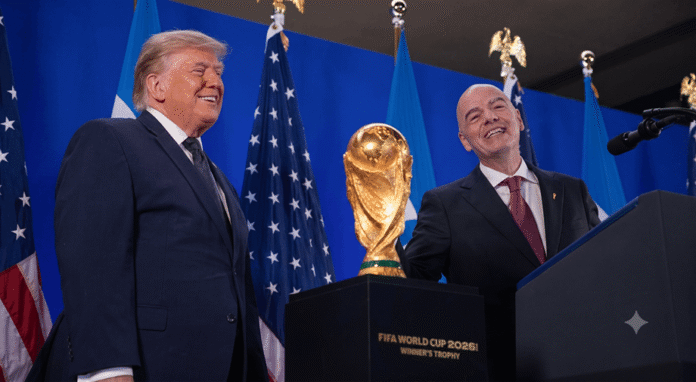
It is a stew of inedible quality. But eat it we are expected to do. Consider the stomach-churning ingredients. FIFA, an opaque organisation of mafia qualities that governs world football. Add to the mix crawling-to-power President Gianni Infantino, a preposterous darling of authoritarian favour. Mix in his cringeworthy, very public association with US President Donald Trump, peace prize and all. And money. Money, money and some. Will that contaminated mix set?
Not happy with the loot secured from the just concluded Men’s World Cup, stained by criminally high-ticket sales and returns from the secondary market, Infantino was onto another venture. This one, largely kept from most of the organisational cadres of FIFA and virtually everybody else, would involve the creation of a private company intended, so the gauleiter-bureaucrats say, to make money to nourish the global game. The media release from July 29 describes the creation of FIFA Forward Enterprise (FFE), a FIFA-owned subsidiary intended to consolidate the organisation’s “commercial and event operations”. The entity would have, if created, involve a portfolio of revenue spanning media rights, sponsorships, licensing, ticketing and hospitality packages, in addition to the actual running of the World Cup and club tournaments. Approval of this caper was to be facilitated through lavish bribes for all 211 FIFA Member Associations: an optional US$20 million per association “in exceptional and immediate funding for special projects from the new FIFA Fast Forward Programme (FFFP)”; US$20 million per association in Forward funding for 2027-2030, to increase by $US2 million for 2031-2034 and a further increase for 2025-2038 to US$24 million.
Some US$4.2 billion would be raised by the subsidiary to fund FFFP “based on an initial equity valuation of US$20 billion by carefully selecting long-term investors who will purchase minority, non-controlling interests in FFE.” At this point, the sceptical mind quivers with suspicion, given that FIFA is effectively offering a share of 20% in the new entity to private investors. FIFA makes little of this problem, going on to say that net returns from the subsidiary “will be reinvested back into footfall worldwide.”
The media missive goes on to note Thrive Eternal as the selected capital holding company to lead the investor group for FFE, with Greg Maffei, former President and CEO of Liberty Media and current CEO of BANN Ventures acting as “a key commercial adviser” and facilitator for the next phase of establishing the subsidiary. What it omits to mention is a fundamental, and blighting factor: the figure behind Thrive Eternal is Joshua Kushner, brother of Jared Kushner, son-in-law of President Trump. Is there no extravagant, lucrative venture that family will not fiddle with?
The calculation, a foolish one as it turned out, was that a majority of the 211 Member Associations would be forthcoming for this lucre-heaped scheme. But the rage was quick in coming. The Union of European Football Associations (UEFA), with its 55 member associations, took the storming lead in their July 30 statement. “We unanimously and unequivocally reject FIFA’s proposal to transfer ownership interests in the World Cup and other FIFA competitions to private investors.” The World Cup could not be seen “as an investment product”, being “one of football’s greatest sporting legacies. It has been built over generations by players, national teams and supporters across every continent. No part of it should be ever surrendered to private investors.” Furthermore, the proposal was “conceived in secret and brought to the brink of approval without any meaningful consultation with those entrusted with stewarding the game.”
UEFA is clear to articulate a philosophy of football that seems at odds with those money-rich realities that determine the international market of players and clubs. “The moment external investors acquire ownership interests in FIFA competitions, football changes forever. Commercial return becomes a permanent obligation.” While this is true insofar as national team competitions stand, the club dimension, marked by the richest market of all – the English Premier League – is utterly awash with “external investors” who are seeking returns and gains. “Football’s future cannot be dictated by the expectations of those whose first duty is to maximise financial return.” This echoes the lost sensibility of the village club with its loyal supporters, their support perennial, their reward minimal.
Whatever the inconsistencies with reasoning and vision, UEFA’s threat was formidable: “As a result of today’s discussion, no UEFA national teams will participate in any FIFA competition for so long as these proposals remain alive, unless this proposal has been abandoned in its entirety and binding assurances have been given that FIFA will never again open its governance or competitions to private ownership.”
Concacaf (Confederation of North, Central America and Caribbean Association Football), with its 41 member associations, also joined the battle. On being informed of the “FIFA Forward enterprise” proposal with the sale of interests in the FIFA World Cup to private investors, the organisation, in its July 30 statement, “expressed deep concerns about the lack of due process surrounding the proposal, the artificially short deadline imposed, and the absence of any review or approval by the relevant FIFA governance bodies.” In rejecting the proposal, the organisation tasked their FIFA Council Members with the task of engaging FIFA to assess how current FIFA resources “could be used to create FIFA Forward funding for football development across our region” and instructing Infantino “to ensure that any matter follows the proper governance processes via staff and FIFA Council”. Doing so reaffirmed “that football’s future – and its greatest asset – must remain in the hands of our football family.”
From the Asian Football Conference (AFC) came much the same gurgling of discontent, signalling a trifecta of global football organisations in revolt. “The AFC stands in solidarity with UEFA and CONCACAF in expressing serious concerns over FIFA’s proposal to introduce private investment into FIFA’s flagship competitions and the decision-making process around FFE.” Given the circumstances, “the proposed FFE cannot realistically achieve the necessary broad consensus and unity required to move forward.”
Within FIFA, tremors struck. Infantino’s own senior adviser on global strategy and governance, Carlos Cordeiro, found the whole affair indigestible, prompting him to resign. The proposal was “a bad deal for football” and would “mortgage football’s future”. It had “become the defining question for FIFA’s future.” Questions were put forth: “Why this deal? Why now? What oversight exists? Who benefits?”
The sheer ugliness of the plan even sent a rumble through the American political establishment, startling some members of the US Congress. The House Judiciary Democrats posted on social media that, “FIFA, Donald Trump’s favourite corrupt racketeering enterprise in world sports, is now going directly into business with the Trump family!” The “fake Peace Prize and giant lease with Trump Tower” had not been enough; Infantino was now performing “a kickback hat trick by pursuing a multibillion-dollar deal with Jared Kushner’s brother to sell ownership stakes in the World Cup to private investors.” Even Britain’s Prime Minister Andy Burnham would offer his scrap of scorn: Infantino’s plan had been an “outrageous suggestion”. That “it could even be brought forward, in my view, shows that the FIFA [president] is the wrong man to lead the organisation.”
By August 1, the proposal had been extinguished, withdrawn with haste by Infantino. By no means had this been a foregone conclusion. Despite the hail of accusations from the vanguard of football associations, smaller member associations hankering for funds could have been swayed by the promised succour. Rogers Byamukama of the Ugandan Football Federation pertinently remarked on the BBC World Service’s Newsday that “football is a very expensive venture, especially on the African continent where the resources are not easy to come by”. FIFA was an essential funder of infrastructure projects, using income generated by the World Cup and sponsorship, and sponsor of grassroot programmes. “From my perspective, any avenue that brings in more resources is good because those resources would be distributed and given to federations, especially on the African continent that would inspire growth.” UEFA might have the right to voice its views on the subject, but its members were not as reliant on FIFA funding.
UEFA expressed unreserved delight at the withdrawal of the proposal, promising to, with its associations and other conferences, to conduct a review “on how this happened and devise a plan to make sure that it cannot occur again.” Infantino has not been a man of his word regarding transparency, being responsible for hatching a “shabby, back room, opaque deal”. He had further failed to make adequate investments in the game, with reserves of over US$5 billion not being put to good use. “UEFA will begin work immediately with partners and stakeholders all over the world and right across the game to propose a new way of distributing resources through the existing FIFA forward programme.” Concacaf similarly noted that Infantino’s “unilateral and egregious act of poor governance and leadership follows a pattern of missteps and similar behaviour. A comprehensive reckoning with this presidency is imperative.” The problems of funding football ventures in poorer states, however, has not dissipated, and the question of what role external capital will pay in that regard is far from stillborn.
Infantino has been a figure who, in seeking election as FIFA president in 2016, spoke off the need for transparency to Member Associations of the body. “I have been this in the last 15 years of my life in UEFA. You will have to play a part every day in the life of FIFA.” The money of FIFA was the money of the member bodies. “It’s not the money of the FIFA President. It’s your money.” How easily forgotten that stance became.
Dr. Binoy Kampmark was a Commonwealth Scholar at Selwyn College, Cambridge. He currently lectures at RMIT University. Email: bkampmark@gmail.com


