

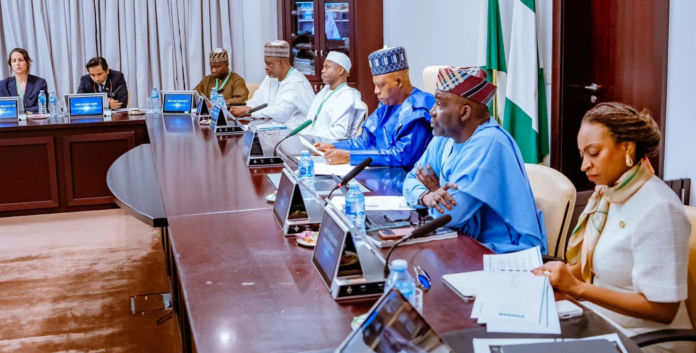
For Nigeria and Nigerians the first week of February 2026 was significant in a lot of ways particularly with the news of an official launching and unveiling of Nigeria’s National Halal Economy Strategy by Vice President Senatir Kashim Shettima in Abuja. Q1
Witnessed by chief driver of the initiative, the Chairman and Chief Executive Officer of Dar Al Halal Nigeria, Alhaji Muhammadu Dikko Ladan, Nigeria’s Ministers of Industry, Trade and Investment, and Agriculture, Ambassadors of Malaysia and France, the Islamic Development Bank, Bank of Industry, NEXIM Bank, the Nigeria Export Promotion Council, Jaiz Bank, and other private-sector stakeholders, the country is positioning of itself as a key player, aiming to add $1.5 billion to Nigeria’s GDP by 2027.
Nigeria’s halal economy is a rapidly growing sector, with the global halal market valued at $7.7 trillion. This initiative is expected to unlock over $12 billion in economic value, strengthen food security, deepen industrial capacity, and create opportunities for small-and-medium-sized enterprises.
The strategy focuses on expanding halal-compliant food exports, developing pharmaceutical and cosmetic value chains, positioning Nigeria as a halal-friendly tourism destination, and mobilizing ethical finance at scale. Nigeria’s large Muslim population and strategic location make it an ideal hub for exporting halal products to other markets in the world.
Its expected that Halal Food and Beverages with a global value of $1.4 trillion, Nigeria can tap into this lucrative market by investing in halal-certified food production while Halal Pharmaceuticals and Cosmetics are a rapidly growing market segment valued at $83 billion.
Some of the multiplier benefits of the Halal Econmy strategy include Nigeria can capitalize on this opportunity by establishing Islamic banks and financial institutions, offering Sharia-compliant financial products and services.
Key initiative benefits of the strategy include Export Expansion, Onboarding Nigerian companies into the Saudi Arabian market and beyond, Halal Certification, Government subsidies covering 50% of certification costs for startups, infrastructure Development, $100 million Sukuk issuance for agricultural hubs in northern states and job Creation upto 2 million jobs by 2027
The strategy is a public-private collaboration, with the Ministry of Industry, Trade and Investment chairing the implementation committee.
Represented at the event by Vice President Senator Kashim Shettima, President Tinubu described the unveiling of the strategy as a signal of Nigeria’s readiness to join the global race for a significant share of the halal economy already embraced by leading nations.
He said the strategy also clearly defines Nigeria’s direction within the market, which is expected to add an estimated $1.5 billion to the nation’s GDP by 2027.
The Vice President called for disciplined, inclusive and measurable action to ensure the strategy delivers jobs and shared prosperity across the country.
“It is with this sense of responsibility that I formally unveil the Nigeria National Halal Economy Strategy. This document is a declaration of our promise to meet global standards with Nigerian capacity and to convert opportunity into lasting economic value.
“What follows must be action that is disciplined, inclusive and measurable, so that this strategy delivers jobs, exports and shared prosperity across our nation,” he stated.
The Vice President outlined what he described as clear and measurable ambitions set by the strategy, including expanding halal-compliant food exports, developing pharmaceutical and cosmetic value chains, positioning Nigeria as a halal-friendly tourism destination, and mobilising ethical finance at scale by 2030.
According to him, these cumulative efforts are projected to unlock over $12 billion in economic value, while strengthening food security, deepening industrial capacity and creating opportunities for small and medium-sized enterprises across the states.
Addressing concerns linking halal to religious affiliation, Shettima noted that the “global halal economy has outgrown narrow interpretations”.
He said it is no longer defined solely by faith, but by trust through systems that emphasise quality, traceability, safety and ethical production, principles that resonate beyond any single community.
“These principles speak to consumers, investors and trading partners who increasingly demand certainty in how goods are produced, financed and delivered. It is within this broader understanding that Nigeria now positions itself,” he said.
The Vice President noted that many advanced Western economies have recognised the commercial and ethical appeal of the halal economy and integrated it into their export and quality assurance systems.
It must be noted that countries such as United Kingdom, France, Germany, Netherlands, United States.of America, Canada, Australia and New Zealand are leading producers, certifiers and exporters of halal food, pharmaceuticals, cosmetics and financial products in the world today.
It is therefore noted that their experience confirms that the halal economy is a global market framework rooted in standards, safety and consumer trust, rather than geography or belief.
The Nigerian Halal strategy was developed through partnerships with the Halal Products Development Company, a subsidiary of the Saudi Public Investment Fund, Dar Al Halal Group Nigeria, and with technical and financial backing from the Islamic Development Bank and the Arab Bank for Economic Development in Africa.
Commenting on the unveiling, the Chairperson of the National Halal Strategy Committee and Minister of Industry, Trade and Investment, Dr Jumoke Oduwole, explained that Nigeria would leverage the African Continental Free Trade area to export halal-friendly goods across Africa and beyond, stressing that participation in the strategy is voluntary.
Also speaking at the event, the French Ambassador to Nigeria, Marc Fonbaustier, represented by Carole Lebreton, Financial Counsellor at the French Embassy in Nigeria, said the strategy was also important to Nigeria–France relations, as France explores ways to build stronger socio-economic ties with Nigeria.
She said the French government stands ready to support Nigeria’s export drive, particularly in food, cosmetics and pharmaceuticals.
Indeed, adopting the halal strategy by Nigeria has opened the door wide for the expansion of its economic fortunes and prosperity.
MUSA ILALLAH
A PUBLIC AFFAIRS ANALYST
He can be reached at musahk123@yahoo.com


