

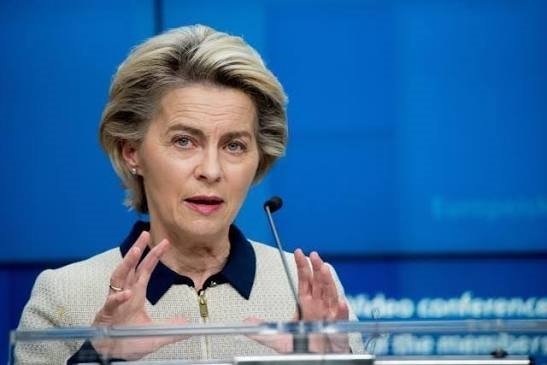
European Commission President Ursula von der Leyen has warned of the risks posed by advanced artificial intelligence (AI) models, calling for human oversight as Europe seeks to expand the technology’s use.
Von der Leyen raised the concerns on Wednesday in Strasbourg while delivering her State of the Union address.
“We want artificial intelligence. We want AI to create more value and responsibility, at lower cost and with less energy consumption.
“But AI has to be employed with human agency. This is the essence of the European way,” she said.
She said she would invite leading AI laboratories to discuss how Europe could support the industry while slowing the pace of AI development.
Her position contrasts with that of US President Donald Trump, who has dismissed concerns over AI safety as a “hoax” and rejected calls for stronger safeguards.
Trump has also described opposition to AI development as part of a “sick conspiracy” against the technology.
Meanwhile, leading figures in the AI industry have raised concerns about the potential consequences of increasingly powerful models.
Dario Amodei, Chief Executive Officer of Anthropic, has called for a slowdown in AI development, warning that an AI swarm could potentially take over the internet and cause hundreds of billions of dollars in damage.
Von der Leyen said on Monday that the warnings from AI developers should be taken seriously, stressing that the technology’s full potential could not be realized without addressing its risks.
She announced that the European Union would work with like-minded partners, including Canada and the United Kingdom, on areas such as AI model evaluation, verification, early-warning systems and safety.
The European Commission president also said the EU would outline plans to expand its computing capacity and develop new mechanisms for directing public and private funding towards promising AI companies.
Von der Leyen is expected to present further initiatives in November aimed at accelerating AI adoption across key sectors, including healthcare, transport, agriculture and food, advanced manufacturing, defense and space.


 models, calling for human oversight as Europe seeks to expand the technology’s use.)