

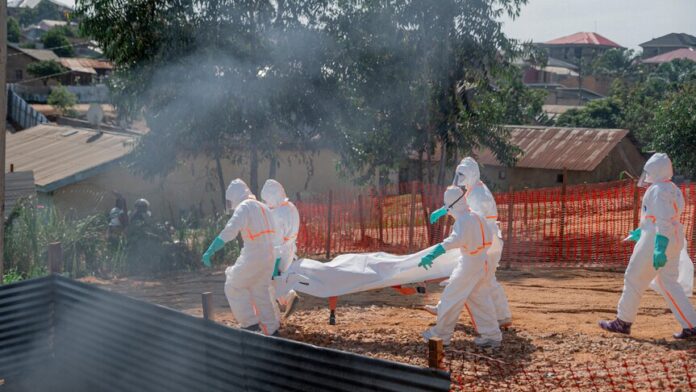
Ebola virus cases in the Democratic Republic of the Congo have reached 1,203, including 321 deaths, since the outbreak was declared in mid-May, the country’s Health Ministry said in a situation update late on Friday, 26 June 2026.
According to the ministry, 148 patients have recovered, while 419 remain in isolation or in hospital. The outbreak, caused by the Bundibugyo strain, has spread across 34 health zones in three provinces: Ituri, the epicentre of the crisis, North Kivu and South Kivu.
Health officials cited community resistance to postmortem testing and insufficient treatment capacity in Ituri as key obstacles. The contact follow-up rate also remains below the 95 per cent target set by health authorities.
“The government reminds everyone that the fight against Ebola is everyone’s responsibility. Every citizen is urged to report any suspected case, adhere to hygiene measures, and avoid handling the bodies of deceased persons,” the ministry said in its statement.
Africa Centres for Disease Control and Prevention Director General Jean Kaseya said on Thursday, 25 June 2026, that international partners, including the World Health Organization, the European Centre for Disease Prevention and Control, and French and Congolese authorities, remain committed to a coordinated response to contain the outbreak.
World Health Organization Director-General Tedros Adhanom Ghebreyesus, writing on X on Saturday, 27 June 2026, said the ongoing regional conflict was compounding the crisis. “War makes fighting Ebola so much harder, blocking access, scattering contacts, and driving people into hiding out of fear and mistrust,” he said.
The outbreak has grown steadily since it was declared on 15 May 2026. Cases passed 1,000 by 22 June, with 254 deaths recorded at the time, and surpassed 300 deaths with 1,155 cases by 26 June, before reaching the latest count of 1,203 cases and 321 deaths.


