

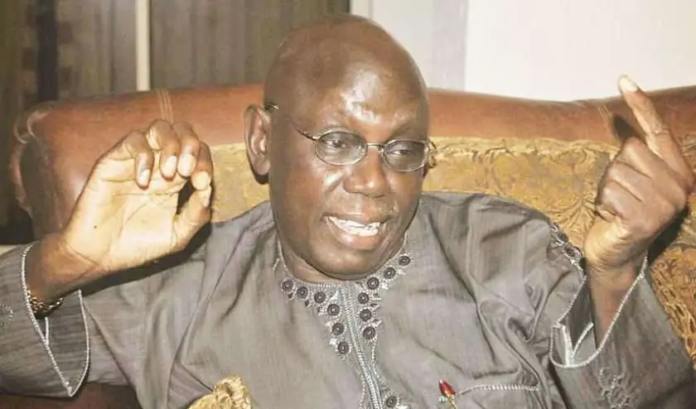
Dan Ochima Agbese, veteran journalist, master prose stylist, and co-founder of Newswatch magazine, has passed on, leaving behind one of the most enduring legacies in Nigerian media history. As part of the iconic quartet that birthed Newswatch, alongside Dele Giwa, Ray Ekpu, and Yakubu Mohammed, Agbese helped to redefine investigative journalism in the 1980s and 1990s.
Calm, disciplined, and intellectually rigorous, Agbese wrote with clarity and purpose, challenging authority without theatrics and mentoring a generation of younger journalists who looked to him for both guidance and moral grounding. More than a columnist, he was an institution builder and a conscience of public life. For decades, Agbese’s voice, always firm, witty, and principled, shaped national discourse. With his passing, Nigeria has lost one of its finest journalistic minds, but his legacy remains etched in ink, integrity, and the pursuit of truth.
In Agbese’s passing, Nigeria has lost not just one of its most respected journalists but a towering figure whose pen shaped public consciousness for more than four decades. His exit marks the end of a generation of media giants who fiercely believed that journalism was not merely a profession, but a calling anchored on truth, courage, and a profound sense of responsibility to society.
Agbese’s name cannot be separated from one of the most transformative chapters in Nigerian media history, in this regard, the founding of Newswatch newsmagazine in 1985. Alongside the late Dele Giwa, Ray Ekpu, and Yakubu Mohammed, he co-founded what became, throughout the 1980s and 1990s, Africa’s most influential and most quoted English-language news magazine. In those years, Newswatch emerged as a citadel of bold investigative journalism, with its pages filled not only with breaking stories but with deep analysis, interpretation, and commentary that forced the country to confront itself.
Within this formidable quartet, Agbese’s voice was distinct. His essays were marked by clarity, calm logic, and a mischievous wit that could critique without malice and challenge without losing civility. He mastered the art of disarming power with intelligence, never with theatrics. Where others raged, Agbese reasoned; where others shouted, he wrote with precision, humour, and integrity.
What made Dan Agbese exceptional was the discipline he brought to the craft. He understood writing as architecture, with every sentence carefully placed and every argument meticulously structured. Even those who disagreed with him could not ignore the meticulous thought in his essays. Agbese’s prose was accessible elegant and never arrogant.
Many Nigerian journalists learned, directly or indirectly, from reading him. Younger reporters often turned to his columns not just for content but for craftsmanship, specifically as to how he constructed arguments, how he transitioned gracefully from anecdote to analysis and how he ended a piece with quiet force instead of verbal fireworks.
When Newswatch became a target of governmental hostility, Agbese and his colleagues stood firm—not out of bravado, but out of conviction. They understood that a nation without a free press becomes a nation without a compass. Their work helped embed the culture of accountability in Nigeria’s national life, a legacy that continues today. Agbese’s impact extended far beyond the printed page. He was a mentor to countless journalists and writers who sought not just professional guidance but moral clarity.
Those of us who passed through the Newswatch newsroom recall his generosity with knowledge and his insistence that journalism must be anchored on ethics. Even after Newswatch, his intellectual restlessness did not wane as he continued to write, teach, and consult. His reflections on governance, leadership, and national development demonstrated a mind that was as sharp at 80 as it had been at 40.
To those who passed through his tutelage, Agbese was warm, witty, and approachable. Despite his stature, he carried himself without airs. He had an extraordinary ability to listen—deeply, attentively, respectfully. His humour was subtle, and his laughter infectious. Agbese did not see journalism as a battlefield, but as a conversation with society. He believed in nuance, in balance, and in the duty to be fair even to those in positions of power. For him, journalism was a tool for enlightenment.
If truth be told, the story of Nigerian journalism cannot be told without devoting a significant chapter to Dan Agbese. He belonged to a rare class of practitioners who elevated journalism from mere reporting to a form of civic leadership. Through his columns, editorials, and institutional contributions, he helped shape how Nigerians think about governance, accountability, and public duty.
For the forest of Nigerian journalism, a giant tree has fallen. But Agbese can smile in his grave in the knowledge that the forest stands taller because he once walked among us.
Magaji. <Magaji778@gmail.com> writes from Abuja


