

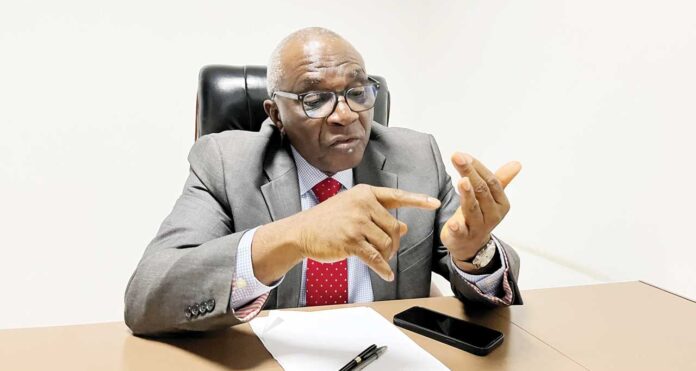
On Wednesday, May 27, 2026, a doctored video of Martins Vincent Otse (VeryDarkMan/VDM), which had been circulating on social media, caught the attention of Bayo Onanuga, President Tinubu’s media advisor. In the video, VDM appeared to reference an AI-generated voice of President Bola Tinubu saying insecurity in Nigeria would continue because Nigerians did not vote for him in 2023.
When the video came to Onanuga’s attention, he quickly posted on social media. He vowed that VDM would face the “full weight” of the law upon his return to Nigeria for “being a conveyor and disseminator of a fake audio of President Tinubu.”
“This is a clear case of an egregious abuse of the social media platform,” Onanuga wailed.
Really? What was in the Tinubu audio that terrified Aso Rock?
Onanuga, a veteran journalist, did not bother to check whether VDM actually made the video. He did not verify that it appeared on VDM’s social media accounts. He seemed to think: “We got him. We need to teach him a lesson for criticizing Tinubu.”
That, my friend, is how not to be a journalist.
More disturbing was how both traditional and new media amplified Onanuga’s accusation without doing the most basic verification. Media ethics require journalists to cross-check such claims and, at the very least, reach out to the accused before publication.
None of that happened in most news reports.
From abroad, VDM responded. He blasted the president’s media chief for failing to carry out due diligence before attributing the video to him.
When it became clear that VDM did not produce the video, Onanuga neither retracted his threat nor apologized, just as he did after the 2023 presidential election, when he issued his infamous warning to Igbo residents of Lagos against “interfering” in the state’s politics.
“Let 2023 be the last time of Igbo interference in Lagos politics,” he wrote. “Let there be no repeat in 2027. Lagos is like Anambra, Imo, any Nigerian state. It is not No Man’s Land. Mind your business.”
Despite public outrage and demands for a withdrawal, Onanuga doubled down. He refused to apologize and argued that Igbo people posed an “existential threat” to the Yoruba people and that he was “first of all Yoruba, before being a Nigerian.”
Then he moved on.
Nigeria moved on, too.
Just as it is moving on now.
On June 4, police in Benin City arrested one Ifechukwu Dennis. They accused him of creating the deepfake audio of Bola Tinubu.
Most Nigerians on social media greeted the news with a chorus of “lock him up and throw away the keys.” They argued that what he did could incite public disorder.
The poor boy is probably locked up with the keys thrown away.
Yet the fundamental question remains unanswered: What crime did Ifechukwu Dennis commit?
As expected, government officials are already invoking the ubiquitous cybercrime and anti-bullying laws. Some suggest Dennis intended to incite the public, cause disaffection, and undermine law and order in Nigeria. It is the familiar language of suppression inherited from the military era.
Apparently, a public that was not incited when President Tinubu awarded an $11 billion no-bid contract to Hitech Construction Company, owned by his friends, the Chagourys, will suddenly pour into the streets because an AI-generated Tinubu voice said insecurity would continue because Nigerians did not vote for him.
Eleven billion dollars is more than one-fifth of Nigeria’s 2026 budget of $49.4 billion. And it is financed with loans that future generations of Nigerians will repay—with interest.
Tinubu is a satirist’s delight.
For a president who rarely speaks to Nigerians or explains what his government is doing, it is hardly surprising that people try to imagine what he is thinking. Even presidents like Donald Trump, who explain too much, inspire people to imagine what is going on inside their heads.
In every healthy democracy, satirists lampoon public figures. It humanizes them. A cartoon can reduce a god-wannabe politician to size.
A civic space where ignorance and suppressive laws are deployed to criminalize the ridiculing of public officials is a space on the verge of complete closure. Any government that cannot take a joke is dangerous.
I do not know Ifechukwu Dennis. But judging from the photographs circulating online, he appears to be a young man who dabbled in satire.
His most likely crime is writing bad satire about powerful people who cannot take a joke.
If writing satire comes too easily, you are probably writing bad satire.
My late friend, Wads Nas, became famous for writing bad satire defending Sani Abacha and other Nigerian bad sons.
Unlike much of the bad satire produced today by both the learned and the unlearned, Wads Nas’ satire was never malignant.
The entire hullabaloo over the doctored VDM video and the AI-generated voice of President Tinubu boils down to one thing: Bad satire.
Nothing more. Nothing less.
…
Rudolf Ogoo Okonkwo teaches Post-colonial African History, Diasporic African Literature, and African Folktales at the School of Visual Arts in New York City. He is the author of “This American Life Sef.” His latest book is “A Kiss That Never Was.”


