

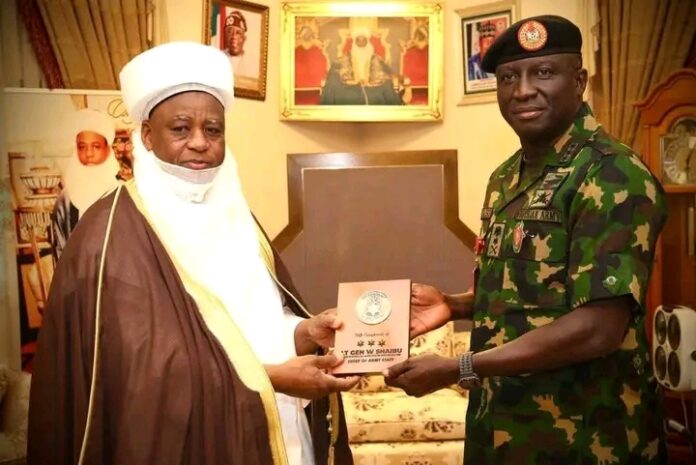
The Chief of Army Staff (COAS), Lieutenant General Waidi Shaibu, on Friday paid a courtesy visit to the Sultan of Sokoto, Muhammadu Sa’ad Abubakar, in a move aimed at strengthening civil military relations and promoting peace across Nigeria.
According to the Nigerian Army, the visit was geared towards reaffirming its resolve to work closely with community and traditional leaders to promote stability, coexistence and national unity.
“The visit highlights the renewed commitment of the Nigerian Army to strengthening civil military relations and fostering collaboration with traditional institutions in support of national unity, peace and security,” the army said in a statement shared on X (formerly Twitter).
The meeting came less than 24 hours after the United States, through its Africa Command (AFRICOM), launched airstrikes on suspected Islamic State (ISIS) enclaves in parts of Sokoto State.
AFRICOM said the aerial bombardment was carried out at the request of Nigerian authorities, a claim later confirmed by the Defence Headquarters (DHQ), which disclosed that the Nigerian military worked in collaboration with the US government to execute the operation.
Samaila Uba, Director of Defence Information, said the strikes were carefully calibrated to neutralise the targeted terrorist elements while minimising collateral damage.
However, concerns were raised by Ladan Salihu, a Nigerian broadcaster and former Director-General of the Federal Radio Corporation of Nigeria (FRCN), who alleged that the airstrikes missed their intended targets and lacked precision.
Salihu claimed that some of the bombs landed in Jabo village, Tambuwal Local Government Area of Sokoto State, adding that residents reported no fatalities in the affected area.
In response, the Ministry of Information clarified that the intended target of the airstrikes was the Buani forest in Tangaza Local Government Area of Sokoto State. The ministry further explained that debris from the strikes fell in Jabo village and parts of Offa in Kwara State.
The development has continued to generate public debate, even as security authorities insist the operation was a success and part of ongoing efforts to degrade terrorist networks in the country.


