

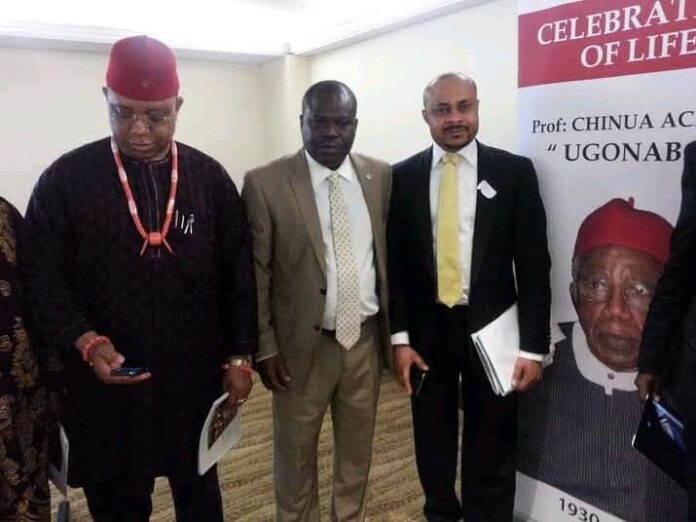
The Memorial
In April 2014, at the London Hilton, we gathered to mark the first anniversary of Chinua Achebe’s passing. The room was full of writers, diplomats, and Nigerians who still believed his words could save us.
As I closed my address that night, I said something I had never planned:
“I am an Ijebu man from the Southwest region of Nigeria, born by a Northern mother at the heart of the Eastern region of Enugu. Therefore, I’m a miniature map of Nigeria.”
The hall rose. Not for me. For the idea. For the possibility that one person could carry the whole country and not break.
Achebe spent his life warning us that Nigeria’s trouble was not in our diversity, but in our leadership. Ten years after he left us, I stood at the London Hilton for his first memorial and tried to answer him with my life.
Achebe’s Burden
“The trouble with Nigeria is simply and squarely a failure of leadership.”
The Trouble with Nigeria, 1983.
This statement is the foundation of my life as a miniature map of Nigeria.
Achebe’s burden was to remind us that division was a choice, not destiny. He argued for leadership rooted in character, competence, and fairness. He saw how our diversity — which should have been our greatest asset — was weaponized into mutual suspicion.
“Nigeria is what it is because its citizens live in a state of mutual suspicion and distrust.”
The Trouble with Nigeria, 1983.
That is the wound. The miniature map is the answer.
The Miniature Map
I did not choose my coordinates. Ijebu heritage from my father. Northern blood from my mother. Eastern soil as my first cry in Enugu. Three regions. One person. One story.
I grew up eating amala, miyan kuka, and jollof. I heard proverbs in Yoruba, Hausa-inflected English, and Igbo songs from neighbors. I learned early that “us vs them” is a political invention, not a human reality.
If one man can carry Southwest, North, and East in his chest without contradiction, then Nigeria can too. Our intertribal heritage is not rare. It is just rarely celebrated. We treat mixed homes like exceptions, when they should be the model.
The Call
If I can be a miniature map of Nigeria, then Nigeria can be a giant map of possibility.
But maps are useless if we refuse to follow them. And right now, we are lost because we keep navigating by tribe instead of by issues.
Achebe gave us the diagnosis. My life, and the lives of millions of intertribal Nigerians, give us the evidence. What remains is the choice.
This is the moment for those of us with similar providential grace to align our thoughts and heritages for our beloved country, Nigeria — destined for greatness.
The call is simple:
1. Lead with issues, not identity.
Hospitals don’t ask for your surname before they save you. Roads don’t care what language you speak on them. Power, water, jobs, security, education — these are Nigerian problems. When we vote, appoint, and debate based on competence and track record instead of “where he comes from,” we begin to heal.
2. Reward fairness, not favoritism.
Trust dies the moment people believe the system is rigged for “us” against “them.” Leadership must be seen to be fair — in hiring, in projects, in justice. When a child in Sokoto, Sagamu, and Nsukka believes she has the same shot, suspicion begins to fade.
3. Celebrate the miniature maps among us.
We must stop treating intertribal families as footnotes. They are the future. They are living proof that “North, South, East, West” can live in one home, one heart, one country. Our policy, media, and politics must reflect that Nigeria.
Achebe once said, _”If you don’t like someone’s story, write your own.”_
We didn’t like the story of division, corruption, and ethnic arithmetic. So let’s write another one.
Let the story of Nigeria be told by those who have lived all of Nigeria. By the Ijebu man with a Northern mother born in Enugu. By the Hausa-Igbo couple in Abuja. By the Yoruba-Ijaw teacher in Port Harcourt. By all of us who carry more than one region in our blood.
That night in London, the room stood up because they were tired. Tired of division. Hungry for an example.
Ten years later, the question is still before us:
Will we keep describing the problem, or will we become the answer?
Conclusion: Prayers for National Unity
Broad Vision: Leaders must embrace the entire nation.
Healing Divides: End old tribal wounds and favoritism.
Peace and Growth: Foster inclusion, equal care, and fair power distribution across all regions.
Moving Forward
Issue-Based Politics: Reject politics that divide people by ethnicity or religion.
Strength in Diversity: Treat national variety as the country’s greatest asset.
Call to Action: Pray for leaders to receive wisdom, knowledge, and understanding to make the nation great again.
Finally, let the story of Nigeria be told by those who have lived all of Nigeria. It mirrors Achebe’s own insistence that we must tell our own stories.
I am a miniature map.
Nigeria can be too.
Citizen Richard ODUSANYA
Public Affairs Enthusiast and Good Governance Advocate
odusanyagold@gmail.com


