

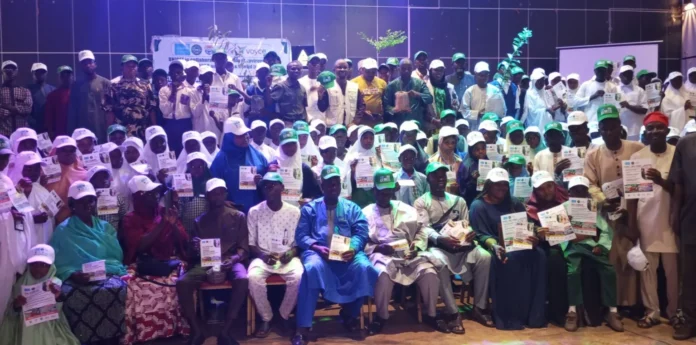
The United Nations Children’s Fund (UNICEF), in partnership with the Young and Useful Generation Initiative (YUGI), has mobilized 225 secondary school students from across Sokoto State as climate ambassadors to drive grassroots action against climate change.
The initiative, which aims to empower young people to champion environmental sustainability, equipped the students with skills to mobilize their peers and implement climate resilience projects within their schools and communities.
Speaking at the two-day program on Thursday, YUGI Executive Director, Mr. Edayi Edison, said the project seeks to establish 1,000 climate change associations in secondary schools nationwide and facilitate the planting and nurturing of at least 10,000 trees.
Edison warned that climate change, driven by human activities and changing weather patterns, continues to threaten livelihoods through declining agricultural productivity, drying water sources, deforestation, and environmental degradation.
He disclosed that about 150 teachers and members of civil society organizations (CSOs) also participated in the program, which focuses on advancing climate action through evidence-based advocacy, capacity building, and innovative solutions.
According to him, three students were selected from each of the 75 participating schools as climate anchors in the first phase of the initiative.
He added that the program would subsequently be expanded to tertiary institutions as well as additional secondary and primary schools.
Edison stressed the need for stronger collaboration among stakeholders to deepen climate awareness and strengthen community resilience against environmental challenges.
“The impact of environmental degradation on ecosystems, public health, and economic development requires urgent and coordinated action from all sectors of society,” he said.
In his remarks, UNICEF Water, Sanitation and Hygiene (WASH) Specialist, Dr. Eteng Ebri-Ibor, called for the timely provision of tree seedlings to support afforestation efforts, revealing that UNICEF had earmarked 10,000 seedlings for Sokoto State under the initiative.
Ebri-Ibor said the intervention was part of UNICEF’s Green Rising Campaign and was designed to address the growing threats of climate change, desertification, and deforestation in the state.
He also urged government authorities to strengthen sanctions against indiscriminate tree felling, arguing that existing penalties were insufficient to deter offenders.
According to him, stricter enforcement would encourage tree replacement and promote long-term environmental sustainability.
He encouraged the newly inaugurated climate ambassadors to apply the knowledge gained during the program and share it with their peers to support environmental restoration through tree planting and conservation efforts.
Also speaking, Prof. Musa Shamaki educated participants on proper seedling management, waste disposal practices, and the principles of “rethink, refuse, reuse, reduce, and recycle” as effective strategies for managing plastic waste and protecting the environment.
Using practical examples, he highlighted the impact of urbanization, infrastructure development, construction, and farmland expansion on deforestation and ecosystem degradation.
Shamaki emphasized the importance of collaboration among government institutions, the private sector, civil society organizations, and development partners in tackling climate-related challenges.
Another resource person, Dr. Olalekan Oderinde, urged students to adhere to established guidelines on tree planting and environmental sustainability while embracing climate change mitigation and adaptation strategies.
The event featured the inauguration of the students as Green Ambassadors, interactive question-and-answer sessions, and discussions on climate challenges, practical solutions, and commitments needed to sustain the initiative.
The program forms part of broader efforts to empower young people as agents of change in addressing climate and environmental challenges at the grassroots level.
SOURCE: NAN


