

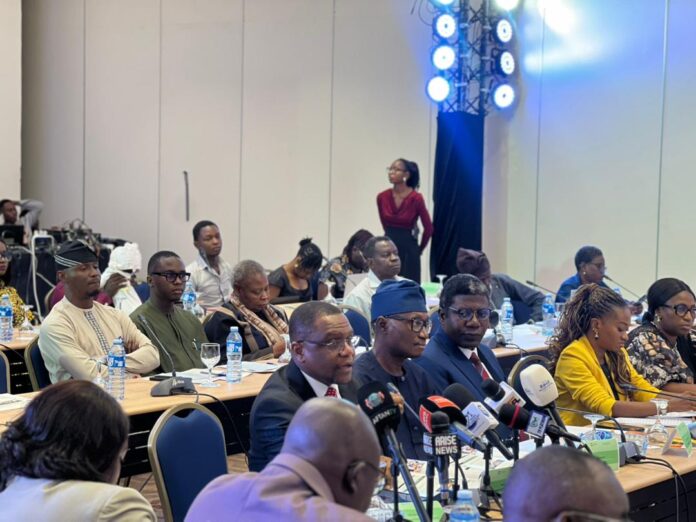
A non-governmental organization working in the area of driving citizen-led democratic development, the Kimpact Development Initiative, KDI has released its State of Democracy Performance in Nigeria Report, a data-driven assessment of how democracy is functioning across all 36 states of the Federation.
The report which was presented at the Abuja Continental Hotel, with participants from across Nigeria and beyond joining virtually, as stakeholders engaged in critical questions on participation, accountability, and performance across states.
Data presented during the event showed that no state reached high electoral participation, with 97.2% falling below that standard.
Also, political inclusion remained the weakest dimension, with 100% of states below acceptable levels.
The report further revealed that while various institutions were present at the state levels, 58.3% of states operate below functional institutional standards, raising the questions as to why participation does not translate into accountability, and why systems exist without delivering outcomes.
In his opening remarks, the KDI Team Lead, Bukola Idowu, noted that as Nigeria approaches critical national decisions, there is a need to move beyond assumptions and engage with democracy through evidence, data, and lived realities.
According to him, democracy is active across states but does not necessarily translate into accountable governance.
“Across Nigeria, the picture is more complex than it seems, where visibility doesn’t always equal performance, and participation doesn’t always translate into impact. These are the kinds of patterns data begins to surface when you take a closer look,” he noted.
Idowu urged participants not to see the report as a final verdict, but a recommendation and a look at the realities that should lead the nation back to the drawing board to continue the work on strengthening democracy.
The Head of Research and Programs at the KDI, Oluwafemi John reframed how the Democracy Performance Index should be understood, noting that rather than a binary of strong or weak, good or bad, the Index is a tool for learning, one that reveals patterns, gaps, and opportunities across states.
He posited, “With no state reaching high participation, all states falling below acceptable inclusion levels, and over half operating below functional institutional standards, the data is not just evaluative, it is instructive.
“The value lies in what can be taken forward, what is working, what is not, and what can be improved. There is much to learn, and even more to act on.”
A Nigerian gender activist, while noting that Nigeria faces existential problems, raised a critical issue of accountability, emphasising that obligations owed must be addressed and enforced, not ignored.
Another participant, Amaechi Anakwe pushed the conversation beyond systems and structures, observing that Nigeria’s problem goes beyond democracy, to include the people’s cultural values and inclinations.
Reflecting on pre-colonial governance systems like the Oyo Empire, he argued that leadership was more distributed and less concentrated in a single authority, raising questions about how power is structured today.
In a goodwill message, the National Secretary of the Nigeria Union of Journalists, NUJ, Achike Chude, identified the time of transition as a critical reality often overlooked, arguing that Nigeria cannot afford a slow, generational approach to democratic development.
For his part, Prof. Earnest Ereke challenged prevailing ideas about how democracy is framed and practiced, questioning the notion of labeling democracy as “liberal” or “illiberal,” while noting that such distinctions can contribute to structural problems rather than resolve them.
He also pointed to the legislature as a critical, but underutilized, bridge between government and the people, adding that strengthening this connection requires deeper public engagement and meaningful reform within the legislative system.
In their goodwill messages, Omolara Akinyeye, the Deputy Executive Director at Policy Legal and Advocacy Center (PLAC) and Busari Sarafadeen, the Director General of the Conference of Speakers of State Legislators in Nigeria, both congratulated KDI on the launch of the report.
Other goodwill messages from key stakeholders reinforced a shared understanding that strengthening democracy requires alignment across sectors, not isolated efforts.


