

Barely two days after showcasing seizures of raw donkey skin and other contraband, Nigeria’s anti-smuggling campaign has taken a more alarming turn as operatives of the Nigeria Customs Service uncovered a suspected fuel supply route allegedly linked to insurgents operating through Cameroon.
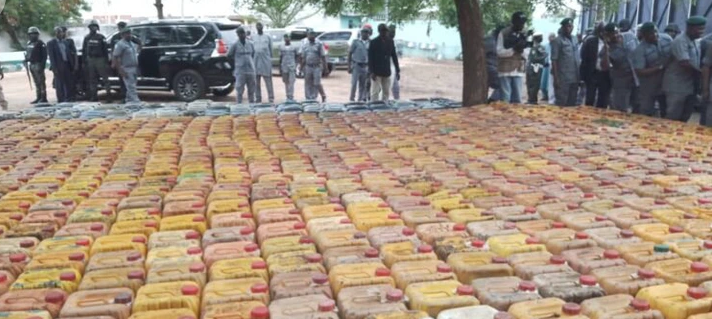
At a press briefing in Yola on Friday, customs authorities revealed the interception of a fully loaded fuel tanker alongside thousands of jerry cans filled with Premium Motor Spirit (PMS), believed to be destined for criminal networks in the Lake Chad region.
The operation, conducted under the intelligence-driven “Operation Whirlwind,” exposed what officials described as a vast smuggling network exploiting Nigeria’s porous borders and fuel price disparities to move large quantities of petrol out of the country.
Deputy Comptroller AL Aliyu disclosed that within six weeks, operatives recorded 47 seizures across major smuggling corridors in Adamawa, including Mubi, Sahuda, Belel, Fufore, and Maiha axes.
The seizures comprised 64,410 litres of petrol stored in 2,550 jerry cans, along with additional containers and vehicles used for transportation.
In a related development, officers intercepted a DAF tanker carrying 50,000 litres of PMS along the Mubi–Uba road in the early hours of April 15, 2026. Authorities noted that the scale of the movement suggests organized diversion schemes with possible links to insurgent logistics pipelines across the border.
Aliyu warned that the illegal trade is driven by significant price differences between Nigeria and neighboring countries. While petrol sells for about N1,330 per litre in Nigeria, it reportedly exceeds N2,000 per litre in Cameroon, creating a thriving black market for smugglers.
“This is not just economic sabotage,” he said. “These products could end up powering insecurity.”
Security analysts have long cautioned that fuel smuggling routes may double as supply chains for extremist groups such as Boko Haram, enabling their operations in remote border areas.
The Customs Service vowed to intensify its crackdown and dismantle the networks behind the illicit trade. Meanwhile, the seized fuel will be auctioned publicly, with proceeds remitted to the federal government.
Authorities also called on citizens and border communities to provide intelligence, stressing that tackling smuggling and its potential links to terrorism requires collective vigilance.


