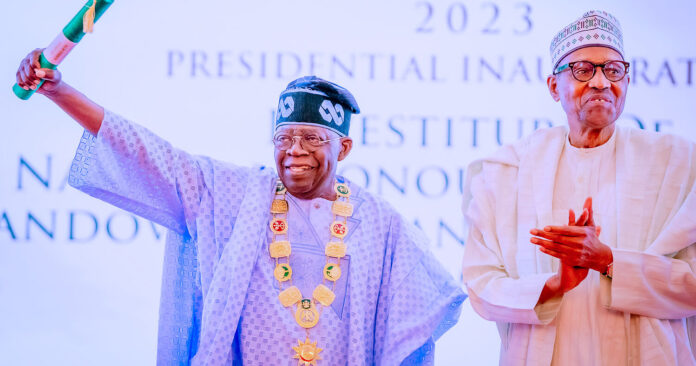
It is an undisputable fact that Nigerian Governors have witnessed an unprecedented rise in funding from the monthly ‘awoof’ by the federal Allocation and fiscal commission, FAAC since PBAT took over the reigns of the country’s leadership from now late President Muhammadu Buhari on May 29th 2023.
Even during the PMB years, Nigerian Governors have had it so good with numerous interventions and support to their states and FCT finances to keep them afloat in the provision of the dividends of democracy to their people.
President Buhari’s administration provided funding support to states through initiatives like the N2 trillion in bailout and budget support packages, which included the $5.4 billion Paris Club refunds, N614 billion Budget support facility, and N700 billion in infrastructure loans/refunds among others.
Additional support was provided by PMB through the N656 billion Bridge Financing Facility to help states repay previous loans, and the NG-CARES program aimed at mitigating the economic and social impact of the COVID-19 pandemic in the 36 states and FCT.
These supports were largely aimed at helping state governments meet their financial obligations arising from revenue shortfalls consequent from the fall in crude oil prices globally.
The funding supported projects and programmes, with the aim of boosting economic recovery and providing a social safety net for citizens.
The greater aim by the PMB administration in all the interventions was to lift 100 million Nigerians out of poverty in 10 years as part of government’s economic sustainability plan put in place in the wake of the COVID-19 Pandemic.
In May 2023, Nigeria’s Federation Account Allocation Committee (FAAC) shared a total of N786.161 billion among the three tiers of government (federal, state, and local). This disbursement came from revenue generated during the month.
However, the coming of the PBAT administration following its withdrawal of fuel subsidy during its inauguration speech at Eagle Square in Abuja, withdrawal of energy subsidy, along with an increase in VAT and introduction of numerous other taxes, states’ monthly Allocation from the Federation Account increased several-fold.
FAAC inflows skyrocketed from ₦5.4 trillion in 2023 to ₦11.4 trillion, accounting for nearly 66 per cent of the total revenue growth.
While revenue expanded sharply, many states were sustained by allocations from the centre during the period, despite a 110.7 per cent surge in such distributions, with soaring debt and low capital spending compounding their dilemma.
Apparently disturbed by the situation in the states, Governor Abdullahi Sule of Nasarawa state, urged state governors across the country to take full responsibility for security in their domains, emphasizing that the level of resources now available makes excuses unacceptable.
Speaking at the 2025 Northern Nigeria Investment and Industrialization Summit in Abuja, Sule highlighted that monthly allocations to the federal, state, and local governments have quadrupled under President Bola Tinubu’s reform-driven administration.
“For the first time in our history, all tiers of government are sharing more revenue than they ever imagined.”
“Over N2.2 trillion was shared this August 2025 alone. When I became governor in 2019, we were sharing between N590 billion and N620 billion. Today, it is four times that amount”, he said
Sule urged northern governors to channel the windfall into sectors capable of transforming the economy while also taking charge of the security of their states.
“Every state now has the resources to secure its people. We should stop blaming anybody for our security. If we are blaming anybody, blame ourselves,” he declared.
The Federation Account Allocation Committee (FAAC) had earlier announced the disbursement of N2.22 trillion among the three tiers of government in August of 2025, out of a gross total of N3.63 trillion.
In the words of BudgIT’s global director, Oluseun Onigbinde: “Nigeria is at a fiscal crossroads as inflation and debt obligations continue to outweigh revenue growth.” He further urged states to scale back dependence on federal allocations, strengthen local economies and prioritise investments in education, healthcare, and infrastructure.
Indeed, the collapse of governance at the national and subnational levels in the country, despite the increase in funding, calls for action for both government and citizens to make governance more transparent, accountable, and people-centred.
As it is now, there is nothing to show in the states in terms of projects that will impact the lives of the people of the states.