

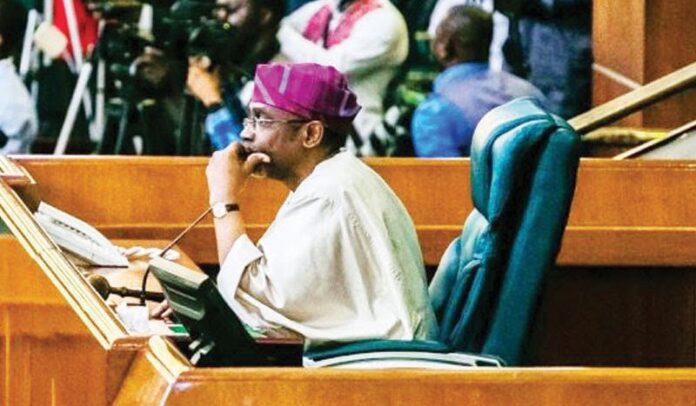
It appears everyone in Abuja has a Femi Gbajabiamila story. Very few are willing to tell it publicly.
Speak to politicians, contractors, lobbyists, businesspeople, or civil servants who have worked in the House of Representatives over the last 20 years or sought an audience with President Bola Tinubu, and sooner or later the conversation turns to the President’s Chief of Staff. The details differ, but the stories converge on one point: fear.
It is not necessarily fear of physical violence, but rather fear of what he represents: the gatekeeper to Nigeria’s most powerful office. Not even Abba Kyari came close to wielding power the way Gbajabiamila does.
In today’s Nigeria, access is pure lithium. To lose access is to lose contracts, appointments, influence, protection, and sometimes even relevance. If you doubt it, ask Femi Ojodu. That is why many who privately complain about Gbajabiamila refuse to speak on the record. They fear permanent exile from the corridors of power.
It is remarkable that a politician occupying such a strategic office also carries one of the most controversial professional histories in Nigerian public life.
On February 26, 2007, the Supreme Court of Georgia approved disciplinary action against Gbajabiamila after he admitted to stealing a client’s funds. Court records show that he received a $25,000 personal injury settlement on behalf of a client but failed to disburse the money promptly. His law license was suspended, and in July 2020, the State Bar of Georgia revoked it after he failed to satisfy the conditions for reinstatement. He later refunded the client’s money after four years in the House of Representatives.
Long before those proceedings concluded, however, Gbajabiamila had returned to Nigeria and reinvented himself politically.
Elected to the House of Representatives in 2003, he rose from opposition leader to Majority Leader, then Speaker, and ultimately Chief of Staff to the President.
Tinubu’s choice of Femi Gbajabiamila as Chief of Staff was a telling display of the president’s character judgment.
Gbajabiamila arrived in Lagos the same way Bola Tinubu had arrived a few years earlier. For those who wonder how the two men got along so well, Bola Tinubu left Chicago after federal authorities pursued the forfeiture of more than $460,000 from a bank account linked, according to court records, to a narcotics and money-laundering investigation in Chicago. He ultimately agreed to the civil forfeiture without a criminal conviction.
For their supporters, those episodes are little more than footnotes in careers defined by political survival. But astute political observers consider them potential points of leverage, or even blackmail, that foreign governments could hold against them.
Since the Fourth Republic, power in Nigeria has depended largely on how close one is to the president. Today, except for Remi Tinubu, who donates unbudgeted billions from unknown sources wherever she goes, few people stand closer to the President than Femi Gbajabiamila.
That is why whispers about Gbajabiamila, in and beyond Abuja, matter.
For more than three years, I have listened to politicians, businesspeople, and government insiders recount their encounters with the presidency. Almost all insist that their names never appear in print. Some fear losing contracts. Others worry about appointments, investigations, or being shut out. In Abuja, they believe, memory is elephant-shaped, and access comes at a premium.
And if they openly reveal serious infractions, they risk suffering the same fate as Prince Adeyemi Adeniyi’s personal assistant, Dolapo Babatunde Tanimola.
If you know the origins of Lagos politics in the Fourth Republic, particularly the Funsho Williams example, you will understand why.
Their caution reminds me of a story from the administration of President Goodluck Jonathan.
A Nigerian-American businessman once told me how a federal minister instructed him to submit three bids for a government contract through three different companies registered in separate geopolitical zones. The objective was simple: create the appearance of competition while ensuring that the preferred company won.
As the meeting ended, the minister gave one final instruction.
“If we ever meet at a public event,” he said, “don’t even greet me.”
The businessman was stunned.
The minister understood something fundamental about corruption in Nigeria. The appearance of distance mattered almost as much as the transaction itself. Public association had to be avoided, even when private arrangements had already been concluded.
That was a different Nigeria.
Then, corruption still carried enough shame that those involved tried to hide their fingerprints. Today, the very powerful simply go for the no-bid, Gilbert Chagoury-style Lagos-Calabar Superhighway contract. For others, the methods have become more sophisticated. They deploy shell companies that span continents, beneficial ownership disappears behind corporate secrecy, and money moves through offshore accounts, cryptocurrencies, and digital networks. The fewer direct fingerprints, the better.
Political power has evolved in much the same way.
In previous administrations, influence was spread across ministers, governors, party leaders, legislators, and presidential advisers. Today, many, both inside and outside government, believe that one of the surest routes to the presidency passes through a remarkably small circle of mostly Lagos boys imported into Abuja.
Under Tinubu, an informal network of old friends and associates, mostly from Lagos, controls what used to be the formal structures of government. As transparency fades, murky deals and opaque actions dominate the public space, eroding public confidence.
Femi Gbajabiamila did not invent patronage politics, nor did he create Nigeria’s culture of political gatekeeping. He has become its most shrewd poster boy.
The larger question is what it says about our democracy when so many people feel unable to discuss openly those who wield enormous influence behind the scenes.
A healthy democracy requires citizens to be informed and to discuss matters of state openly, based on credible information provided by the government, not the shoddy defenses put up by presidential spokesmen before investigations even begin. Agents of the state should not terrorize journalists for asking questions aimed at holding those in power accountable. It is in the public interest that scrutiny of government policies occur uninhibited.
In a democracy, enforcing silence is not the mark of a master political strategist but of a scared mini-tyrant suffering from untreated paranoia.
Some say even the president is afraid because Gbajabiamila knows where the bodies are buried. Come on—not the Jagaban. No, sir. Why would President Bola Tinubu be afraid of Femi Gbajabiamila? Unless Gbajabiamila reminds Tinubu of his younger self.
Rudolf Ogoo Okonkwo teaches Post-colonial African History, Diasporic African Literature, and African Folktales at the School of Visual Arts in New York City. He is the author of “This American Life Sef.” His latest book is “A Kiss That Never Was.”


