

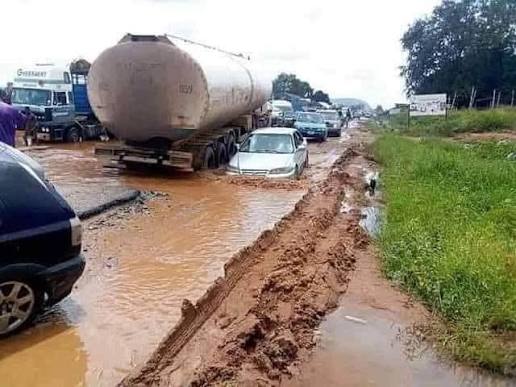
Nigeria’s annual flooding has once again exposed a problem that goes far beyond the rising waters. Across cities, towns and rural communities, floods have revealed the alarming condition of roads and streets that, in many cases, appear incapable of withstanding even the pressures of ordinary rainfall.
What should ordinarily be a temporary environmental challenge has increasingly become a transportation and infrastructure crisis. Roads are washed away, asphalt surfaces collapse, potholes become craters, drainage channels are blocked or poorly designed, and entire stretches of streets become impassable. For motorists, commuters, traders and residents, the consequences are immediate: damaged vehicles, longer travel times, disrupted businesses and, in severe cases, loss of lives and property.
The flooding has therefore presented Nigeria with an uncomfortable but necessary question: “Are the country’s roads being constructed and maintained to the standards required to withstand the realities of its environment?”
The answer to the foregoing question cannot simply be that the rains were unusually heavy. While extreme rainfall can overwhelm even well-designed infrastructure, the ease with which many roads deteriorate under water raises legitimate questions about planning, construction quality, drainage, materials, supervision and maintenance.
Nigeria already has several institutions with responsibilities relating to road construction and quality control. The Federal Ministry of Works is responsible for federal highways and has the Department of Highway Materials, Geotechnics and Quality Control, with responsibilities that include materials testing, design review and quality assurance. The Federal Roads Maintenance Agency (FERMA), is charged with the maintenance and rehabilitation of federal roads.
There is also the Council for the Regulation of Engineering in Nigeria (COREN), which regulates engineering practice, while state ministries of works and infrastructure oversee roads under their respective jurisdictions. Institutions such as the Nigerian Building and Road Research Institute (NBRRI), also possess research and technical capabilities relevant to road construction and materials.
Against the backdrop of the foregoing, it is difficult to escape the conclusion that Nigeria does not lack institutions empowered to ensure that roads are properly designed, constructed and maintained. What is glaringly missing, however, is the consistent enforcement of these responsibilities with the independence, professionalism and accountability required. The sorry state of many roads across the country suggests that the problem is not the absence of institutions, but the failure, or unwillingness, of those entrusted with these responsibilities to make them work as they should.
A road should not become a matter of public concern only after it has developed dangerous potholes or collapsed during the rainy season. Road infrastructure requires a lifecycle approach. From soil investigation and drainage design to the selection of construction materials, laying of asphalt, supervision of contractors and subsequent maintenance, every stage matters.
In addition, drainage, in particular, deserves far greater attention. This is as a beautifully paved road without adequate drainage is little more than an expensive temporary structure waiting for its first serious confrontation with nature. Water is one of the greatest enemies of road infrastructure. When rainwater is not properly channeled away, it penetrates the pavement, weakens the subgrade and accelerates deterioration. This is why road construction cannot be separated from drainage construction. Building roads without simultaneously addressing the drainage system is a recipe for repeated expenditure.
The authorities should therefore move beyond the culture of emergency repairs. Rather than waiting for roads to collapse before allocating billions of naira for rehabilitation, governments should establish systematic inspection and preventive-maintenance programmes.
Every major road should have a maintenance history showing when it was constructed, the contractor responsible, the materials and specifications used, the defects subsequently identified, the repairs undertaken and the agencies responsible for inspection. Such records would make it easier to determine whether a road failed because of exceptional circumstances, poor design, defective materials, inadequate workmanship or simply years of neglect.
There is, however, another danger that must not be ignored: road regulation itself must not become another avenue for corruption.
READ ALSO: How Peter Obi Plans to Bring Back Fuel Subsidy If Elected
It would be counterproductive to respond to poor road quality by creating more opportunities for officials, contractors and consultants to manipulate inspections, inflate contracts or demand unofficial payments under the guise of quality control.
In fact, the answer is not simply more bureaucracy. It is stronger accountability. Therefore, quality-control processes should be transparent, technically driven and independently verifiable. Materials should be tested by accredited laboratories, project specifications should be publicly accessible where appropriate, construction milestones should be independently certified, and payments should be tied to verifiable work rather than political connections.
Also, where roads fail prematurely, responsibility should also be established. Contractors should not automatically be blamed for every failed road, just as government agencies should not automatically escape scrutiny. Where defective workmanship or materials are established, appropriate contractual remedies should follow. Where inadequate designs or supervision are responsible, those involved should equally be held accountable.
COREN and other professional bodies have an important role to play in ensuring that engineering standards are not merely documents sitting on shelves. Professional responsibility must mean something in practice.
The same principle applies to state and local governments. The quality of a road should not depend on whether it is located in Abuja, Lagos, Benin City, Port Harcourt, Ibadan or a rural community. Nigerians who live on streets and roads outside federal jurisdiction are equally entitled to safe and durable infrastructure.
There is also a need for greater coordination among the various authorities. Federal, state and local governments should not operate as though roads, drainage systems and urban planning exist in separate universes. Water does not recognize political boundaries. A poorly maintained drainage channel in one jurisdiction can contribute to flooding in another.
Given the backdrop of the foregoing view, the current flooding should therefore be treated as a national infrastructure audit of sorts. Government should use the opportunity to identify roads and bridges that require urgent intervention, determine the reasons for their deterioration and establish preventive-maintenance schedules. New roads should undergo rigorous technical scrutiny before approval, while existing roads should be inspected routinely rather than only when public complaints become too loud to ignore.
Most importantly, Nigeria needs to abandon the mentality that road construction is primarily about awarding contracts and inaugurating projects. A road is not successful because a contractor has been paid, a ribbon has been cut or a politician has commissioned it. A road succeeds when it serves its purpose safely and efficiently over its expected lifespan.
To sound a note of warning in this context, Nigeria cannot continue spending scarce public resources by repeatedly rebuilding infrastructure that should have been built properly in the first place.
In fact, the lesson from this year’s flooding should therefore extend beyond flood control. It should compel a fundamental rethink of how roads are designed, constructed, supervised and maintained.
In addition to the foregoing view, regulation must be holistic. Engineering standards must be enforced. Maintenance must be continuous. Professional responsibility must be taken seriously. And transparency must accompany every stage of the process. But above all, the fight for better roads must not become another fight over who gets a bigger slice of the public purse.
Nigeria does not merely need more roads. It needs roads that are properly designed, properly built, properly inspected and properly maintained, and a system that can deliver all four without turning infrastructure development into another marketplace for corruption.


